Ten framework: the voice agent quick start depends on four vendors
Open-source framework for conversational voice AI agents
At a glance
- What is it?
- TEN is an open-source Python framework for real-time multimodal conversational AI, and the README lists it as one of five projects in the TEN ecosystem, alongside Agent Examples, VAD, Turn Detection and the Portal. Its documented first run needs Agora, Deepgram, ElevenLabs and OpenAI credentials, Docker, and Node.js v18.
- Who is it for?
- TEN suits a team that already has RTC and speech vendor accounts and wants to build real-time voice agents in Python inside containers. It does not suit anyone starting offline, since the quick start prerequisites list Agora, Deepgram, ElevenLabs and OpenAI credentials.
- Can I use it commercially?
- Check first. The repository uses a licence we do not classify automatically, so read its LICENSE file before any commercial use.
- Is it still maintained?
- Yes. The repository last received commits 1 day ago.
- What is it written in?
- Mainly Python, according to GitHub's language statistics.
Answers come from the project's GitHub data, last synced on November 15, 2026, and from our analysis. They are not legal advice.
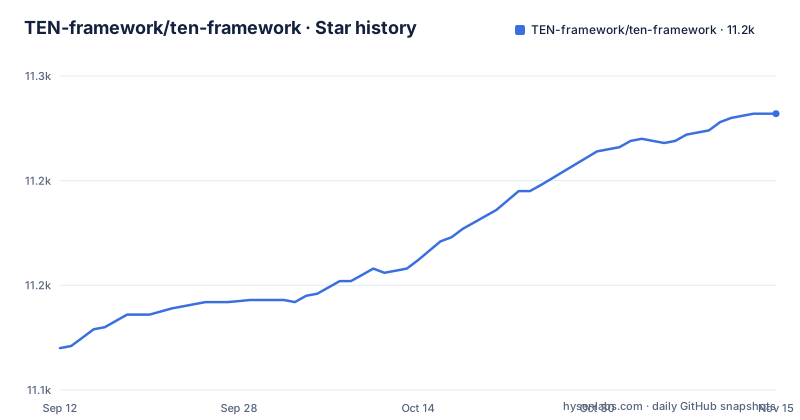
Star history
- TEN-framework/ten-framework11,232 ★ · +112
| Repository | 2026-09-12 | 2026-11-15 |
|---|---|---|
| TEN-framework/ten-framework | 11.1k | 11.2k |
112 Stars in the last 64 days, measured from the daily GitHub snapshot. Compare with other projects
Editorial analysis
The core repository is one layer of a five-repository ecosystem
TEN is described as an open-source framework for real-time multimodal conversational AI, and the primary language in this repository is Python. What matters more for a reader is that the framework is not one repository. The ecosystem is written out as TEN Framework, Agent Examples, VAD, Turn Detection and Portal, five separate projects.
Voice activity detection and end-of-turn detection are the two pieces that decide when a human has finished speaking and when the agent should answer. The README lists VAD and Turn Detection as separate projects in the ecosystem, and names Memory, VAD and Turn Detection as extensions the voice assistant example can be extended with.
Four vendor keys gate the first run, with no documented offline path
The prerequisites table is the first thing a new user meets, and it is a list of credentials rather than a list of libraries. You need an Agora App ID and App Certificate, an OpenAI API key, Deepgram for speech-to-text, and ElevenLabs for text-to-speech, plus Docker or Docker Compose and Node.js LTS v18, on a machine with at least 2 CPU cores and 4 GB of RAM.
Those four keys map one to one onto the stages of a conversation, which is a clean design and an expensive one. RTC transport comes from Agora, speech in from Deepgram, the language model from OpenAI, speech out from ElevenLabs.
The .env file you copy from the template carries exactly those variables and comments each one with the stage it serves:
AGORA_APP_ID=
AGORA_APP_CERTIFICATE=

# Deepgram (required for speech-to-text)
DEEPGRAM_API_KEY=

# OpenAI (required for language model)
OPENAI_API_KEY=

# ElevenLabs (required for text-to-speech)
ELEVENLABS_TTS_KEY=
Development happens inside a named container, not on the host
The build sequence is four commands and it never touches your host Python environment. You enter the agent examples directory, copy the environment template, then bring up the development containers.
cd ai_agents
cp ./.env.example ./.envdocker compose up -dThe next step names the container you then work in:
docker exec -it ten_agent_dev bashThat last command is the shape of the whole workflow. Builds, dependency installs and the agent process run inside ten_agent_dev, and the host checkout contributes the .env file and the compose configuration.
Two voice assistants, one chained and one realtime, with a task-driven build
Once inside the container the documentation picks between two defaults under agents/examples. The first is called the chained voice assistant, the second the speech-to-speech voice assistant in real time. The distinction is the shape of the pipeline: one runs speech to text to language model to speech as separate steps, the other is built for a realtime round trip. The README describes the Multi-Purpose Voice Assistant example, not specifically the realtime one, as supporting both RTC and WebSocket connections.
Before either one starts, a build step is required, and it is the part that surprises Python developers first. The instruction is to run task install before the first launch and after changing dependencies or Go source code, and that step installs the TEN, Python and frontend dependencies and builds the Go API server.
So a Python agent pulls in a frontend build and a compiled Go server. It also means the one command people forget, task install, is not only about Python packages.
Avatar, diarization, SIP and board examples each add another vendor
Beyond the voice assistant the examples spread across vendors and hardware. Lip Sync Avatars works with several vendors: the featured character Kei is an anime character with MotionSync-powered lip sync, realistic avatars come from Trulience, HeyGen and Tavus, and the linked example covers Live2D characters. Speaker Diarization uses SpeechMatics for real-time diarization that detects and labels speakers, demonstrated through an interactive game called Who Likes What rather than a general interface.
Three more examples pull away from the browser. SIP Call turns phone calls into TEN sessions. Transcription is a standalone audio to text tool. Doodler turns spoken or typed prompts into hand-drawn sketches on a board with a crayon palette. ESP32-S3 Korvo V3 runs an agent example on an Espressif development board, with its own integration guide.
The pattern to notice is that none of these are one switch in the framework. Each is a separate example.
The Apple Silicon Docker note exists but is commented out
One instruction for ARM Macs is present in the document and will not be rendered. It tells you to uncheck Use Rosetta for x86/amd64 emulation in Docker settings, adds that this may result in slower build times on ARM, and says performance will be normal when deployed to x64 servers. The whole note is wrapped in an HTML comment, so a reader following the rendered prerequisites never sees it.
The underlying issue is real regardless of formatting. Container builds on Apple Silicon run through an x86 emulation layer unless the image and toolchain match the host architecture, and the trade is compile speed rather than runtime speed, which is exactly what the note says.
If you are on an M-series Mac, check that setting before your first docker compose up rather than after a ten minute build feels wrong. The project also carries a .devcontainer/ directory and a .vscode/ directory at the root.
The root package.json only lints, so the build lives in Taskfile.yml
The JavaScript surface of this repository is a linter, not a build. The root package.json defines four scripts and three development dependencies:
{
  "scripts": {
    "lint": "biome check --all --config-path biome.json",
    "lint:fix": "biome check --write --unsafe --config-path biome.json",
    "format": "biome format --all --config-path biome.json",
    "format:write": "biome format --write --config-path biome.json"
  },
  "devDependencies": {
    "@biomejs/biome": "2.3.0",
    "@types/mocha": "^10.0.10",
    "@types/node": "^22.17.1"
  }
}
Two details are worth pausing on. Mocha type definitions are installed while no test script exists in this file, so npm test has nothing to run here. And with no build or start script, the entry points for a developer are the Taskfile.yml and the task commands quoted in the quick start.
The rest of the root tells you what the project is made of: ai_agents/, core/, packages/, build/, third_party/, tools/, docs/, plus BUILD.gn and clang tooling files, which point to compiled components alongside the Python.
Release numbering is patch-only and the licence field reads NOASSERTION
The three most recent releases sit in the 0.11 range: 0.11.72 on 2026-09-18, 0.11.73 on 2026-09-22 and 0.11.74 on 2026-10-21, with the last push on 2026-11-02 and the repository not archived. The cadence is active and the numbering carries no major or minor signal, so a patch number is where an interface change would land if one landed.
The licence is the softer spot. A LICENSE file sits at the repository root and the project ships CLA.md, CLAUDE.md, AGENTS.md and a .coderabbit.yaml for contribution tooling, but the licence field on the repository resolves to NOASSERTION, meaning no licence was detected automatically. That is not the same as no licence, and it is not a licence either.
Treat the badge as no answer. Read the LICENSE file yourself before vendoring the framework into a product or before signing a contributor agreement, because a corporate scanner and a GitHub badge will both report nothing here. The project also runs a Discord, an X account, a LinkedIn page and a Hugging Face Space, and the documentation is translated into Chinese, Japanese, Korean, Spanish, French and Italian.
Editorial conclusion
TEN suits a team that already has RTC and speech vendor accounts and wants to build real-time voice agents in Python inside containers. It does not suit anyone starting offline, since the quick start prerequisites list Agora, Deepgram, ElevenLabs and OpenAI credentials. Before you commit, open the LICENSE file at the repository root, because the detected licence field reads NOASSERTION and the badge cannot tell you what you may redistribute. Then check that the agent examples repository and the TEN VAD and turn detection repositories are at versions you have pinned yourself.
Frequently asked questions
What is TEN Framework?
It is an open-source framework for real-time multimodal conversational AI, with Python as the primary language in this repository and an official site at agent.theten.ai. It belongs to an ecosystem of five projects: TEN Framework, Agent Examples, VAD, Turn Detection and Portal.
What does TEN Framework need before I can run an agent example?
An Agora App ID and App Certificate, an OpenAI API key, a Deepgram key for speech-to-text and an ElevenLabs key for text-to-speech, all placed in a .env file copied from .env.example. On top of that you need Docker or Docker Compose, Node.js LTS v18, at least 2 CPU cores and 4 GB of RAM.
Can TEN Framework run without cloud API keys?
The documented quick start does not offer that path, since every stage of the pipeline is assigned to a vendor: Agora for transport, Deepgram for speech-to-text, OpenAI for the language model and ElevenLabs for speech.
Which languages does the TEN Framework repository contain?
Python is the primary language. The build step in the quick start also installs frontend dependencies and builds a Go API server, and the root tree carries BUILD.gn with clang-format, clang-tidy and clangd configuration for compiled components.
Official sources
Add this badge to your README
If you maintain this project, the badge below links readers to this analysis and shows its maintenance status from the daily GitHub snapshot. Paste the markdown into your README; add ?metric=license or ?metric=stars to the image URL for a different field.

[](https://hysenlabs.com/projects/ten-framework-ten-framework)Star history chart for your README
[](https://hysenlabs.com/projects/ten-framework-ten-framework)Was this useful?