HunyuanOCR-1.5: faster decoding for long structured OCR output
HunyuanOCR-1.5: Making Lightweight OCR VLMs Faster and Better
At a glance
- What is it?
- HunyuanOCR-1.5 keeps the HunyuanOCR-1.0 backbone and attacks the real cost of OCR, token by token decoding of long structured output. DFlash speculative decoding, a llama.cpp path and an agent-built data pipeline buy speed and coverage, at the price of three mutually exclusive inference environments and a training stack that is not lightweight.
- Who is it for?
- Adopt HunyuanOCR-1.5 when long structured output is your real cost and decoding latency, not accuracy, is what hurts day to day. Leave it aside if you need a single pip install path or a published accuracy table, because the README stops short of both.
- Can I use it commercially?
- Check first. The repository uses a licence we do not classify automatically, so read its LICENSE file before any commercial use.
- Is it still maintained?
- Yes. The repository last received commits 29 days ago.
- What is it written in?
- Mainly Python, according to GitHub's language statistics.
Answers come from the project's GitHub data, last synced on October 22, 2026, and from our analysis. They are not legal advice.
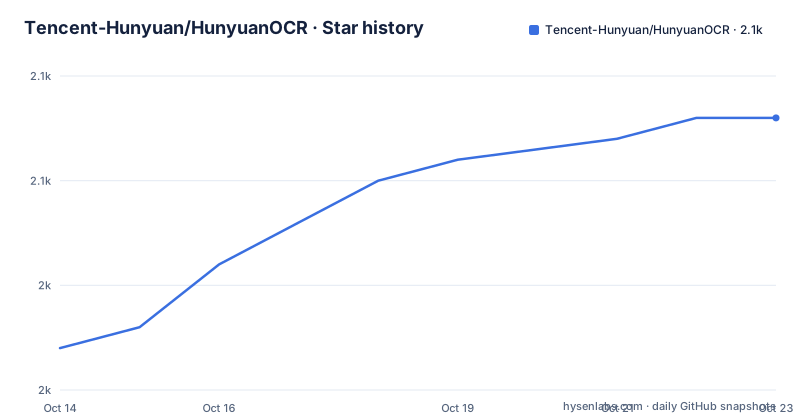
Star history
- Tencent-Hunyuan/HunyuanOCR2,053 ★ · +11
| Repository | 2026-10-14 | 2026-10-22 |
|---|---|---|
| Tencent-Hunyuan/HunyuanOCR | 2k | 2.1k |
11 Stars in the last 8 days, measured from the daily GitHub snapshot. Compare with other projects
Editorial analysis
Four OCR tasks share one unchanged backbone
HunyuanOCR-1.5 is a lightweight, end-to-end OCR specialized vision-language model that folds document parsing, text spotting, information extraction and text-image translation into a single end-to-end VLM. What the 1.5 line does not do is redesign the backbone inherited from HunyuanOCR-1.0; the engineering went into decoding speed and training instead. That choice keeps the architecture comparable across both versions, so an evaluation of 1.0 does not carry over, and anyone holding older weights has to switch to the `v1.0` branch rather than the default `main` branch to reproduce old numbers. The audience is narrow and identifiable: teams whose documents produce very long outputs, where tables and formulas dominate page cost, plus developers who want the same model on a laptop instead of a multi-GPU server. Inference code and model weights have been public since the 2025/11/25 entry, which is the earliest date there is anything to run.
DFlash drafts tokens in parallel, the target verifies once
Autoregressive output is where OCR bills get paid, because dense pages emit the longest sequences. HunyuanOCR-1.5 adapts a speculative decoding framework called DFlash: a lightweight block-diffusion draft model proposes several candidate tokens in parallel, and the target model verifies all of them in one pass. The stated payoff is lower decoding latency on long structured output while preserving the output distribution of the target model. Read that claim narrowly. It is a statement about the accelerated model matching its own unaccelerated distribution, not about matching HunyuanOCR-1.0, and not about matching a different serving framework, since an older note still records a residual accuracy difference between the Transformers and vLLM frameworks and calls it work in progress. DFlash also changes the hosting bill, because a draft model is a second set of weights to load, and nothing in the README gives its memory cost or its acceptance rate.
Inference runs in three mutually exclusive environments
The root `requirements.txt` is unusually honest about its own limits, and the closing comment spells out the split:
# Inference is NOT covered by this file. It uses three separate, mutually
# exclusive environments (vLLM release / vLLM nightly+DFlash / transformers),
Each of those three environments carries its own requirements file under `inference/`, and `inference/README.md` is the index. Dependencies are therefore chosen by path rather than by project: a stock vLLM install, a vLLM nightly plus DFlash, and transformers are three setups that will not share one virtualenv. Picking the wrong one tends to surface as an import error or a silently unused acceleration path rather than as a clear message. Worth noting for anyone skimming: the file the README treats as the inference entry point is not the file at the repository root, and the root one is a training stack.
llama.cpp moves the same model onto a laptop CPU
Beyond the server-grade vLLM path, the project documents PC-side deployment through `llama.cpp`, aimed at CPU, consumer-GPU and laptop hardware. The named pieces are a GGUF-converted checkpoint and an OpenAI-compatible `llama-server`, with the walkthrough in `docs/llama_cpp.md`. The difference from the vLLM path is one of kind, not degree: one loads a quantized GGUF through a C++ inference server exposing an OpenAI-shaped HTTP API, the other serves the original weights through a paged-attention engine on GPUs. Local deployment is also the cheapest way to evaluate the model, because it skips the dependency stack that trips people up, and llama.cpp needs no torch, deepspeed or flash-attn. What the README leaves open is whether DFlash speculative decoding is reachable through llama.cpp at all, and it gives no quantization level, no context length and no hardware table for the checkpoint.
Training is a four-step chain ending in a draft model
Training is presented as an ordered chain rather than one entry point. Step one prepares packed training data, which explains why the root requirements pull in `lmdb` and `binpacking`. Step two is supervised fine-tuning of the HunyuanOCR base model. Step three trains the DFlash draft model from scratch, and step four continues from an existing DFlash checkpoint instead. Those middle two steps are not independent, since a draft model only earns its place if it tracks the target it accelerates, so the base model has to be settled first. The 2026/07/24 entry widens the picture with a unified inference environment documented at `docs/inference/inference.md` and a verl-based reinforcement learning stack described in `train_verl/README_en.md`. Having a reinforcement learning path sitting beside the supervised one shows the project is still moving past fine-tuning, and the agent-driven data flow it describes targets long-tail work such as low-resource OCR, ancient-script OCR and multi-image text-centric QA.
CHAOS-Bench corrupts characters to catch hallucination
The benchmark work is the most concrete part of the repository. CHAOS-Bench, added on 2026/07/13 and kept at `benchmarks/CHAOS-Bench`, is a character-level hallucination benchmark: it injects character-level corruptions into academic-paper images and measures whether a model reports what it can actually see. That targets a failure mode accuracy tables hide, namely a fluent transcription of a glyph that is not there. The same group points at Chronicles-OCR, an ancient-text perception benchmark covering the evolutionary trajectory of the Seven Chinese Scripts and built with the Palace Museum and Anyang Normal University, plus ChartArena for chart parsing, Wild-OmniDocBench for document parsing and MMTIT-Bench for text-image translation. None of those results appear in the README, so anyone choosing on numbers has to read the papers.
The lightweight label meets a manual flash-attn build
Lightweight here describes the model, not the install. The repository root declares `torch>=2.1.0`, `transformers>=4.57.0`, `accelerate>=0.34.0` and `deepspeed>=0.14.0`, alongside an image and data stack:
Pillow>=10.0.0
opencv-python>=4.8.0
numpy>=1.24.0
lmdb>=1.4.0
binpacking>=1.5.2
Then the line that decides whether your afternoon is pleasant:
flash-attn>=2.5.0  # requires manual install: pip install flash-attn --no-build-isolation
openai>=1.30.0  # OpenAI-compatible client for benchmarking
The file itself marks flash-attn as needing a manual build, and the only inference-adjacent entry in the whole file is a client for benchmarking. Anyone who just wants to try the GGUF checkpoint needs none of it, which is exactly why the inference environments live elsewhere.
No pip line, no accuracy table, no rollback path
The table of contents promises Environment setup, Download the weights, Quick start (vLLM AR, single GPU) and PC-side deployment via llama.cpp, and the visible text stops before any of those commands. A reader has to open `inference/README.md` for the three environments, `docs/inference/inference.md` for the unified one, `docs/llama_cpp.md` for the local path, and take the weights from:
https://huggingface.co/tencent/HunyuanOCRNo context length, no quantization level, no DFlash acceptance rate and no batch settings are given, and there is no rollback path. The root listing also mixes code and content in one place, with `train/`, `train_verl/`, `inference/`, `llama_cpp/`, `benchmarks/`, `configs/`, `scripts/`, `tools/`, `tests/`, `assets/`, `ruff.toml` and `HunyuanOCR_v1.0/` sitting beside a requirements file that disclaims inference. The last push landed on 2026-09-24 and the repository is not archived, so the code is moving. The LICENSE file carries custom terms that no common identifier names, so anyone planning to ship the weights inside a product has to read that file directly.
Editorial conclusion
Adopt HunyuanOCR-1.5 when long structured output is your real cost and decoding latency, not accuracy, is what hurts day to day. Leave it aside if you need a single pip install path or a published accuracy table, because the README stops short of both. Before committing, open `inference/README.md` and match your serving stack against the three environments it lists, then read the terms file at the repository root, whose wording is custom. Run one CHAOS-Bench image through your own build first, and time the decode step on it.
Frequently asked questions
Can I run HunyuanOCR-1.5 on a laptop without a GPU?
The project points PC-side users at `llama.cpp` with a GGUF-converted checkpoint and an OpenAI-compatible `llama-server`, aimed at CPU, consumer-GPU and laptop hardware, with the walkthrough in `docs/llama_cpp.md`. That path needs neither torch nor deepspeed nor flash-attn.
Does HunyuanOCR-1.5 need flash-attn installed for inference?
The root `requirements.txt` marks `flash-attn>=2.5.0` as requiring a manual install, but the same file states that inference is not covered by it. Inference uses three separate, mutually exclusive environments under `inference/`, each with its own requirements file.
What is DFlash and do I have to train it myself?
DFlash is the speculative decoding framework behind the speed work: a block-diffusion draft model proposes several tokens in parallel and the target model verifies them in a single pass, which shortens decoding of long structured output. The training chain has a step that trains the draft model from scratch and another that continues from an existing checkpoint.
Can I still use the original HunyuanOCR-1.0 code and weights?
They live on a separate branch. The README directs users to the `v1.0` branch and to `README_v1.0.md`, and the 1.0 files are kept in `HunyuanOCR_v1.0/` rather than on the default branch.
How does HunyuanOCR-1.5 measure hallucination?
CHAOS-Bench, kept at `benchmarks/CHAOS-Bench`, injects character-level corruptions into academic-paper images and probes the seeing-is-believing ability of OCR vision-language models, which exposes fluent output for glyphs that are not there.
Official sources
Add this badge to your README
If you maintain this project, the badge below links readers to this analysis and shows its maintenance status from the daily GitHub snapshot. Paste the markdown into your README; add ?metric=license or ?metric=stars to the image URL for a different field.

[](https://hysenlabs.com/projects/tencent-hunyuan-hunyuanocr)Star history chart for your README
[](https://hysenlabs.com/projects/tencent-hunyuan-hunyuanocr)