HY-World 2.0 ships four pipeline stages, and one of them has no weights entry
HY-World 2.0: A Multi-Modal World Model for Reconstructing, Generating, and Simulating 3D Worlds
At a glance
- What is it?
- HY-World 2.0 is Tencent's world model that turns text, single images, multi-view images or video into meshes and 3D Gaussian splattings. Its open-source plan is fully ticked, its comparison table makes absolute claims with one number attached, and the Model Zoo text ends inside its first row.
- Who is it for?
- HY-World 2.0 is worth an afternoon for someone who already has a CUDA box and wants geometry they can open in Blender or a game engine, and it is not a substitute for Genie 3 or Cosmos if what you need is video.
- Can I use it commercially?
- Check first. The repository uses a licence we do not classify automatically, so read its LICENSE file before any commercial use.
- Is it still maintained?
- Yes. The repository last received commits 95 days ago.
- What is it written in?
- Mainly Python, according to GitHub's language statistics.
Answers come from the project's GitHub data, last synced on November 15, 2026, and from our analysis. They are not legal advice.
Star history
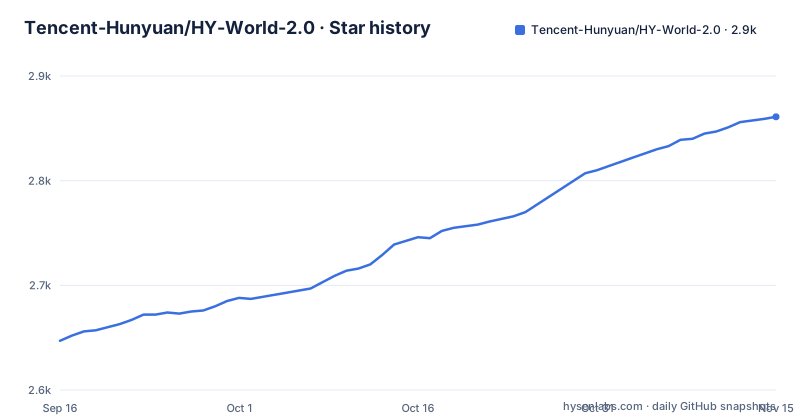
- Tencent-Hunyuan/HY-World-2.02,861 ★ · +214
| Repository | 2026-09-16 | 2026-11-15 |
|---|---|---|
| Tencent-Hunyuan/HY-World-2.0 | 2.6k | 2.9k |
214 Stars in the last 60 days, measured from the daily GitHub snapshot. Compare with other projects
Editorial analysis
Four stages in the pipeline, and one of them has no weights release
The generation pipeline is four steps: Panorama Generation with HY-Pano 2.0, then Trajectory Planning with WorldNav, then World Expansion with WorldStereo 2.0, then World Composition with WorldMirror 2.0 plus splattings learning. The open-source plan has five items and every box is checked. Three of them ship model weights, namely WorldMirror 2.0 code and checkpoints, the HY-Pano 2.0 model and code, and the WorldStereo 2.0 model and code. WorldNav appears only inside the line for full inference code for world generation, which groups it with WorldStereo and world composition, and the splattings learning stage has no line of its own. So a trajectory planning model is invoked by the pipeline without a weights entry anywhere in that plan. The training side of that last stage does get dependencies: a GS training utilities group carries viser, tyro, splines, pymeshlab, scikit-build-core, nanobind and pybind11.
WorldMirror 2.0 predicts depth, normals, cameras and splats in one forward pass
Reconstruction is the feed-forward half. Given multi-view images or a casual video, WorldMirror 2.0 predicts dense point clouds, depth maps, surface normals, camera parameters and 3DGS attributes simultaneously in a single forward pass, with flexible-resolution inference accepted anywhere from 50K to 500K pixels. Camera pose is therefore a prediction rather than something solved from the input, and the repository pins pycolmap==3.10.0, a structure-from-motion library, without saying where it enters the process. The same dependency file carries cupy==13.6.0, an array library built on CUDA, in a group labelled model utilities. No minimum GPU, no memory figure and no CPU fallback are named in this text. The tree splits its examples the same way the two capabilities are split, with examples/worldgen/ and examples/worldrecon/ as separate directories.
The comparison table claims zero rendering cost with one number attached
The table setting video world models against HY-World 2.0 makes several absolute claims: real-time rendering on consumer GPUs, precise control with zero-error behaviour, real physics collision, accurate lighting, 3D consistency that is native rather than flickering, unlimited playable duration against a video limit stated as typically 1 min, and inference cost that does not accumulate, with rendering cost written as approximately 0. The one minute is the only figure anywhere in the table. No row says what was measured, on what hardware, or against which video model. The table of contents also carries a Performance section, and the text present here reaches only the first data row of the Model Zoo table, so those measurements are not in view. Two naming slips sit in the same table, with the body text writing Isaac Sim while the final row writes Isaac Engine.
No GitHub releases exist, so the weights sit on two external hosts
The repository has no GitHub releases at all, which leaves no tag, no changelog and no attached asset to pull from the project itself. Weights are reached through two external hosts linked in the banner, one on Hugging Face and one on ModelScope, alongside the technical report on arXiv and pages at 3d-models.hunyuan.tencent.com and 3d.hunyuan.tencent.com. The second of those is the product page a July 2026 news entry pushes for HY World 2.1, which is the version this repository does not contain. News also carries a May 18, 2026 line for world generation inference code with WorldStereo 2.0 weights, a May 11 line for HY-Pano 2.0 code and weights, and two separate April 16, 2026 lines, one for the technical report and partial codes and one for WorldMirror 2.0 code and weights.
requirements.txt pins 17 of 41 dependencies and leaves numpy below the last group
The dependency file is organised by comment headings: core deep learning, model utilities, vision and video, text and tokenization, point cloud and 3D, metrics and logging, and GS training utilities. Seventeen of its 41 requirements carry exact versions and 24 are bare names. Two placements are worth noticing. numpy==1.26.4 sits on its own beneath the final group instead of inside any of them, and openai appears as a bare requirement under model utilities with no stated purpose in this text. Video decoding is requested twice over, through imageio with the ffmpeg extra and through decord. A second file, requirements_git.txt, sits beside the first, and neither file explains how the two relate.
The Model Zoo table ends inside its first data row
Model Zoo opens with a world reconstruction heading for the WorldMirror series and a five column table of Model, Description, Params, Date and Hugging Face. A single row is present: WorldMirror-2, marked new, described as multi-view or video to 3D reconstruction, with an approximate parameter count of 1.2B. That line is where it stops, before the Date and Hugging Face columns are filled in and before any table for world generation appears. So the parameter budget of the only model whose row can be read is known while its publication date and checkpoint location are not, and the three generation models have no rows here to be weighed against it. Nothing later in this text stands in for those entries.
A submodule file, a second requirements file and four documents in two languages
The root of the repository holds a .gitmodules file and the two requirements files, and nothing in the text present here explains which repository the submodule pulls in or how requirements_git.txt differs from requirements.txt. Documentation is duplicated by language as well: README.md alongside README_zh.md, and DOCUMENTATION.md alongside DOCUMENTATION_zh.md, under a banner that offers English and Simplified Chinese. All implementation sits in a single package directory named hyworld2/, with assets/ and the two example directories beside it. Two parallel documents per language means an English and a Chinese copy of the same instructions both exist, and any argument name or config key has to stay identical across all of them.
The generation bullet lost the stage labels its architecture section keeps
The introduction names two capabilities. World reconstruction is described in full, naming WorldMirror 2.0 and the five quantities it predicts together. The world generation bullet is not. It runs `a)` with HY-Pano 2.0, `b)` with WorldNav, `c)` with WorldStereo 2.0 and `d)` with WorldMirror 2.0 and 3DGS learning, and after each letter the stage name is simply absent. Those names do exist a few sections down, where the architecture is written out as Panorama Generation, Trajectory Planning, World Expansion and World Composition, in that order. The pipeline is therefore recoverable from the architecture section, while the lettered list in the introduction has lost it. That architecture section opens by deferring to the tech report for details, linked as arXiv 2604.14268.
Editorial conclusion
HY-World 2.0 is worth an afternoon for someone who already has a CUDA box and wants geometry they can open in Blender or a game engine, and it is not a substitute for Genie 3 or Cosmos if what you need is video. Before you commit, settle three things: where the WorldNav trajectory-planning weights come from, since that stage runs but has no weights line in the open-source plan, whether the absent Performance section contains the numbers behind claims such as rendering cost near zero, and whether License.txt grants more than the bare repository does. Pin torch==2.7.1 and the other seventeen exact versions rather than resolving the twenty-four bare names fresh.
Frequently asked questions
What output formats does HY-World 2.0 produce?
Meshes and 3D Gaussian splattings. The framework accepts text, single-view images, multi-view images and videos, and returns 3D world representations that can be imported into engines such as Blender, Unity, Unreal Engine and Isaac Sim.
Which HY-World 2.0 models have released weights?
WorldMirror 2.0 code and checkpoints, the HY-Pano 2.0 model and code, and the WorldStereo 2.0 model and code. WorldNav appears in the generation pipeline and inside the inference code line but has no weights entry of its own in the open-source plan.
Does the HY-World 2.0 repository contain HY-World 2.1?
No. A July 2026 news entry announces HY World 2.1 and points at the product page at 3d.hunyuan.tencent.com/sceneTo3D. The repository has no GitHub releases, and weights are reached through the linked Hugging Face and ModelScope models.
What hardware is needed to run HY-World 2.0 inference?
No minimum GPU or memory figure is stated. requirements.txt pins torch==2.7.1 and cupy==13.6.0, the latter being an array library built on CUDA, and names no CPU fallback. Of its 41 requirements, 17 carry exact version pins and 24 are bare names.
How does HY-World 2.0 differ from video world models such as Genie 3?
A table sets them side by side: non-editable pixel videos that typically last about a minute against meshes or splats that persist, per-frame inference against one-time generation with rendering cost written as approximately 0, and video files engines cannot use against assets importable into Blender, Unreal Engine and Isaac.
What license is HY-World 2.0 released under?
No license is asserted for the repository as a whole, while a License.txt file sits in the root directory. No license name appears in the README text that is present, which links a technical report, a Discord channel and an account instead of a license page.
Official sources
Add this badge to your README
If you maintain this project, the badge below links readers to this analysis and shows its maintenance status from the daily GitHub snapshot. Paste the markdown into your README; add ?metric=license or ?metric=stars to the image URL for a different field.

[](https://hysenlabs.com/projects/tencent-hunyuan-hy-world-2-0)Star history chart for your README
[](https://hysenlabs.com/projects/tencent-hunyuan-hy-world-2-0)Was this useful?