tensorflow/datasets: the disclaimer says it does not vouch for the data or claim you have a licence
TFDS is a collection of datasets ready to use with TensorFlow, Jax, ...
At a glance
- What is it?
- TensorFlow Datasets packages public datasets as tf.data.Dataset objects, Apache-2.0 licensed, with a short code example and a four-value design statement. The most consequential text in the README is a disclaimer saying the project neither hosts nor distributes the datasets, does not vouch for their quality or fairness, and makes no claim that you have permission to use them.
- Who is it for?
- tensorflow/datasets fits a team that wants a dataset behind a stable Python call rather than a download script, and that values the determinism guarantee the project makes, since all users are said to get the same examples in the same order, which is the property that makes a benchmark reproducible. Read the disclaimer before you rely on any of it.
- Can I use it commercially?
- Yes. Apache-2.0 is a permissive licence: you can use, modify and sell software built on it, as long as you keep its copyright and licence notices.
- Is it still maintained?
- Yes. The repository last received commits 2 days ago.
- What is it written in?
- Mainly Python, according to GitHub's language statistics.
Answers come from the project's GitHub data, last synced on November 13, 2026, and from our analysis. They are not legal advice.
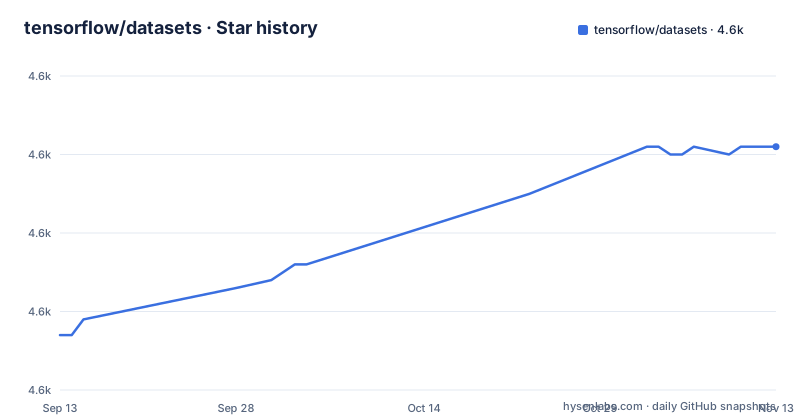
Star history
- tensorflow/datasets4,611 ★ · +24
| Repository | 2026-09-13 | 2026-11-13 |
|---|---|---|
| tensorflow/datasets | 4.6k | 4.6k |
24 Stars in the last 61 days, measured from the daily GitHub snapshot. Compare with other projects
Editorial analysis
The library does not host the data and does not vouch for it
This is the paragraph to read first, and it appears near the bottom of the README under a heading spelled as Disclaimers. The wording is that this is a utility library that downloads and prepares public datasets, that the project does not host or distribute these datasets, does not vouch for their quality or fairness, and does not claim that you have license to use the dataset, and that it is your responsibility to determine whether you have permission to use the dataset under the dataset's license. Three separate disclaimers in three clauses: hosting, quality, and licensing. The practical effect is that installing this library gives you a convenient loader and no legal position whatsoever, and the licence review that any project using public data needs to do still has to be done per dataset. For a research codebase that cites datasets in a paper, that is the sentence that determines whether a citation is enough.
Determinism is stated as a guarantee, and it is the one that matters
Four values are listed, and they are not equally concrete. Simplicity is that standard use-cases should work out of the box. Performance is stated as following best practices and being able to achieve state-of-the-art speed, with a link to the TensorFlow data performance guide rather than a number. Customisability is that advanced users can have fine-grained control, again without a mechanism named. Determinism and reproducibility is the specific one: all users get the same examples in the same order. That is a stronger claim than most dataset wrappers make, and it is the claim a benchmark depends on, since a result that changes because a shuffle seed differed is not a result. The README then routes dissatisfaction to the issue tracker with the note that if those use cases are not satisfied, feedback is wanted, which frames the four values as testable.
A nightly build renames the package and stamps the version from an environment variable
The build script contains a small mechanism worth knowing about because it is how the project publishes nightlies without touching the release version. It reads the TFDS_NIGHTLY_TIMESTAMP environment variable. If it is set, the distribution project name becomes tfds-nightly rather than tensorflow-datasets, and the version is rewritten as the current base version with a dev suffix built from the timestamp, in the form X.Y.Z.dev followed by the digits of the environment variable. If it is not set, the project name stays tensorflow-datasets and the version from the package's version module is used unchanged. Two details follow. The version is imported directly from a version file by appending its directory to the path so the file can be read before the package is installed, which is why that import carries an explicit suppression comment. And the timestamp comes from the environment rather than from the clock inside the build, so the publish workflow is what actually decides the version.
pyproject.toml holds three build requirements and setup.py holds everything else
The repository has both build files, and the split is worth noting because it is not the modern arrangement. pyproject.toml contains only a build-system table with three requirements, setuptools, wheel and packaging, and the setuptools.build_meta backend. There is no project table, no dependency list and no metadata in it. All of that lives in setup.py, which carries the Apache 2.0 licence header, a module docstring explaining that each dataset definition contains the logic to download and prepare the dataset and to read it into a model through the tf.data.Dataset API, and a note that usage outside of TensorFlow is also supported. The dependency list starts there as a REQUIRED_PKGS constant whose first entry is absl-py at 1.0.0 or newer, with a comment recording the reason for a minimum version. The load call the README leads with is short enough to quote, since it is the shape every dataset call takes:
ds = tfds.load('mnist', split='train', as_supervised=True, shuffle_files=True)
ds = ds.shuffle(1000).batch(128).prefetch(10).take(5)
So a tool that reads only pyproject.toml will conclude the project has no declared dependencies, which is a trap for anyone automating dependency extraction.
Adding a dataset is a labelled issue, and priority is a thumbs-up reaction
The contribution path for datasets is described in four sentences and it is entirely on the tracker. Adding a dataset is said to be straightforward by following the project's own guide. To request one you open a dataset request GitHub issue, and the link points at a specific issue template with the dataset request label and a title pattern of a bracketed data request followed by the dataset name. Then the part that tells you how prioritisation actually works: you vote on the current set of requests by adding a thumbs-up reaction to the issue, and that reaction list is linked as the queue. So there is no maintainer-side triage described, no roadmap file and no milestone list. The queue is the reactions.
A citation is requested, and a removal request is equally easy
Two closing paragraphs balance each other. The citation request is explicit: include the given citation when using tensorflow-datasets for a paper, in addition to any citation specific to the used datasets. So the library asks to be cited separately from the data itself, which is a reasonable convention given it supplies no data. The removal request is the mirror image: if you are a dataset owner and want to update any part of it, such as the description or the citation, or do not want your dataset included in this library, get in touch through a GitHub issue. That is an unusual thing to offer and it is worth noting because it means the catalogue is not permanent and can shrink. There is also a pointer to Google AI's Responsible AI Practices for readers interested in fairness, which sits alongside the fairness disclaimer as an acknowledgement that the wrapper cannot solve the problem it names.
One package directory, a YAPF style file and a pytest.ini
The repository root is short and says how the project is checked. There is a .pylintrc and a .style.yapf, so the formatting tool is YAPF rather than Black, and the lint configuration is pylint rather than the ruff or flake8 arrangements common in newer Python projects. There is a pytest.ini at the root and a CI workflow linked in the README header specifically named for pytest. There is an AUTHORS file, a CHANGELOG.md, a CONTRIBUTING.md, a LICENSE, and a docs/ directory, plus the single package directory tensorflow_datasets/. A .vscode/ directory and a .github/ directory complete the list. The absence of a tests/ directory at the root is the notable omission: with pytest.ini present and a pytest workflow in CI, the test suite either lives inside the package directory or is located elsewhere, and neither is visible from the root listing.
Editorial conclusion
tensorflow/datasets fits a team that wants a dataset behind a stable Python call rather than a download script, and that values the determinism guarantee the project makes, since all users are said to get the same examples in the same order, which is the property that makes a benchmark reproducible. Read the disclaimer before you rely on any of it. The library is a wrapper, not a host: it does not vouch for quality or fairness, it does not claim you have a licence, and determining whether you have permission under each dataset's own licence is stated as your responsibility. That is the correct legal posture for a catalogue, and it means your own review burden does not go away by using the library. Two smaller things to check: dataset owners can ask for removal through an issue, so the catalogue contents are not permanent, and nightly builds come from an environment variable hook that renames the package to tfds-nightly. The last push is dated 2026-11-02.
Frequently asked questions
What does TensorFlow Datasets do?
It provides many public datasets as tf.data.Dataset objects. Each dataset definition contains the logic to download and prepare the dataset and to read it into a model through the tf.data.Dataset API, and usage outside of TensorFlow is supported. The project describes itself as a utility library rather than a host of data.
Does tensorflow-datasets give me a licence to use the datasets?
No, and the README says so directly. It is a utility library that downloads and prepares public datasets; the project does not host or distribute them, does not vouch for their quality or fairness, and does not claim that you have license to use a dataset. Determining whether you have permission under each dataset's own license is your responsibility.
How do I request a new dataset in tensorflow-datasets?
Open a dataset request GitHub issue using the project's issue template, which applies the dataset request label. To get it prioritised, vote on the current set of requests by adding a thumbs-up reaction to the issue, and that reaction list is the queue the project links as the set of open requests.
Official sources
Add this badge to your README
If you maintain this project, the badge below links readers to this analysis and shows its maintenance status from the daily GitHub snapshot. Paste the markdown into your README; add ?metric=license or ?metric=stars to the image URL for a different field.

[](https://hysenlabs.com/projects/tensorflow-datasets)Star history chart for your README
[](https://hysenlabs.com/projects/tensorflow-datasets)Was this useful?