TickDB ships the MCP server and the skill, and hosts the feed
TickDB: AI-native real-time stock API and market data API for US stocks, HK stocks, A-shares, forex, crypto, indices and commodities. Skill, CLI, MCP, REST API and WebSocket.
At a glance
- What is it?
- A market data service covering forex, metals, indices, US, Hong Kong and mainland Chinese stocks and crypto, offered through five access paths. Two of them are in the repository as source; the REST and WebSocket backend behind them is not.
- Who is it for?
- Use TickDB when you want one API across several markets and you would rather not run four vendor integrations, and pick the MCP path if you want the server code under your own control, since it is the only server-side piece published here. Before you build on it, check three things.
- Can I use it commercially?
- Yes. MIT is a permissive licence: you can use, modify and sell software built on it, as long as you keep its copyright and licence notices.
- Is it still maintained?
- Yes. The repository last received commits 9 days ago.
- What is it written in?
- Mainly Python, according to GitHub's language statistics.
Answers come from the project's GitHub data, last synced on November 15, 2026, and from our analysis. They are not legal advice.
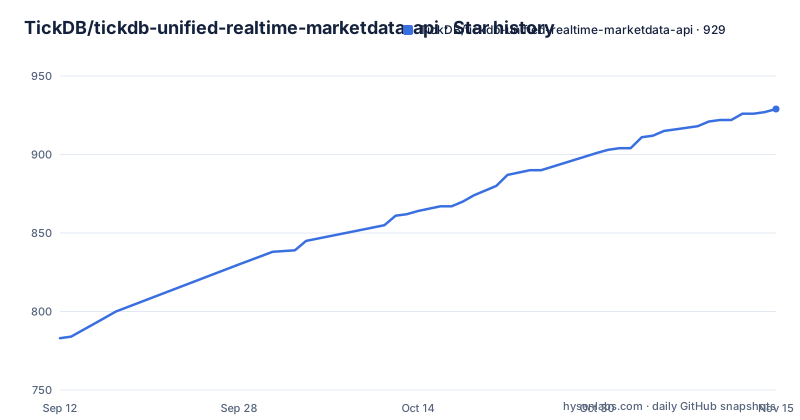
Star history
- TickDB/tickdb-unified-realtime-marketdata-api929 ★ · +146
| Repository | 2026-09-12 | 2026-11-15 |
|---|---|---|
| TickDB/tickdb-unified-realtime-marketdata-api | 783 | 929 |
146 Stars in the last 64 days, measured from the daily GitHub snapshot. Compare with other projects
Editorial analysis
Two directories of the stack are in the repository
The root holds a license, three README files, an assets folder, a workflow directory, and two pieces of the product: a skill directory and an MCP server directory. Everything else described on the page is a hosted service. The REST base URL, the socket endpoint and the symbol catalogue are not in this tree, so you cannot read the data path. The MCP server is the exception, and the page goes out of its way to make that point: the hosted MCP endpoint runs on the same code as the directory, so what you install, what you deploy yourself and what the vendor operates are the same server. It is described as thirteen tools, requiring Python 3.11 or newer, with a Dockerfile, forty-six unit tests, an MIT license and continuous integration, and three setup documents beside it covering client configuration, self-deployment and the full reference.
Four routes are tabulated, six examples are claimed
The core endpoint table lists four routes: historical candles, real-time ticker, order book depth and recent trades. The access table earlier on the page describes the REST option as an HTTP API with six endpoint examples, and the numbered walkthrough beneath the table gives five requests, the fifth being a symbol catalogue query that is not in the table at all. So the count appears in three places and does not agree with any of them. The parameter naming disagrees too. The candle and depth examples use a singular symbol parameter, while ticker and trades use a plural symbols parameter; the ticker example combines US, Hong Kong and crypto symbols. The catalogue example instead filters by market and limit. The request shape itself is a header and a query string:
curl -H "X-API-Key: YOUR_API_KEY" \
     "https://api.tickdb.ai/v1/market/kline?symbol=700.HK&interval=1h&limit=24"
The socket puts the key in the URL
Authentication is a header on the HTTP side, sent as a named key header on every request. The WebSocket side is different: the connection URL itself carries the key as a query parameter, in a secure-scheme address on the realtime path. That is the ordinary way to authenticate a socket when the client cannot set headers, and it has the ordinary consequence, which is that a URL carrying a credential is the kind of string that ends up in proxy logs, browser history and crash reports. If you connect from a place you do not control, that is worth thinking about. The subscription protocol after connecting is small: a command field and a data object naming a channel and a list of symbols, and three channels are named, ticker for price updates, depth for order book changes and trade for executions.
The trial credential reaches 72 instruments, the catalogue claims 37,527
Two numbers on the page describe different things and are easy to conflate. The feature list claims coverage of more than 37,527 instruments across six markets, grouping the United States, Hong Kong and mainland China stocks with forex, crypto and indices. The skill path says something much smaller: install it and the assistant obtains a trial credential with no registration step, and that credential can query seventy-two popular instruments. So the number a new user meets first, seventy-two, is a small fraction of what the service claims to cover, and the page does not explain how to move between them. The markets themselves are named with concrete examples rather than categories: a currency pair, a metal pair quoted against the dollar, a US ticker with a market suffix, an index symbol, a Hong Kong security, a mainland listing and a crypto pair.
The only releases are tags scoped to the MCP directory
There are two releases, and both are prefixed with the MCP directory name rather than the repository name, with versions 0.1.3 and 0.1.2. That tells you two things about the versioning scheme: only the server component is released, and it has not left the zero-one series. The repository itself is not archived, and its last commit is dated 2026-06-20, the same day as the newer of the two tags. Everything on the page that is not in the MCP directory, the CLI included, therefore has no version marker at all in this tree. The CLI is installed globally from npm and configured with a key, and it is described as the path for terminals, scripts and agents rather than as part of this source release:
npm install -g tickdb
tickdb config set-key YOUR_API_KEY
tickdb ticker BTCUSDT,XAUUSD
The default README is Chinese with two translations beside it
The file you land on is written in Simplified Chinese, and the header links two siblings: a traditional Chinese version and an English one. That is worth noting for anyone arriving from an English search, because the code blocks are the same in all three but the surrounding explanation, the feature framing and the use-case list are not. The page describes itself as an open toolset and separates what it publishes from what it hosts: an AI skill directory holding the skill definition that agents install, and the MCP server directory, with the hosted REST, WebSocket and MCP endpoints sitting on top of them. The skill install is a single package-runner command naming a skill marketplace, and the alternative is copying the skill file straight out of the repository.
Editorial conclusion
Use TickDB when you want one API across several markets and you would rather not run four vendor integrations, and pick the MCP path if you want the server code under your own control, since it is the only server-side piece published here. Before you build on it, check three things. The REST routes are named inconsistently, with a singular symbol parameter on two endpoints and a plural one on the others, so write a thin client rather than generating calls. The socket takes the key in the query string, so keep it out of anything that logs URLs. And the trial credential the skill installs reaches only a small set of instruments, which is well short of the catalogue.
Frequently asked questions
What is included in the TickDB repository source?
A skill directory and a Python MCP server directory with thirteen tools, a Dockerfile, forty-six unit tests and setup documentation. The REST and WebSocket backends behind the hosted endpoints are not in the tree.
How does TickDB authenticate REST and WebSocket calls?
REST requests carry the key in a named header. The socket connection passes the same key as a query parameter in the websocket URL, which is the usual approach when a client cannot set headers and also means the credential can appear in logs that record URLs.
How many instruments can the TickDB trial key query?
Seventy-two popular instruments. The feature list separately claims coverage of more than 37,527 instruments across six markets, so the trial credential reaches a small fraction of the catalogue.
Which versions of the TickDB MCP server have been released?
Two, and both tags are scoped to the MCP directory rather than the repository: 0.1.3 and 0.1.2. Neither has left the zero-one series, and the CLI has no release tag in this tree.
Which market data endpoints does TickDB expose over HTTP?
Four are tabulated: historical candles, ticker, order book depth and recent trades, plus an available-symbols query shown in the examples. The candle and depth examples use symbol, ticker and trades use symbols, and the catalogue example uses market and limit.
Which realtime channels does the TickDB WebSocket support?
Three: ticker for price updates, depth for order book changes and trade for executions. A subscription is a message with a command field and a data object naming the channel and a list of symbols.
Official sources
Add this badge to your README
If you maintain this project, the badge below links readers to this analysis and shows its maintenance status from the daily GitHub snapshot. Paste the markdown into your README; add ?metric=license or ?metric=stars to the image URL for a different field.

[](https://hysenlabs.com/projects/tickdb-tickdb-unified-realtime-marketdata-api)Star history chart for your README
[](https://hysenlabs.com/projects/tickdb-tickdb-unified-realtime-marketdata-api)Was this useful?