Cortex compiles a model of you, and ships its download from a different GitHub organisation
Cortex local-first personal memory app
At a glance
- What is it?
- A local-first personal memory app for AI tools: a SwiftUI shell over a FastAPI engine on 127.0.0.1:8766, seven typed memory layers, and a context protocol that refuses to re-send what an agent already holds. The interesting parts are where the defaults are conservative and where they are not.
- Who is it for?
- Cortex is built for someone who has been re-explaining the same preferences to three different assistants and wants that to stop, and the design holds up: the retrieval layer cites or abstains, the memory is plain Markdown you can read and delete, and the review step puts a human between an import and anything the model will use. Three things to settle first.
- Can I use it commercially?
- Yes. MIT is a permissive licence: you can use, modify and sell software built on it, as long as you keep its copyright and licence notices.
- Is it still maintained?
- Yes. The repository last received commits 19 days ago.
- What is it written in?
- Mainly Python, according to GitHub's language statistics.
Answers come from the project's GitHub data, last synced on November 25, 2026, and from our analysis. They are not legal advice.
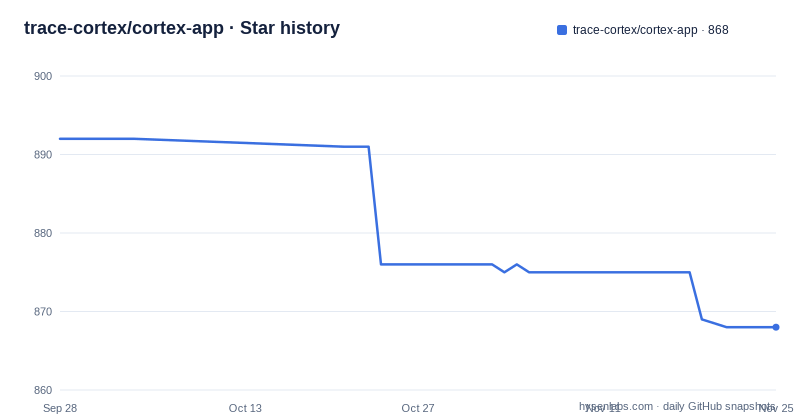
Star history
- trace-cortex/cortex-app868 ★ · -24
| Repository | 2026-09-28 | 2026-11-25 |
|---|---|---|
| trace-cortex/cortex-app | 892 | 868 |
-24 Stars in the last 58 days, measured from the daily GitHub snapshot. Compare with other projects
Editorial analysis
The install link points at another organisation, with releases twice in the path
The first install step sends you to a DMG hosted on a different GitHub organisation than the one holding this repository, and the URL has the path segment for releases repeated.
The repository itself is one account, the landing link at the top of the file is a separate product site under another name, and the name the project uses for its own thesis is that third name rather than the app name. The affiliation block attributes the work to a university faculty of engineering, and the two contact addresses in the privacy section are student and university addresses at two institutions.
So there are three identities in one file: where the code lives, where the site lives, and where the binary lives. The one you cannot do from this repository is install it.
That matters more than a branding quirk, because the same file says the app checks for updates on its own and that new releases arrive automatically once you are on a recent build. An auto-updater fed by another organisation's release page means the trust decision about what code runs on your Mac was made by the publisher of that page, and it was not made in the repository you cloned to read the code. Anyone who cares about that should read the installer and updates document before enabling automatic updates.
Build numbers skip, and the newest release is six weeks behind the last push
Building from source is four commands, and one of them is the retrieval gate:
./macos/build.shpython3 -m pytest backend/testspython3 scripts/retrieval_eval.pyThe backend needs Python 3.11 or newer, a virtual environment, and the runtime requirements installed from a file inside the backend directory. The retrieval script is described as a deterministic, offline gate, which is the right shape for a quality check on a system whose default embedding is a hash: no network, no model, same result twice.
The releases themselves are not semantic versions. They are build numbers under a 0.2.0 prefix, and the three most recent are 17, 23 and 24, with the release names carrying the build number in prose and a short description of what changed.
The gap matters. Build 17 is followed by 23 in the visible history, so six builds are not in the release list at all, and there is no way from the tag names to tell whether they were never published, were superseded, or were published and dropped.
The dates are the second issue. The three releases sit on three consecutive days in July, and the last push to the repository is on 26 August 2026, which is after all of them and well after the newest one. So the head of the default branch contains work that has not shipped in a tagged build.
That sits awkwardly beside the auto-update claim. If you install from the newest release, the updater is a mechanism to move you forward from there; if you built from source on the head of the branch, the updater would be a mechanism to replace your build with an older line of work. Nothing in the file says which state the updater considers current, and there is no version comparison described.
The default embedding is a hash, not a model
The retrieval stack is described as a fusion: BM25, vector nearest neighbour, temporal, and intent, reranked on the device, with the rule that it cites or abstains. That is a real hybrid design.
The default configuration, though, is deliberately unambitious. The embedding provider variable defaults to hash, described as staying offline and local with a deterministic hash embedding, and the dimensions are set to 384. A hash embedding puts similar strings near each other and unrelated strings apart, and it does not know that two differently worded sentences mean the same thing.
So on a fresh install, the vector half of the fusion is not semantic, and the recall that the associative retrieval is built on has to come from the lexical, temporal and intent legs instead. Configuring a real embedding provider is described as raising recall, and the example names a small hosted model with a key that is left empty by default.
Two other defaults are worth noting for the same reason. Extraction has an optional provider and falls back to deterministic local extraction when the key is unset, so the hosted model named in the example file is opt-in. And the vector search has a strictness flag that defaults to off, which is the right default for a system whose fallback is a hash rather than a failure.
Three input-capture packages sit beside a claim of no ambient recording
The privacy section says the app records nothing ambient, and specifies no screen and no microphone. It also says a source is read only after you connect it, and that context is shared with a tool only within the permission you grant.
The runtime dependency list runs to thirteen packages, and three of them exist to observe the machine rather than to serve it: one reads the macOS process list, one provides keyboard and mouse event listeners, and one reads and writes the clipboard.
The claim as written is not contradicted by that, because screen and microphone are exactly the two things named as excluded, and none of the three can capture either. But the combination is worth stating plainly for anyone reading the privacy claim as a summary. An app that keeps a memory of everything you do, imports your chat history, and serves it to whichever assistant you connect, does not need a keylogger to be privacy-sensitive; it needs the trust controls, and those are documented separately as scoped, revocable per-tool permissions with redaction on by default.
The same list also contains a Redis client with a C parser, in a product described as local-first with SQLite, and two tracing packages for model observability. The example environment file has no variable that points the tracing anywhere, so where those traces go depends on defaults rather than on configuration.
Two local origins, one port, and the token rules written out in the example file
The example environment file is unusually explicit about how the local service is secured, and it is worth reading as the security documentation.
The API key is documented as needing a long random token, with a note that the packaged app generates one. Next to it is a flag that stays at zero and is only set when someone deliberately wants the sample development token accepted, which is the right way to ship a way in. The MCP key is separate and optional, with the note that REST endpoints still require the main key while the MCP endpoint accepts either the app token or the scoped one. Its scopes are enumerated: read, write, export and maintenance.
So a tool can be granted the ability to export your memory without being granted write, which is the kind of separation that matters when the consumer is an agent.
The binding is loopback on a fixed port, and the CORS setting lists two origins for it, the address with the IP and the address with the hostname. That is a deliberate allowance for a tool that resolves the host one way and the server the other, and it does widen the origin list by one entry.
The backup settings are the other detail worth keeping. Pruning by count is on, at twenty local archives, and pruning by age is off, with the reason given: users may depend on older local recovery archives. That is a data-retention default chosen against silent deletion, which is rarer than it should be.
Memory is Markdown you own, addressable by hash and rebuildable
The portability claim is the load-bearing one, and it is specific about the format.
Sources become typed, layered memory in a SQLite store with full-text search and vectors, and that store mirrors to a human-readable vault you own. The context packs are addressed by their SHA-256 hash and are replayable, so the model is plain Markdown plus an index that can be rebuilt. The claim that it is erasable in one act and vendor-portable follows from that, and switching assistants takes the model with you.
The layers are seven and they are named: voice, preferences, decisions, facts, episodic, entities and topics. Agents load their calibration through a single endpoint before they work, which is the mechanism behind the stated thesis that delegation stops meaning re-explanation.
The trust model is the review gate. The loop is four steps: connect your sources, review what is useful and archive the noise, ask with cited answers or let a connected tool retrieve what you approved, and keep reads, saves, exports and connections visible and revocable. Approved memory goes in; nothing becomes recallable without passing that gate.
The sleep-time pass is the piece with the most interesting constraint. It runs while you are away and resolves only contradictions that clear deterministic safety rules, with your source memory staying authoritative and every decision logged, and it pre-warms the hot-context packs so the next request is served from a checked cache rather than a cold build.
The repository ships a browser extension, a site and a Redis store the README never mentions
The documentation table is thorough, ten documents covering architecture, two protocol documents, the vault format, integrations, imports, trust controls, two encryption documents and the installer. Two more are pointed at separately for development setup and architecture.
The top level is considerably wider than that. Alongside the macOS directory, the backend, the docs and the scripts there are separate top-level Python modules for capture, ingestion, instrumentation, a Redis store, an MCP server, a UI, and a GitHub-backed store, plus a top-level Claude Desktop config. There are also directories for an extension, a site, a specification, status pages, deployment, release artefacts, an SDK and packages.
None of that is described in the README's architecture section, which covers a SwiftUI app, a local FastAPI engine, SQLite and a vault. A browser extension and a website are separate products with separate trust surfaces, and a shipped desktop-tool config at the root of the repository is the kind of file worth reading before you run anything.
The narrower point is about how someone evaluates this. A security scanner configuration for Python sits at the root too, which is a good sign, but the architecture a reader is shown and the architecture in the tree are not the same shape, and anyone assessing the attack surface should read the directories rather than the overview.
Editorial conclusion
Cortex is built for someone who has been re-explaining the same preferences to three different assistants and wants that to stop, and the design holds up: the retrieval layer cites or abstains, the memory is plain Markdown you can read and delete, and the review step puts a human between an import and anything the model will use. Three things to settle first. Whether you want a local service running. The backend binds a port, holds an API token, and offers write, export and maintenance scopes, which is a larger surface than a notes app needs and a real dependency on a machine you also run AI tools on. Whether the default retrieval is good enough, since the default embedding provider is a deterministic hash rather than a model, so the vector half of the hybrid search earns its place only once you configure a real one. And where you get the binary, because the download link does not point at this repository, which also means the automatic updater is fed by someone else's release page. Nothing here requires an account unless you turn on cloud sync, and that tier is opt-in and account-based.
Frequently asked questions
What is the Cortex app from trace-cortex/cortex-app?
A local-first Mac app that compiles a model of how you work from your notes and AI chat exports, and serves it to AI tools. A native SwiftUI app bundles a local FastAPI engine on 127.0.0.1:8766, sources become typed memory in SQLite with full-text search and vectors, and that mirrors to a Markdown vault you own.
Is Cortex free to use, and what does the cloud tier cost?
The README states no price for the app and says the default experience needs no account and no cloud. An optional Cortex Cloud tier for multi-device sync is opt-in and account-based, with its design described in docs/ACCOUNTS_ENCRYPTION_DESIGN.md, and no price is given for that tier either.
Does Cortex send my notes and chats to a server?
By default the work is local. Extraction uses deterministic local extraction unless you set a provider key, the embedding provider defaults to a deterministic hash, and the backend binds to 127.0.0.1 with an API token. Cloud sync is opt-in, and context is shared with a connected tool only within the permission you grant.
How does Cortex deliver context to a connected AI tool?
Through the Contextual Memory Protocol, which packs the smallest cited, model-calibrated context that answers the task, using a token-aware knapsack and a per-session delta channel that does not re-send what the agent already holds. Retrieval fuses BM25, vector nearest neighbour, temporal and intent signals, reranks on the device, and cites or abstains.
Where do I download the Cortex app, and which Macs does it run on?
macOS 13 or later, as a notarized Developer ID signed DMG, with automatic updates. The install link in the README points at the newest release on a different GitHub organisation rather than at this repository, so the binary is not published from the codebase you clone.
Official sources
Add this badge to your README
If you maintain this project, the badge below links readers to this analysis and shows its maintenance status from the daily GitHub snapshot. Paste the markdown into your README; add ?metric=license or ?metric=stars to the image URL for a different field.

[](https://hysenlabs.com/projects/trace-cortex-cortex-app)Star history chart for your README
[](https://hysenlabs.com/projects/trace-cortex-cortex-app)Was this useful?