trailofbits/publications: Security Research Archive
Publications from Trail of Bits
At a glance
- What is it?
- trailofbits/publications is a document repository for Trail of Bits papers, presentations, reviews, case studies, disclosures, and related security research. It is useful as a reference collection, but it is not a Python library or an installable analysis tool.
- Who is it for?
- Adopt this repository as a reference archive when you need to locate Trail of Bits research by topic, publication type, or review area. Do not adopt it as a Python dependency, runnable scanner, or release-managed software package.
- Can I use it commercially?
- Yes, with credit. CC-BY-SA-4.0 allows commercial use as long as you credit the authors and indicate what you changed. It is written for creative content, so check how it applies to any code.
- Is it still maintained?
- Yes. The repository last received commits 1 day ago.
- What is it written in?
- Mainly Python, according to GitHub's language statistics.
Answers come from the project's GitHub data, last synced on November 7, 2026, and from our analysis. They are not legal advice.
Star history
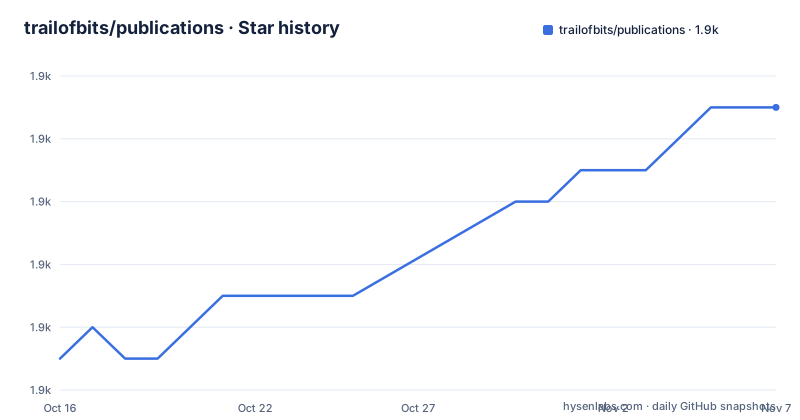
- trailofbits/publications1,919 ★ · +8
| Repository | 2026-10-16 | 2026-11-07 |
|---|---|---|
| trailofbits/publications | 1.9k | 1.9k |
8 Stars in the last 22 days, measured from the daily GitHub snapshot. Compare with other projects
Editorial analysis
What trailofbits/publications Contains
trailofbits/publications addresses document discovery. It gathers Trail of Bits publications in one repository instead of requiring readers to search separately across academic venues, conference sites, company publications, and external links. The intended audience includes security engineers, researchers, students, reviewers, and readers looking for technical background on software security, cryptography, blockchain systems, machine learning, infrastructure, and adjacent engineering topics.
The archive is broader than a conventional paper repository. Its README indexes academic papers, white papers, guides and handbooks, conference presentations, podcasts, webinars, public comments, case studies, security reviews, disclosures and exploits, workshops, datasets, and service overviews. Several security-review sections are also divided by subject. Examples include cryptography reviews, AI/ML reviews, cloud-native reviews, wallet reviews, and blockchain ecosystems such as Bitcoin, Ethereum/EVM, Solana, Starknet, Tezos, TON, Substrate, and Tendermint/Cosmos.
This breadth changes how the project should be evaluated. It is a curated publication library, not a single research artifact with one executable workflow. The README provides title, venue, year, file path, and external destination metadata for many entries, but it does not claim that every publication uses the same document format or access model. Some entries point to PDFs stored in the repository, while others point to arXiv, ACM, IEEE, conference websites, or other external pages.
The repository is not archived, and its last push was on 2026-10-15. That supports treating the index as recently changed, but there are no GitHub releases from which to infer a packaged version or upgrade history. Readers who need stable software dependencies should look elsewhere.
Repository Structure and Document Flow
The repository behaves like a manually organized library built around README.md. Directories such as papers/, presentations/, reports/, reviews/, case-studies/, public-comments/, datasets/, workshops/, and service-overviews/ separate major publication classes. The README acts as the catalog, connecting human-readable titles to repository-relative paths or external URLs.
That architecture is easy to inspect. A local PDF entry uses a path such as papers/debloater-eval.pdf, while an external entry can point directly to a conference or paper service. Metadata is presented in tables for academic papers, with columns for the paper title, venue, and publication date. Other sections use nested Markdown headings to group presentations and reviews by technical area.
The repository’s primary language is listed as Python, but the visible repository structure and README describe a publication collection rather than a Python application. No command-line entry point, package manifest, importable module, build configuration, or execution interface is identified in the repository facts. Treating the repository as source code would therefore be a category error.
Links cross a trust and availability boundary. Repository-relative documents can be opened directly from GitHub or a clone, whereas external links depend on the continued availability and behavior of sites such as ACM, IEEE, arXiv, USENIX, and conference organizers. The README does not document link checking, mirrored files, offline bundles, or a command for validating catalog entries. Any automation that crawls this repository would need to account for both local paths and external URLs.
Accessing the Archive and Opening a First Paper
The README does not provide installation commands, Python package setup, or a release procedure. It presents the archive as content available through the repository and its linked destinations. The repository has no GitHub releases, so there is no documented versioned archive to download.
A first use is therefore catalog navigation. Open README.md, choose a section that matches the intended task, and select a publication title. For a repository-hosted paper, the link resolves to a PDF under a directory such as papers/. For an externally hosted paper, the browser follows the linked venue or preprint page.
For example, the academic-papers table links “A Broad Comparative Evaluation of Software Debloating Tools” to papers/debloater-eval.pdf and identifies its venue as USENIX Security 2024. That entry demonstrates the basic access pattern: find the topic in the README, inspect the title and venue metadata, then open the linked document.
There is no documented local extraction workflow. The README does not say whether users should run a PDF parser, OCR pipeline, citation manager, or indexing tool, and it supplies no configuration for one. Likewise, it gives no commands for bulk downloads or searching the archive. The defensible first use ends with opening and reading a selected publication, not installing a package or launching a service.
Security Topics and Review Coverage
The catalog’s subject tags make trailofbits/publications more useful than an undifferentiated document dump. Conference presentations are grouped into automated bug finding and exploitation, blockchain, compilers, cryptography, engineering, education, infrastructure, machine learning, mobile security, programming, side channels, supply chain, and threat analysis and malware. This classification gives engineers several entry points into the archive.
The academic-paper index shows the kinds of technical questions represented. Listed work covers software debloating, dynamic information-flow tracing, subprocess isolation, Ruby fuzzing, MLIR compiler construction, authenticated key exchange, proof systems, memory-corruption analysis, x86-64 binary rewriting, smart-contract fuzzing, static analysis, and symbolic execution. These titles indicate research topics, but the README index alone does not establish the validity, reproducibility, or practical scope of each result.
The review material adds another layer. Client-named reviews include Frax Finance, MobileCoin, Offchain Labs, Reserve Protocol, Scroll, Uniswap, and Western Digital. Technical review groupings include AI/ML, cryptography, technology products, cloud-native systems, invariant testing and development engagements, wallets, and multiple blockchain networks. This organization can help readers compare prior public work, but it does not mean that the repository supplies a repeatable review methodology or current findings for any product.
Disclosures and exploits are indexed as their own category. The presence of exploit material does not make this repository an attack toolkit. Based on the README and repository layout, it is a catalog of publications and reports rather than a packaged offensive framework.
Maintenance, Releases, and Upgrade Cost
The repository is not archived, and the last push was on 2026-10-15. Its topics are academic-papers, conference-presentations, and security-reviews. There are no GitHub releases, so this project has no documented release channel, semantic version, migration guide, or compatibility policy in the repository description.
For readers, the maintenance task is largely editorial: new publications may be added, existing links may change, and metadata may be revised. The README does not describe automation for checking broken links, validating PDF integrity, normalizing citations, or withdrawing superseded documents. Based on the visible layout, adopting the archive requires little installation work, but that convenience does not guarantee that every link will remain valid.
The repository license is CC-BY-SA-4.0. That identifier indicates the stated Creative Commons license for the repository, but individual linked publications may live on external sites or carry separate publication terms. The README does not provide per-file license auditing. Anyone planning to mirror, transform, or redistribute documents should first inspect the repository license and the terms attached to each external work. This is a license-boundary observation, not legal advice.
There is no package upgrade path comparable to `pip`, no dependency lock file identified in the repository listing, and no release artifact to compare. The meaningful change signal is repository history and commit content, not a version number.
Where This Archive Falls Short
The main limitation is the absence of a software interface. A team cannot infer from the Python language classification that it can install this repository as a package, import its contents, or call an analysis API. Searches requiring structured metadata, bulk PDF retrieval, local full-text indexing, citation export, or automated link validation are not documented.
A second limitation is format consistency. The README mixes repository-hosted PDFs with external links to publishers and conference sites. A local clone may therefore contain only part of the catalog, while an unavailable external page can make an entry unusable. The README also does not state that all documents are archived locally.
A third limitation concerns recency semantics. Publication dates identify when works appeared, not whether a review still reflects the current version of a product or protocol. Blockchain and software-security findings can depend on code versions, deployment state, and configuration. Readers should treat the archive as historical research and public review material, then inspect each publication’s own date and scope.
A conventional citation database or downloadable document archive would serve readers who need standardized metadata and offline access. Trail of Bits’ own website is another route for discovering company publications. By comparison, trailofbits/publications is best when the GitHub Markdown index and repository structure are the desired way to browse the collection.
Editorial conclusion
Adopt this repository as a reference archive when you need to locate Trail of Bits research by topic, publication type, or review area. Do not adopt it as a Python dependency, runnable scanner, or release-managed software package. Verify first whether the linked PDF or external venue page is available and whether its citation and license information fit the intended use.
Frequently asked questions
Does trailofbits/publications provide an installable Python package?
No package installation instructions or importable Python interface are documented in the README. The repository is presented as a collection of publications and related documents.
What kinds of documents are available in trailofbits/publications?
The index includes academic papers, white papers, guides, conference presentations, case studies, security reviews, disclosures, workshops, datasets, podcasts, webinars, and service overviews.
Does trailofbits/publications have versioned GitHub releases?
The repository has no GitHub releases. Readers are directed to the repository content and linked publication pages rather than a documented release package.
Official sources
Add this badge to your README
If you maintain this project, the badge below links readers to this analysis and shows its maintenance status from the daily GitHub snapshot. Paste the markdown into your README; add ?metric=license or ?metric=stars to the image URL for a different field.

[](https://hysenlabs.com/projects/trailofbits-publications)Star history chart for your README
[](https://hysenlabs.com/projects/trailofbits-publications)Was this useful?