AIF360: fifteen algorithms, and two extras lists that disagree
A comprehensive set of fairness metrics for datasets and machine learning models, explanations for these metrics, and algorithms to mitigate bias in datasets and models.
At a glance
- What is it?
- An open source fairness toolkit shipped in Python and R whose last release is 0.6.1 from April 2024 while commits continue into 2026, whose install extras are documented as a list the packaging script does not implement, whose requirements file pins versions the extras leave open, and whose metrics work on a bare install while every algorithm needs an extra.
- Who is it for?
- AIF360 is still the broadest fairness reference implementation available in one install, and its breadth is also its problem, as the project's own page admits by saying it can be confusing to choose a metric for a case. Take it when you need a metric and an algorithm in the same library across Python and R, and install deliberately rather than by habit.
- Can I use it commercially?
- Yes. Apache-2.0 is a permissive licence: you can use, modify and sell software built on it, as long as you keep its copyright and licence notices.
- Is it still maintained?
- Yes. The repository last received commits 161 days ago.
- What is it written in?
- Mainly Python, according to GitHub's language statistics.
Answers come from the project's GitHub data, last synced on November 23, 2026, and from our analysis. They are not legal advice.
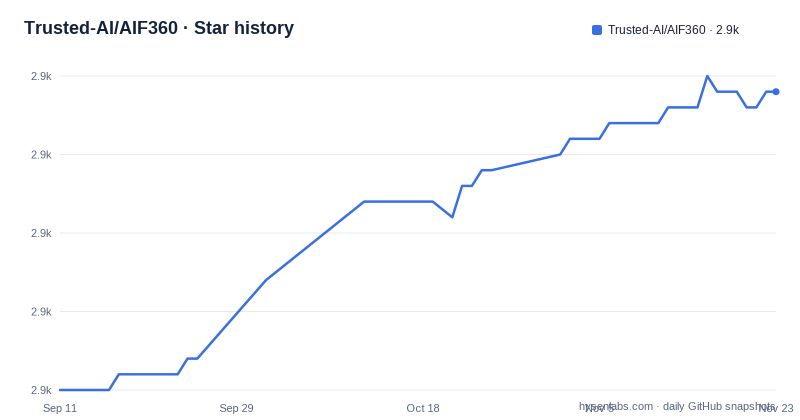
Star history
- Trusted-AI/AIF3602,884 ★ · +19
| Repository | 2026-09-11 | 2026-11-23 |
|---|---|---|
| Trusted-AI/AIF360 | 2.9k | 2.9k |
19 Stars in the last 73 days, measured from the daily GitHub snapshot. Compare with other projects
Editorial analysis
The last release is 0.6.1 from April 2024
Three releases are published: v0.5.0 in September 2022, v0.6.0 in February 2024 and v0.6.1 in April 2024. The repository is not archived and the last commit on the default branch is dated 2026-06-15, so the working tree has moved roughly two years past the newest tag while the version number on the index has not. The packaging script hardcodes the same 0.6.1 rather than reading it from anywhere, which means the index version and the branch can disagree indefinitely without either noticing. The version line has never reached one, and the project says so in its own words twice: the readme and the long description both state that the library is still in development and invite contributions of metrics, explainers and debiasing algorithms.
pip install aif360So read the last commit date rather than the release date when you judge how current the code is, and expect a pre-one package.
The documented extras and the declared extras are different sets
The install section ends by naming the extras you can ask for, and the packaging script declares a different collection. The documented list has fourteen names. The script defines twelve named extras, then derives two more for tests and documentation and one that unions everything. Comparing the two, the documented list includes a name the script never defines, so asking for that extra resolves to nothing the packaging step installed. In the other direction, two extras the script defines are absent from the documented list, which means a reader working only from the page cannot discover them or the dependencies they pull. The union extra is assembled through a set, so the order of its contents follows string hashing rather than the declaration order, which is harmless for installation and visible if you read the metadata.
The requirements file pins what the extras leave open
Two files describe the same dependencies at different strictness. The requirements file, organised by comment into algorithms, notebooks, tests and docs, holds exact pins for several packages: an exact version for the R bridge, for the skorch wrapper, for the optimal transport library, for the plotting extra of the graph library, for the gradient boosting library, and for the three documentation packages. The extras in the packaging script name the same packages with no version at all in most cases, and the top-level requirement file elsewhere uses floors rather than pins for the learning framework, the adversarial robustness toolbox and the fairness library, while one framework is asked for at a floor from 2019. So a developer following the extras gets whatever resolves today, and a developer following the requirements file gets a frozen set that may not install on a current interpreter.
The build regenerates a source file in your checkout
Running the packaging script writes into the tree before it packages anything. It opens the version module inside the package directory in write mode and replaces its contents with a generated comment and a version assignment, using the hardcoded value. Every build therefore leaves a modified file behind, and the file it overwrites is the one an editor or a diff will show you afterwards. The same script assembles the long description as a single hard-wrapped paragraph rather than reusing the readme, and that paragraph is not the same text: it asks for contributions of datasets alongside metrics, explainers and algorithms, while the readme's version of the sentence leaves datasets out. So the description a reader sees on the package index differs from the repository's own front page by one word.
Metrics install bare, algorithms need an extra each
The install note is explicit that some algorithms require additional dependencies although the metrics will all work out-of-the-box. That splits the library in two for practical purposes. The metric side needs nothing beyond the base install, which is why the troubleshooting guidance points at the extras when something fails. The algorithm side maps one algorithm family to one extra, and the dependency each one drags in shows what you are agreeing to: an optimisation solver for the preprocessing method, a deep learning framework for the adversarial method, a second framework for learning fair representations, a R bridge for the adaptation method, and two fairness libraries for the reduction and in-fairness methods. The base install is small; the cost of this toolkit is entirely in the extras you opt into.
Three operating systems share one Python range
The supported configuration table gives macOS, Ubuntu and Windows the same span, Python 3.10 to 3.13, which is unusual precision for a library of this age and one of the better-maintained parts of the documentation. The environment advice is more emphatic than the table. A virtual environment is strongly recommended, with the stated reason that the toolkit requires specific versions of many packages which may conflict with other projects on your system, and the guidance to try it first if installation fails. Conda is recommended for all configurations, with virtualenv called generally interchangeable, and a minimal conda distribution is enough. The worked example creates an environment on Python 3.11, which is inside the supported range but not at either end of it.
One repository, two language packages
The toolkit ships in Python and R from the same tree, which is what the R project file at the root and the package registry badge are for. The R install is a single call to the package manager, and its setup notes live in a readme inside a nested R directory rather than on this page. The two halves are joined at one point: the adaptation extra for Python depends on the R bridge, so that algorithm is a Python front end to an R implementation. Everything else is duplicated or absent per language, and nothing on this page says which metrics or algorithms exist on both sides. That gap matters more than it sounds, because the page invites you to contribute metrics and algorithms without saying which language a contribution would have to target.
Fifteen algorithms, twenty notebooks, and unmatched components
The algorithm list names fifteen methods, each with the paper it comes from, and two of them cite a second paper for the same technique. The metrics list is shorter and grouped, covering group fairness from selection and error rates including rich subgroup fairness, sample distortion, a generalised entropy index, differential fairness and bias amplification, and a multi-dimensional subset scan. The examples directory is larger than both lists: twenty notebooks, a shared helper module, a directory of images and a directory of scikit-learn material. Several notebooks have no counterpart in either list, including one on deterministic reranking, two on the same fairness component with a short test variant, one on an optimal transport metric, and one on explainers that emit JSON. Two more are tutorials on advertising bias and credit scoring, which are the only notebooks named after domains rather than methods.
Editorial conclusion
AIF360 is still the broadest fairness reference implementation available in one install, and its breadth is also its problem, as the project's own page admits by saying it can be confusing to choose a metric for a case. Take it when you need a metric and an algorithm in the same library across Python and R, and install deliberately rather than by habit. Check the extras against your setup script, because the list in the documentation includes a name the packaging script never declares. Pin your own versions, since the requirements file and the extras disagree about how tightly to hold them. Install the metrics first and add one algorithm extra at a time, so a dependency conflict tells you which algorithm caused it. And read the version file, because the build regenerates it.
Frequently asked questions
What is AI Fairness 360?
An extensible open source library for detecting and mitigating bias in machine learning models across the application lifecycle. It contains metrics for datasets and models, explanations for those metrics, and algorithms that mitigate bias, and it is available in both Python and R.
How do I install AIF360?
Run pip install aif360 for the metrics, which work out of the box, or add extras for the algorithms, such as pip install 'aif360[LFR,OptimPreproc]' or pip install 'aif360[all]' for everything. A virtual environment is strongly recommended, with conda preferred, because the toolkit pins many package versions that can conflict with other projects.
Which Python versions and platforms does AIF360 support?
The supported configuration table gives Python 3.10 to 3.13 on macOS, Ubuntu and Windows. The worked conda example creates an environment on Python 3.11.
Does AIF360 have a maintained release history?
The newest release is v0.6.1 from 2024-04-08, after v0.6.0 in February 2024 and v0.5.0 in September 2022. The repository is not archived and its last commit is dated 2026-06-15, and both the readme and the package long description state that the library is still in development.
Which debiasing algorithms does AIF360 include?
Fifteen, each cited to its paper: optimized preprocessing, disparate impact remover, equalized odds postprocessing, reweighing, reject option classification, prejudice remover regularizer, calibrated equalized odds postprocessing, learning fair representations, adversarial debiasing, the meta-algorithm for fair classification, rich subgroup fairness, exponentiated gradient reduction, grid search reduction, fair data adaptation, and sensitive set invariance.
Official sources
Add this badge to your README
If you maintain this project, the badge below links readers to this analysis and shows its maintenance status from the daily GitHub snapshot. Paste the markdown into your README; add ?metric=license or ?metric=stars to the image URL for a different field.

[](https://hysenlabs.com/projects/trusted-ai-aif360)Star history chart for your README
[](https://hysenlabs.com/projects/trusted-ai-aif360)Was this useful?