latex.css makes a web page look typeset, with almost no class names
LaTeX.css is a CSS library that makes your website look like a LaTeX document
At a glance
- What is it?
- vincentdoerig/latex-css is one stylesheet and a fonts directory, distributed three ways and with no runtime dependencies at all. The parts worth knowing are the two-step language support, the short list of opt-in classes for things like abstracts and theorem labels, and a build script whose real work happens before packing rather than in it.
- Who is it for?
- latex.css suits someone who wants a document look on a single page or a small site and does not want to restyle it, since one stylesheet link does the work. It does not suit a design system, because almost everything is class-less and the opt-in list is short.
- Can I use it commercially?
- Yes. MIT is a permissive licence: you can use, modify and sell software built on it, as long as you keep its copyright and licence notices.
- Is it still maintained?
- Activity is slowing. The repository last received commits 6 months ago.
- What is it written in?
- Mainly HTML, according to GitHub's language statistics.
Answers come from the project's GitHub data, last synced on November 24, 2026, and from our analysis. They are not legal advice.
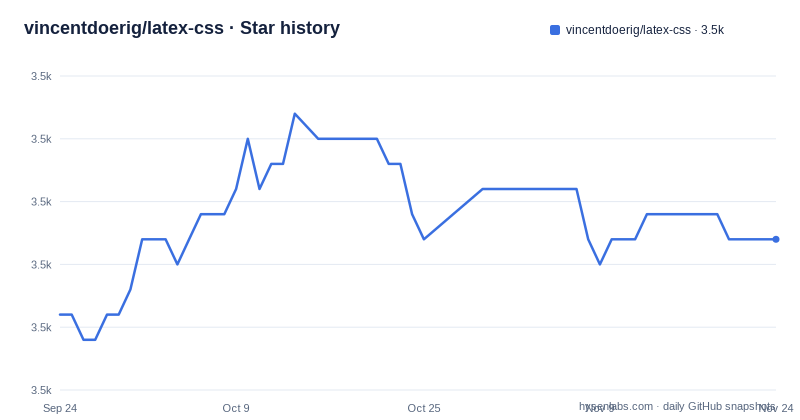
Star history
- vincentdoerig/latex-css3,481 ★ · +3
| Repository | 2026-09-24 | 2026-11-24 |
|---|---|---|
| vincentdoerig/latex-css | 3.5k | 3.5k |
3 Stars in the last 61 days, measured from the daily GitHub snapshot. Compare with other projects
Editorial analysis
Three ways to add one stylesheet
Installation is three routes to the same file, and the readme gives them in order of increasing commitment. The first is a stylesheet link in the head of your project pointing at the project's own deployed address. The second is a link to a content delivery network, with a package name and a file name and no build step at all, which is the route to take when you want the file served from a network rather than from the project's own deployment. The third is a package manager, once for each of the two common ones. Nothing needs configuring, no JavaScript is loaded, and there is no runtime dependency to install: the manifest lists exactly one development dependency, and it is the bundler used to publish the stylesheet rather than anything you would depend on.
<link rel="stylesheet" href="https://latex.vercel.app/style.min.css" />npm install latex.cssAlmost class-less, with a short opt-in list
The description calls the library minimal and almost class-less, and the practical meaning is that you add no classes to get the effect: a document, some paragraphs, a heading structure and you already look typeset. The opt-in list exists for the things a plain document cannot express. The readme names them: an author subtitle, an abstract, lemmas and theorems among others, and points at a reference page listing every supported class-based element. That reference lives in the repository as a page in its own right, alongside an element gallery, which tells you the project treats the styling of individual semantic elements as a documented surface rather than an accident. If you need something the list does not contain, you are writing your own CSS, and everything else still applies underneath it.
Language support needs two changes, not one
Translating the labels is the feature with a genuine gotcha, because it needs two separate edits and the readme describes them as one instruction. The first is including an additional stylesheet from the project's language directory, named for the language you want, in addition to the main stylesheet rather than instead of it. The second is changing the language attribute on the document element to match. Miss the attribute and the extra stylesheet loads without doing anything visible, since the selector it relies on is the one you did not set. A separate page in the repository demonstrates the available languages, so you can see what the labels look like before committing to one. The labels this affects are the ones a reader recognises from a paper: theorems, definitions, lemmas and proofs.
The package main field points at a stylesheet
The manifest is worth reading for a package that contains no code. The main field names the minified stylesheet rather than a module entry point, which is unusual but correct for something that is imported by a bundler rather than by a runtime. The published file list is four entries: a build directory, the fonts directory, the language directory, and two copies of the stylesheet at the root, one named plainly and one named as the minified variant. The fonts directory being shipped matters more than it looks, because a stylesheet that made a page look typeset would be undermined by a missing typeface falling back to the system serif. So the package is self-contained in that sense, and installing it gives you both the styling and the fonts it was designed against.
The build script is a dry run and prepack does the work
The two scripts are named in a way that inverts the order you would expect. The one called build does nothing but ask the package manager to perform a dry run of packing, which lists what would be published without publishing anything. The one called prepack is where the real work happens: it runs the bundler and then copies the resulting stylesheet from the build directory back to the repository root under the minified name. So the file your users link to is produced as a side effect of publishing, and the command named build is a verification step rather than a compilation. That arrangement works, and it is also the reason the root stylesheet and the minified one are both committed: the root copy is the artefact the website serves, and the package manager takes it from there.
Four upstreams are credited, one of them for the reset
The acknowledgements section credits four separate projects, and the credit is specific enough to be useful. The library itself is based on another stylesheet of the same name by a different author, which is the direct ancestor. Most of the reset underneath it comes from a modern reset written by someone else, so a bug in the reset is not this project's bug. The sample markup test page is adapted from an existing test page, which is how the project's own gallery gets its coverage of edge cases. And the idea of sidenotes was taken and adapted from a stylesheet built around a particular author's book design, which is the one credit here that points at an aesthetic source rather than a code source. The repository root also carries a directory named after a syntax highlighter, which is how code samples inside a document get coloured.
Releases land about once a year
The release record is short and evenly spaced. A version in late September 2024, one in the middle of May 2025, and one in the middle of May 2026, so the pattern is closer to annual than to the release cadence of most packages. The newest tag carries the same timestamp as the repository's last recorded push, which means the tag and the final commit are the same moment and nothing has landed since. The repository is not archived. Deployment configuration for a static hosting platform sits at the root beside the bundler configuration, and the two documentation pages, the element gallery and the language list, are ordinary HTML files in the repository rather than generated output, which is why they can be read on the deployed site without a build step.
Editorial conclusion
latex.css suits someone who wants a document look on a single page or a small site and does not want to restyle it, since one stylesheet link does the work. It does not suit a design system, because almost everything is class-less and the opt-in list is short. Before deploying it, remember that language support needs a second stylesheet and a changed document attribute, and that the package's main field points at a stylesheet rather than at code.
Frequently asked questions
Does anyone still use LaTeX?
This repository is not about producing LaTeX. It is a stylesheet that makes a web page resemble a typeset document, and what it offers is one dependency free file with opt-in classes for elements such as an author subtitle, an abstract, lemmas and theorems.
How to create a .TeX file?
The project does not deal with LaTeX source files. It targets the opposite case, styling an existing web page. Three installation routes are given: a stylesheet link to the deployed copy, a link to a content delivery network, or installing the package with either of the two common package managers.
Is LaTeX like HTML?
The project does not draw that comparison, but the design implies it. The stylesheet works on ordinary markup with almost no class names, so a page written in HTML acquires a document appearance without being restructured, and the elements that cannot be inferred are handled through an opt-in list of classes.
What are the disadvantages of using LaTeX?
Not a question this repository addresses, since it contains no LaTeX. What it documents instead is its own two-step language support: a second stylesheet for the chosen language must be included in addition to the main one, and the document's language attribute must be changed to match, so a single change leaves the labels untranslated.
Official sources
Add this badge to your README
If you maintain this project, the badge below links readers to this analysis and shows its maintenance status from the daily GitHub snapshot. Paste the markdown into your README; add ?metric=license or ?metric=stars to the image URL for a different field.

[](https://hysenlabs.com/projects/vincentdoerig-latex-css)Star history chart for your README
[](https://hysenlabs.com/projects/vincentdoerig-latex-css)Was this useful?