VMHeaven proxy lists: plain text files, two repositories, and two features still coming
Fresh list of HTTP/S & SOCKS4/SOCKS5 Proxies, Amazon excluded, Updating every 15 minutes!
At a glance
- What is it?
- A repository of free HTTP, HTTPS, SOCKS4 and SOCKS5 proxy lists published as text files, both per protocol and per country, where the protocol download commands point at a different repository than the country ones, and geolocation selection plus the promised API do not exist yet.
- Who is it for?
- This list fits a scraping or geo-block experiment where a rotating pool of open proxies is acceptable and you will test the endpoints yourself. It does not fit anything that needs provenance, uptime guarantees or a stable API, since the lists are plain text with no versioning and two of the advertised features are still marked as upcoming.
- Can I use it commercially?
- Not without permission. GitHub finds no licence file in the repository, and without a licence all rights are reserved by default: you may read the code but not reuse it. Check the README, or ask the authors, before using it.
- Is it still maintained?
- Yes. The repository received new commits within the last day.
- What is it written in?
- GitHub does not report a main language for this repository.
Answers come from the project's GitHub data, last synced on October 22, 2026, and from our analysis. They are not legal advice.
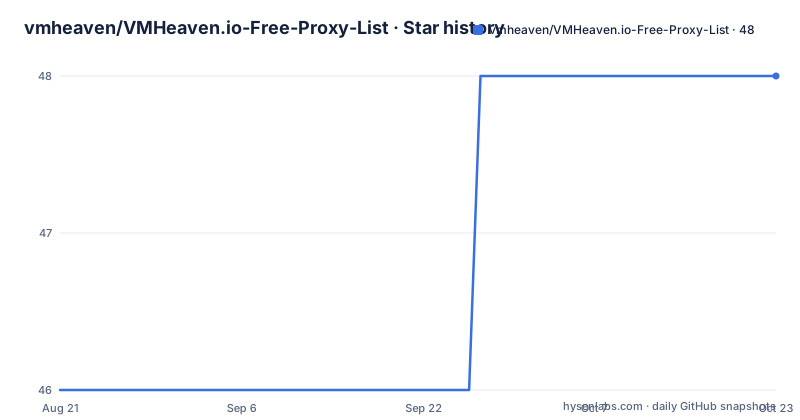
Star history
- vmheaven/VMHeaven.io-Free-Proxy-List48 ★ · +2
| Repository | 2026-08-21 | 2026-10-22 |
|---|---|---|
| vmheaven/VMHeaven.io-Free-Proxy-List | 46 | 48 |
2 Stars in the last 62 days, measured from the daily GitHub snapshot. Compare with other projects
Editorial analysis
Four documented text files, and two the README never mentions
The whole deliverable is a handful of text files at the repository root. http.txt, https.txt, socks4.txt and socks5.txt are the four documented lists, one per protocol, and each is fetched straight from the raw content URL with curl. Two more files sit beside them without appearing anywhere in the instructions: allproxy.txt, which by its name suggests a combined list, and http_anonymous.txt, which is a narrower HTTP subset. Nothing in the documentation says whether either is current, what its line format is, or how it differs from http.txt. If you are writing a consumer for this repository, treat those two as undocumented rather than assuming they mirror the documented four.
Country lists follow Country/{COUNTRY_CODE}/{type}.txt
Country selection is a path convention rather than a flag. The pattern is Country/{COUNTRY_CODE}/{type}.txt, and the documented example for the United States is:
curl -sL https://raw.githubusercontent.com/vmheaven/VMHeaven.io-Free-Proxy-List/refs/heads/main/Country/US/http.txt -o us-http.txtThe same four types exist per country, https.txt, socks4.txt and socks5.txt sitting next to http.txt. To change the country you swap the code segment, with DE, GB, FR and NL given as the examples, and the local filename is a convenience you choose, as in us-http.txt for the US HTTP list. The naming convention for those outputs is yours rather than the project's, so a script that fetches several countries should keep its own mapping instead of assuming the repository defines one. Note also that the file format itself is never specified: the instructions show a curl command per file and stop there, so a consumer has to discover whether each line is host, host and port, or a URL by looking at the content, and there is no documented line length or comment convention.
The per-type downloads point at a different repository
Here is the detail most people will trip over. The four per-type commands target vmheaven/VMHeaven-Free-Proxy-Updated, while the four per-country commands target vmheaven/VMHeaven.io-Free-Proxy-List, which is the repository you are reading. The two names are not the same and neither is a redirect documented anywhere, so the protocol lists and the country lists are being served from two different places with a shared naming family. Both URLs pin the branch explicitly with refs/heads/main, so a rename on either side would break the fetch rather than silently follow. If you build a downloader from these instructions, hard-code both repository names and expect to update them if either is reorganised.
Two update frequencies are claimed, and they disagree
The repository description says the list is updated every 15 minutes. The README says frequent updates, staying ahead with a proxy list updated every few hours. Nothing else in the documentation reconciles the two, and there is no commit schedule, no release history and no changelog to check against. What is verifiable is the branch itself: the last push to main was September 30, 2026, which is consistent with either claim. For an open proxy list the difference matters more than it looks, because entries go stale quickly and a fifteen-minute claim sets an expectation about address survival that the documentation never backs up. Treat the commit times of the text files, not the prose, as the freshness signal.
The filtering claim names what it excludes, not what it verifies
Two bullets make the quality claim. Reliable sources says only verified and functional proxies are listed. Verified sources says AWS and Amazon are excluded along with other proxy honeypots, and the repository description repeats the Amazon exclusion. A third bullet, high speed, says regular tests ensure only the fastest proxies are used. What none of these say is how a proxy is tested, from where, how often the pool is re-swept, or what happens to an address that was good yesterday. So the exclusions are real and checkable in the sense that Amazon-hosted addresses should not appear, while the freshness and speed claims rest on a process the documentation does not describe. The exclusion is also the one filter you can verify cheaply: fetch a list, check the addresses against cloud provider ranges, and you will know whether the stated filter is actually being applied to the file you hold.
Geolocation selection and the API are announced, not shipped
Two of the advertised features are explicitly future tense. Geolocation support says you can choose proxies from specific regions, marked coming soon. API access says you can fetch proxies programmatically with the upcoming API. Neither exists in the repository today, so the only machine-readable interface is the plain text files described above, fetched over HTTPS from raw content URLs. That is workable for a script that runs occasionally and caches its results, and awkward for anything that wants structured metadata such as country, latency or anonymity classification. The rest of the feature list, covering HTTP, HTTPS, SOCKS4 and SOCKS5 access and the intended uses of web scraping, bypassing geo-blocks and online anonymity, describes what the files are for rather than what the tooling provides.
The project asks for stars and disclaims responsibility
The README spends as much space on promotion as on format: give it a star, share it, join discussions, follow updates, submit issues or proxy sources, tweet about it, mention it in a blog post, recommend it on forums. Contributions are welcome through a pull request or a suggestion. The disclaimer at the end is short and worth quoting in spirit rather than in full: the listings are provided for informational purposes, for viewing purposes, and the author does not encourage or support anything illegal or unlawful. Repository metadata is thinner than the README suggests: no licence is declared, there are no GitHub releases, the primary language is not recorded, and the site behind the project is vmheaven.io. The Country/ directory is the only structured part of the tree, and it is populated by that path convention rather than by any documented script.
Editorial conclusion
This list fits a scraping or geo-block experiment where a rotating pool of open proxies is acceptable and you will test the endpoints yourself. It does not fit anything that needs provenance, uptime guarantees or a stable API, since the lists are plain text with no versioning and two of the advertised features are still marked as upcoming. Before using an entry, check that the file you fetched came from the repository you expected, and treat the exclusion of AWS and Amazon as a filter the project applies rather than a guarantee about any single address.
Frequently asked questions
Where can I find a free proxy list from vmheaven?
As plain text files in the repository: http.txt, https.txt, socks4.txt and socks5.txt at the root, plus per-country copies under Country/{COUNTRY_CODE}/{type}.txt, each fetched with curl from the raw content URL on the main branch.
Is there a free proxy I can use from this vmheaven list?
The project states that only verified and functional proxies are listed, that regular tests keep the fastest ones, and that AWS, Amazon and other proxy honeypots are excluded. It does not document the testing procedure, so the endpoints still need checking on your own network.
How do I check a proxy from the vmheaven list?
The repository does not document a checking procedure. Its claims are that proxies are tested regularly for functionality and speed and that AWS and Amazon addresses are excluded, and the intended uses listed are web scraping, bypassing geo-blocks and online anonymity.
Does vmheaven provide VPN servers or a proxy API?
The files are HTTP, HTTPS, SOCKS4 and SOCKS5 proxies rather than VPN servers, and the promised API is described as upcoming rather than shipped, with geolocation selection marked coming soon. The only working interface today is the text files.
Official sources
Add this badge to your README
If you maintain this project, the badge below links readers to this analysis and shows its maintenance status from the daily GitHub snapshot. Paste the markdown into your README; add ?metric=license or ?metric=stars to the image URL for a different field.

[](https://hysenlabs.com/projects/vmheaven-vmheaven-io-free-proxy-list)Star history chart for your README
[](https://hysenlabs.com/projects/vmheaven-vmheaven-io-free-proxy-list)