Wan2.2 ships three requirements files, a yapf Makefile, and no GitHub releases
Wan: Open and Advanced Large-Scale Video Generative Models
At a glance
- What is it?
- Wan2.2 is the Wan team's Apache-2.0 video generation code, covering text-to-video, image-to-video, character animation and speech-to-video. Its dependency files disagree with each other, its formatter is not the one it configures, and its versions live outside the repository.
- Who is it for?
- Adopt Wan2.2 if you need a specific task model, the Animate or S2V path, and you are willing to assemble the environment from three separate dependency files and weights pulled from the Wan-AI organization on Hugging Face or ModelScope. Keep away if you need one pinned install or a recorded upgrade path, because the repository has neither GitHub releases nor a single dependency file.
- Can I use it commercially?
- Yes. Apache-2.0 is a permissive licence: you can use, modify and sell software built on it, as long as you keep its copyright and licence notices.
- Is it still maintained?
- Yes. The repository last received commits 55 days ago.
- What is it written in?
- Mainly Python, according to GitHub's language statistics.
Answers come from the project's GitHub data, last synced on November 15, 2026, and from our analysis. They are not legal advice.
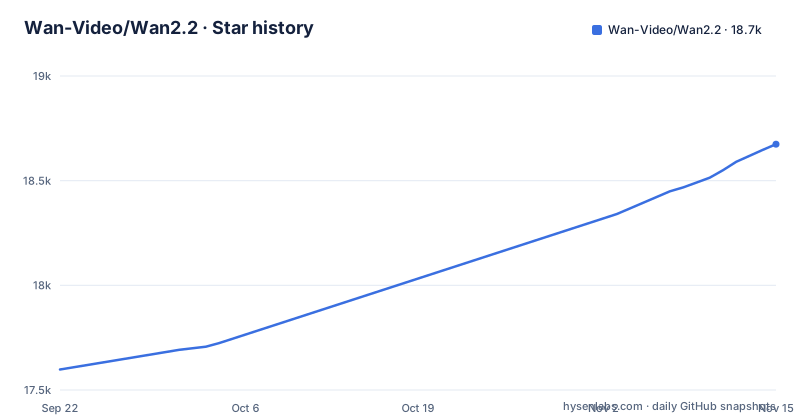
Star history
- Wan-Video/Wan2.218,674 ★ · +1,076
| Repository | 2026-09-22 | 2026-11-15 |
|---|---|---|
| Wan-Video/Wan2.2 | 17.6k | 18.7k |
1,076 Stars in the last 54 days, measured from the daily GitHub snapshot. Compare with other projects
Editorial analysis
There is no GitHub release to pin, and the version string is the only marker
The repository has no GitHub releases. There is no release page to diff and no changelog file in the tree. The only version marker in the tree is the `version = "2.2.0"` line in `pyproject.toml`, and the last push to main was on 2026-09-21.
That shapes every upgrade decision. You cannot say which commit corresponds to a weight file, and there is no release to roll back to. An upgrade means reading commit history and comparing the weight repositories on the Wan-AI organizations at Hugging Face and ModelScope by hand.
The news list adds to the confusion rather than fixing it. Entries are not in date order: the Nov 13, 2025 Diffusers integration for Wan2.2-Animate-14B sits above the Sep 19, 2025 Animate release, the Aug 26, 2025 S2V release and three Jul 28, 2025 entries, and the Sep 5, 2025 line about CosyVoice text-to-speech support is filed last. Read the whole list before concluding the newest capability is the first one.
The Makefile formats with yapf while pyproject configures black
The repository has exactly one Makefile target, and it is a formatting target. The `format` rule runs isort across `generate.py` and `wan`, then runs yapf in place over the same files. That is the tool that actually reformats the code when you type `make format`.
`pyproject.toml` configures a different formatter. It sets `[tool.black]` with a line length of 88, `[tool.isort]` with the black profile, and `[tool.mypy]` with strict enabled. The `dev` optional dependency group lists pytest, black, flake8, isort, mypy and `huggingface-hub[cli]`, and yapf is not in it.
The consequence is a repository where the configured style and the applied style are different tools. A contributor who runs `make format` gets yapf output, not black output, and if yapf is not already installed in their environment the yapf step fails. If you plan to send patches, run black yourself first and treat the Makefile target as a separate historical artifact.
pyproject and requirements.txt install different environments
The package metadata and the pinned dependency file disagree on three packages. `pyproject.toml` asks for `transformers>=4.49.0` with no ceiling, while `requirements.txt` asks for `transformers>=4.49.0,<=4.51.3`. The metadata lists `imageio`, the requirements file lists `imageio[ffmpeg]`. And `requirements.txt` includes `torchaudio`, which `pyproject.toml` does not list at all.
So the same repository produces two different environments depending on which file you install from, and the ceiling that matters most for diffusers pipelines exists only on one of the two paths. Anyone who runs `pip install .` gets an uncapped transformers, which is the first thing to break when a new transformers release lands.
There is a packaging detail behind this too. `[tool.setuptools]` ships a single package named `wan`, with package data set to include every Python file beneath it, so the `wan` package installs but the `generate.py` entry script at the repository root is not part of the installed distribution. Installing the package gives you a library; running a model still means running a script from a clone.
flash_attn has no version bound and no fallback path
`flash_attn` appears in both dependency files with no version constraint and no optional marker. It is a hard requirement of the base install, not an accelerator you can leave out.
That has a practical consequence at install time. On a machine without a matching prebuilt wheel, pip falls back to building the extension from source, which needs a CUDA toolchain and a compiler that a plain Python environment does not have. The failure surfaces as a build error partway through the install, before any model or checkpoint is involved, and the error text points at a compiler rather than at your GPU.
The second constraint is quieter. Both files hold numpy below the next major with `numpy>=1.23.5,<2`, so a host environment that already carries numpy 2 has to be downgraded before this project will install cleanly. There is no CPU-only variant listed in the dependency files, which means the 5B model that the project says runs on a consumer card still starts from a dependency tree that requires flash_attn.
Three requirements files means three environments, not one
The tree carries `requirements.txt`, `requirements_animate.txt` and `requirements_s2v.txt`, one for the base models and one for each of the two newer task models, Wan2.2-Animate-14B and Wan2.2-S2V-14B. There is no combined file.
Read that as an environment decision. A machine that runs text-to-video in the morning and character animation in the afternoon has to satisfy two separate dependency files. Either keep two virtual environments and pay for the duplication, or merge them by hand and lose the guarantee that either file was tested as written.
The `examples/` directory quietly documents the input contract for those two models. It holds `pose.png`, `pose.mp4`, `talk.wav`, `sing.MP3`, `zero_shot_prompt.wav`, `i2v_input.JPG`, a pair of files named `Five Hundred Miles.MP3` and `Five Hundred Miles.png`, and a `wan_animate/` subdirectory. A pose image, a pose video and an audio file tell you what Animate and S2V expect without a word of prose, and note that the sample filenames contain spaces, which matters the moment you pass one to a shell.
The consumer-card claim belongs to the 5B hybrid, not the 14B models
The hardware statement in the project is specific and easy to over-read. The 5B model is built with Wan2.2-VAE, which the project gives a compression ratio of 16×16×4, supports both text-to-video and image-to-video at 720P resolution and 24fps, and can run on consumer-grade cards such as a 4090. That sentence is about one model.
The 14B checkpoints are a different set of facts. Diffusers weights exist as Wan2.2-T2V-A14B-Diffusers and Wan2.2-I2V-A14B-Diffusers (alongside Wan2.2-TI2V-5B-Diffusers), and there are separate Animate-14B and S2V-14B models. The consumer-card sentence does not cover them.
Plan the machine from the model you actually want, not from the 4090 line. If you need the 14B text-to-video or image-to-video weights, check their hardware requirements separately, because the 4090 claim in the feature list applies only to the 5B hybrid.
The MoE denoising split is the interesting part and the least documented one
The architectural change from Wan2.1 is a Mixture-of-Experts design that separates the denoising process across timesteps into specialized expert models. The project states the intent plainly: this enlarges the overall model capacity while maintaining the same computational cost. Training data also grew, by 65.6% more images and 83.2% more videos than Wan2.1, and the aesthetic training set carries detailed labels for lighting, composition, contrast and color tone.
Capacity at unchanged compute is the claim that deserves a follow-up question. If denoising moves between experts over the course of a clip, then which expert has to be resident at any step, and whether the rest can stay on disk, determines both memory use and load time.
The same applies to the style labels: detailed lighting and color tone labels are described as enabling more precise and controllable cinematic style generation.
The community list is where the faster paths through Wan actually live
If your constraint is throughput on a fixed number of GPUs, the projects the README collects approach it differently from upstream. LightX2V integrates Wan2.1 and Wan2.2 and publishes step-distillation models, quantized models and lightweight VAE models, which is a different answer to the same problem than running the full denoising loop. FastVideo ships distilled Wan models with sparse attention that the project credits with speeding up inference.
One entry needs a warning label. Helios is built on Wan2.1, not Wan2.2, and the community list attributes minute-scale synthesis at 19.5 FPS on a single H100, and about 10 FPS on a single Ascend NPU, to that Wan2.1 base. Those numbers describe a different model generation and cannot be carried over to a 14B Wan2.2 run.
Two more entries change what a clip looks like rather than how fast it renders. Prompt Relay is an inference-time method for temporal control, letting you specify what happens at each moment, and HuMo is a human-centric framework on Wan for fine-grained control of human video from text, image and audio. Upstream inference code is the baseline; these are the forks to read before you commit to a hardware plan.
Editorial conclusion
Adopt Wan2.2 if you need a specific task model, the Animate or S2V path, and you are willing to assemble the environment from three separate dependency files and weights pulled from the Wan-AI organization on Hugging Face or ModelScope. Keep away if you need one pinned install or a recorded upgrade path, because the repository has neither GitHub releases nor a single dependency file. First, install from `requirements.txt` rather than the package metadata, and check that the transformers ceiling of `<=4.51.3` still matches the diffusers version you intend to run.
Frequently asked questions
Is WAN 2.2 free?
The code is published under Apache-2.0 with a LICENSE.txt at the repository root, and the model weights are open on the Wan-AI organizations at Hugging Face and ModelScope. The hosted options it links, including wan.video and the ModelScope and Hugging Face demos, are separate from the code.
How to install WAN 2.2 locally?
The repository ships an INSTALL.md at its root, and the environment is described by three dependency files: `requirements.txt`, `requirements_animate.txt` and `requirements_s2v.txt`. The package metadata asks for Python `>=3.10,<4.0` with `torch>=2.4.0` and `flash_attn`, and the weights come from the Wan-AI organization on Hugging Face or ModelScope.
Does Wan2 2 generate images?
Wan2.2 is a set of video models. The 5B TI2V model generates video at 720P resolution and 24fps from text or from a starting image, and the examples directory includes i2v_input.JPG as an image-to-video input.
Is there a Wan2 2 VAE?
The 5B model is built with Wan2.2-VAE, which the project gives a compression ratio of 16×16×4. Weights for the models are published on the Wan-AI organizations at Hugging Face and ModelScope, and the community list also points to LightX2V, which publishes lightweight VAE models for Wan.
how to use wan2.2 in comfyui
Wan2.2 has been integrated into ComfyUI, with tutorial pages in Chinese and English on the ComfyUI documentation site. The project's own Diffusers weights are named Wan2.2-T2V-A14B-Diffusers, Wan2.2-I2V-A14B-Diffusers and Wan2.2-TI2V-5B-Diffusers, and Wan2.2-Animate-14B has a Diffusers port as well.
Official sources
Where this project is recommended
Add this badge to your README
If you maintain this project, the badge below links readers to this analysis and shows its maintenance status from the daily GitHub snapshot. Paste the markdown into your README; add ?metric=license or ?metric=stars to the image URL for a different field.

[](https://hysenlabs.com/projects/wan-video-wan2-2)Star history chart for your README
[](https://hysenlabs.com/projects/wan-video-wan2-2)Was this useful?