VibeThinker reports a 1.5B and a 3B reasoning model, and ships neither training code nor a release
Tiny Model, Big Logic: Diversity-Driven Optimization Elicits Large-Model Reasoning Ability in VibeThinker-1.5B
At a glance
- What is it?
- WeiboAI's VibeThinker repository is a model card: weights links on Hugging Face and ModelScope, two paper PDFs at the root, and an eval directory. The numbers are dense with comparison targets, and the pipeline that produced them is described in the reports rather than committed here.
- Who is it for?
- VibeThinker is a weights release with a research write-up attached, and it suits two readers. The first is someone looking for a small reasoning model to run on their own hardware, where the 1.5B variant and the 3B variant have very different cost profiles and the ModelScope link matters where Hugging Face is hard to reach.
- Can I use it commercially?
- Yes. MIT is a permissive licence: you can use, modify and sell software built on it, as long as you keep its copyright and licence notices.
- Is it still maintained?
- Yes. The repository last received commits 93 days ago.
- What is it written in?
- Mainly Python, according to GitHub's language statistics.
Answers come from the project's GitHub data, last synced on November 15, 2026, and from our analysis. They are not legal advice.
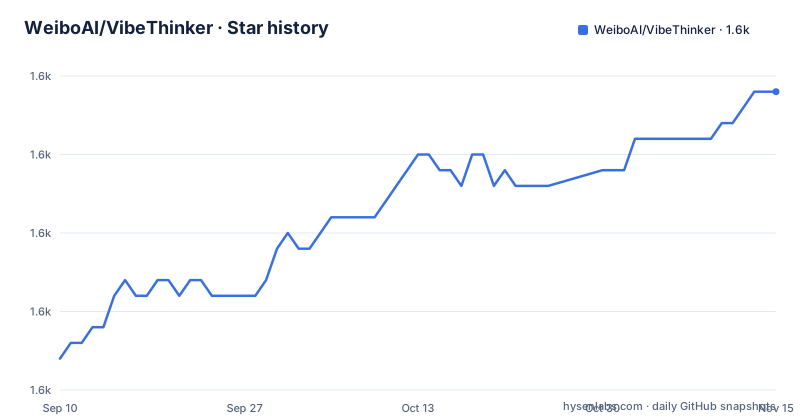
Star history
- WeiboAI/VibeThinker1,589 ★ · +17
| Repository | 2026-09-10 | 2026-11-15 |
|---|---|---|
| WeiboAI/VibeThinker | 1.6k | 1.6k |
17 Stars in the last 66 days, measured from the daily GitHub snapshot. Compare with other projects
Editorial analysis
The tree holds two PDFs, an eval directory and no code
There are eight top level entries in this repository: .gitignore, LICENSE, README.md, README_old.md, VibeThinker-1.5B.pdf, VibeThinker-3B.pdf, eval/ and figures/. No package manifest, no requirements file, no training script and no model class. The licence is MIT, which covers what is here.
What is here is therefore a model card plus its evidence. Both technical reports are committed as PDFs at the root, and the same two documents are linked on arXiv: 2606.16140 for the 3B model and 2511.06221 for the 1.5B model. The project also hosts a Hugging Face papers page for each. Weights are distributed through Hugging Face and ModelScope, both under the WeiboAI organisation, with matching paths for VibeThinker-3B and VibeThinker-1.5B.
There are no GitHub releases. Nothing here is versioned, tagged or packaged, so the only signal of movement is the commit history, where the last push is dated 14 August 2026. The project also keeps a README_old.md next to the current one, and a figures/ directory for the images used in the write-up.
The news entries give the release order. On 5 November 2025 the 1.5B model was announced as coming; on 11 November it was open sourced; on 19 November it reached first place on Hugging Face's trending models; on 16 June 2026 the 3B model was released; and on 12 August the Claim-Level Reliability paper behind the 3B report came out, with its code in a separate repository at WeiboAI/CLR. The repository shows 1579 stars, 117 forks and 16 open issues.
VibeThinker-3B is a post-trained Qwen2.5-Coder-3B
The 3B model is a three billion parameter dense reasoning model built on Qwen2.5-Coder-3B. Nothing about the architecture is novel; the work is in the post-training, described as an upgraded Spectrum-to-Signal pipeline made of four stages: curriculum based supervised fine-tuning, multi-domain reinforcement learning, offline self-distillation, and instruction oriented reinforcement learning.
The scope is deliberately narrow. The model is designed for tasks with reliable verification signals, and the named set is mathematical reasoning, competitive programming, STEM reasoning, and instruction following with explicit constraints. That constraint explains the choice of base model as much as the results do, since a code-tuned 3B base is being pointed at verifiable domains rather than at open ended chat.
The numbers given are 94.3 on AIME26, 89.3 on HMMT25, 80.2 Pass@1 on LiveCodeBench v6, and a 96.1 percent acceptance rate on recent unseen LeetCode weekly and biweekly contests from 25 April to 31 May 2026. The LeetCode figure is the interesting shape among them, because it is a pass rate on problems published after the training data was cut, which is the closest thing here to an out-of-distribution check.
The write-up claims this puts the model in the range of much larger frontier reasoning systems while being orders of magnitude smaller, and the framing is consistent across the page: small parameter count, high density of verified reasoning signal. Whether that framing survives depends on the evaluation setup in the report rather than on the summary, and the report is one of the PDFs in the tree.
CLR lifts AIME26 from 94.3 to 97.1 at test time
Claim-Level Reliability Assessment is a test-time scaling strategy for answer-verifiable reasoning, introduced in the 3B report. The gains are quoted as differences from the same base model rather than from a baseline: AIME26 goes from 94.3 to 97.1, HMMT25 from 89.3 to 95.4, and BruMO25 reaches 99.2. The name says what the method looks at. Instead of scoring a whole answer, it looks at claims inside it.
CLR is a separate artefact from the model. The news log records that the detailed paper on it was released on 12 August 2026, with the paper on arXiv as 2608.11994 and the code at github.com/WeiboAI/CLR, a different repository from this one. So the test-time component of the 3B recipe lives outside the weights release, and anyone reproducing the top-line numbers needs both pieces.
That split matters when reading the two sets of figures side by side. 94.3 on AIME26 is the model, 97.1 is the model with CLR applied, and the difference between those two columns is one paper and one repository that this project does not contain. The HMMT25 pair behaves the same way, moving 89.3 to 95.4, which is a larger jump than the AIME one.
BruMO25 is the only score quoted for that benchmark anywhere on the page, and it arrives already at 99.2, after scaling. With no unscaled counterpart given, there is no way to tell from this page how much of that number is the base model.
The 1.5B model is argued against DeepSeek R1 at 671 billion parameters
VibeThinker-1.5B is a 1.5 billion parameter dense model trained with the Spectrum-to-Signal Principle, and its headline claim is a size ratio: 100x to 600x smaller than models such as Kimi K2 at over 1000B parameters and DeepSeek R1 at 671B.
The specific comparison is against the initial DeepSeek R1, described as over 400 times larger, on three mathematical benchmarks. AIME24 is 80.3 against 79.8, AIME25 is 74.4 against 70.0, and HMMT25 is 50.4 against 41.7. The AIME24 margin is one tenth of a point, so the strength of that particular claim rests on the other two.
The 1.5B model is also placed against closed models, described as beating Magistral Medium and Claude Opus 4 while matching GPT OSS-20B Medium, and elsewhere as comparable to MiniMax-M1 and ahead of DeepSeek R1-0120 and GPT-OSS-20B-Medium on AIME24, AIME25 and HMMT25. Both framings appear on the same page, with slightly different named opponents, which is a reminder that these are selected comparisons rather than a leaderboard.
For scale, the same model is reported at 50.4 on HMMT25 while the 3B model is reported at 89.3 on that benchmark. Two releases from the same team, separated by 1.5B parameters of size and one year of release dates, differ by nearly 39 points there. Whatever the post-training gains, parameter count is clearly not the limiting factor in this project's own results.
A 7,800 dollar budget next to a claimed factor of 30 to 60
The cost claim is the most quotable line on the page. Post-training costs of 294K dollars for DeepSeek R1 and 535K dollars for MiniMax-M1 are set against 7,800 dollars for this approach, described as a reduction by a factor of 30 to 60.
The two figures do not quite bracket the range they are given. 294,000 divided by 7,800 is about 38, and 535,000 divided by 7,800 is about 69. The stated range of 30 to 60 excludes the second comparison, which is the larger of the two, and the low end of 30 matches neither. A range of roughly 38 to 69 would cover both quoted figures exactly.
This is a small arithmetic wobble in a claim that is otherwise the strongest economic argument on the page, and it is worth knowing about because the rest of the numbers here are also self-reported. The cost figure is per model, at 1.5B parameters, for post-training only. Nothing on the page states what that covers: not the base model, not the data synthesis, not evaluation, not the failed runs that a reinforcement learning stage at this scale would produce.
Read the claim as an order of magnitude rather than a multiple. Two orders of magnitude separate 7,800 from 294,000, and the point the project is making, that a small reasoning model can be trained for a few thousand dollars, survives the rounding. The precise factor does not, and the report linked at the root would be the place to check what was counted.
Evaluation is in eval/, and the last note stops mid-sentence
The one part of this repository you can run is the evaluation code, and it is scoped to the 1.5B model. If you want to reproduce the results in that technical report, the program and its usage guide are at ./eval/math/README.md and ./eval/code/README.md. Sample responses from some benchmarks sit in a linked Google Drive folder.
The final line of the page begins a limitation and does not finish it: it states that this code does not support LLM-based judgment of whether, and the sentence ends there. Read as written, the evaluation path described is the deterministic one, with no model acting as a judge. That is consistent with the rest of the project, since the whole premise is verification signals that can be checked mechanically, but the sentence that would have named what is judged instead of judged by a model is missing.
There is no equivalent instruction for the 3B model. The eval section is headed for VibeThinker-1.5B, and the tree gives no second set of evaluation guides, so anyone checking the 3B numbers on AIME26, HMMT25 or LiveCodeBench v6 is left with the report and the sample responses.
Note also what is absent from the run instructions. There is no command line in the page, no pinned dependency set and no environment recipe; the guides inside eval/ carry that. This is consistent with a repository whose purpose is distribution of weights and results rather than distribution of a tool.
The post-training method is described in the reports and absent here
The named methodology is the Spectrum-to-Signal Principle, and the 1.5B release introduces it in two named pieces. Two-Stage Diversity-Exploring Distillation runs in the supervised fine-tuning phase to generate a broad spectrum of solutions. MaxEnt-Guided Policy Optimization runs in the reinforcement learning phase to amplify the correct signal. The description of the mechanism is that output diversity comes first, then the right answers are amplified out of it.
The 3B release calls itself a systematic upgrade of the same principle. Its pipeline strengthens data synthesis, quality filtering and curriculum learning in SFT, extends MGPO style reinforcement learning to multiple verifiable domains, preserves complete long-context reasoning trajectories rather than trimming them, and consolidates through offline self-distillation and instruction oriented reinforcement learning.
None of that is in this tree. There is no SFT data pipeline, no reinforcement learning harness, no MGPO implementation and no distillation script, and the code for the test-time component points at another repository entirely. What you can inspect here is the description, the papers and the evaluation code.
That is a defensible split for a weights release, and it is worth being explicit about what it means for reuse. The methodology is reproducible in principle from the reports, not by pip install. The 3B base model, Qwen2.5-Coder-3B, is public, so the one part of the stack that is independently verifiable today is the starting point, not the result.
Editorial conclusion
VibeThinker is a weights release with a research write-up attached, and it suits two readers. The first is someone looking for a small reasoning model to run on their own hardware, where the 1.5B variant and the 3B variant have very different cost profiles and the ModelScope link matters where Hugging Face is hard to reach. The second is someone studying post-training recipes, in which case the two PDFs at the repository root are the real content. Three things to weigh first. This repository contains no training or inference code, so running the models means loading the weights through your own stack. There are no GitHub releases, so version tracking is by commit. And every comparison here is against models and figures the project chose, on benchmarks it selected, so read the technical reports for the evaluation setup before treating a number as settled.
Frequently asked questions
What is VibeThinker?
VibeThinker is a pair of dense reasoning models from WeiboAI. VibeThinker-1.5B is a 1.5 billion parameter model post-trained with the Spectrum-to-Signal Principle, and VibeThinker-3B is a 3 billion parameter model built on Qwen2.5-Coder-3B. Both are distributed as weights on Hugging Face and ModelScope under the MIT licence covering this repository.
What is VibeThinker-3B?
It is a 3 billion parameter dense reasoning model built on Qwen2.5-Coder-3B and post-trained with an upgraded Spectrum-to-Signal pipeline: curriculum based supervised fine-tuning, multi-domain reinforcement learning, offline self-distillation, and instruction oriented reinforcement learning. It targets tasks with reliable verification signals, such as mathematical reasoning, competitive programming and STEM reasoning.
How do I use VibeThinker?
Download the weights from Hugging Face or ModelScope, where both WeiboAI/VibeThinker-3B and WeiboAI/VibeThinker-1.5B are published. This repository ships no inference or training code, so loading them is your own stack's job. To reproduce the 1.5B results, the evaluation program and usage guide are in eval/math/README.md and eval/code/README.md.
Official sources
Add this badge to your README
If you maintain this project, the badge below links readers to this analysis and shows its maintenance status from the daily GitHub snapshot. Paste the markdown into your README; add ?metric=license or ?metric=stars to the image URL for a different field.

[](https://hysenlabs.com/projects/weiboai-vibethinker)Star history chart for your README
[](https://hysenlabs.com/projects/weiboai-vibethinker)Was this useful?