Blockchain Guide is fifteen chapter folders and a PDF, not a framework
Introduce technologies on blockchain and distributed ledger, from theory to practice with bitcoin, ethereum and hyperledger.
At a glance
- What is it?
- A Chinese-language open book on blockchain and distributed ledgers that runs from history and consensus through Bitcoin, Ethereum, and a long Fabric deployment and chaincode track. The practical reads are the four role based reading orders, the mdPress command for local reading, and two warnings about version drift and licensing.
- Who is it for?
- Read it if you want one Chinese-language path that carries a beginner from definitions to Fabric chaincode, and pick the track that matches your role rather than reading front to back. Do not expect a runnable library, since the Python in the repository is a set of checking scripts rather than a package, and do not reuse chapters in paid training content without checking the license first.
- Can I use it commercially?
- Not without permission. GitHub finds no licence file in the repository, and without a licence all rights are reserved by default: you may read the code but not reuse it. Check the README, or ask the authors, before using it.
- Is it still maintained?
- Yes. The repository last received commits 3 days ago.
- What is it written in?
- Mainly Python, according to GitHub's language statistics.
Answers come from the project's GitHub data, last synced on November 15, 2026, and from our analysis. They are not legal advice.
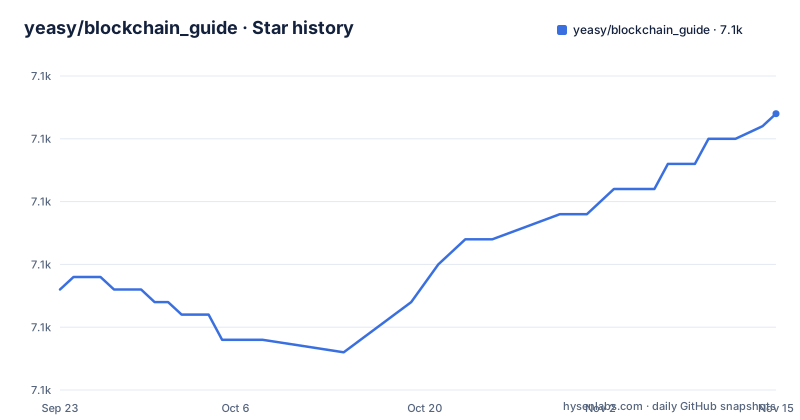
Star history
- yeasy/blockchain_guide7,092 ★ · +14
| Repository | 2026-09-23 | 2026-11-15 |
|---|---|---|
| yeasy/blockchain_guide | 7.1k | 7.1k |
14 Stars in the last 53 days, measured from the daily GitHub snapshot. Compare with other projects
Editorial analysis
The repository is fifteen chapter folders with checking scripts, not a package
The layout tells you what this is. Numbered directories run from 01_history/ through 15_frontiers/, with 08_hyperledger/, 09_fabric_deploy/, 10_fabric_op/, 11_app_dev/, and 13_fabric_design/ carrying the enterprise half, plus appendix/, _code/, and _images/ for supporting files. SUMMARY.md and book.json are the table of contents and book configuration, cover.jpg is the cover, and revision.md holds the revision record. The programming language is listed as Python because of two checking scripts at the top level, check_emphasis.py and check_project_rules.py, alongside a tests/ directory and a tools/ directory. There is no setup.py, no pyproject.toml, and no library to import. The consequence is straightforward: you read this repository, you do not install it, and a deployment that pulls it into a build gets text and two checking scripts rather than a blockchain stack.
Local reading means installing mdPress first, through Homebrew
There are two ways to read, and only one needs a command. Online, the whole book sits at https://yeasy.gitbook.io/blockchain_guide/, which is the project homepage and needs nothing installed. Local, the README asks you to install mdPress first, a separate project by the same author, and then serve the book:
brew tap yeasy/tap && brew install mdpress
mdpress serve
That two line sequence is the entire local setup: a tap, an install, and a serve command. The cost is the toolchain rather than the book. mdPress has to exist before you can preview anything, Homebrew has to be present, and if you are on Windows the README gives you no alternative path because none is documented. The other cost is that the served output reflects your checkout, so a stale local clone quietly shows stale chapters, while the hosted version is what most readers actually see.
The preview PDF is overwritten by mainline pushes and is not a release
Two download paths exist and they differ in a way that matters for citation. The supported one is the GitHub Releases page, linked from the README as the place to get the latest PDF, and the release feed shows v2.4.0 published on 2026-06-16 and v2.3.1 on 2026-05-18. The other is a direct link to blockchain_guide.pdf inside the preview-pdf release, described as a preview that updates automatically with the default branch, gets overwritten as the mainline updates, and does not represent a formal published version. The practical rule is that anyone reproducing a passage should record which release they took it from, because the preview file can change underneath them without a version bump.
Four reader tracks, and the consensus chapters only appear on one of them
The roadmap table assigns different chapter orders to different roles, which saves a lot of reading if you know which one you are. A technical beginner goes chapters 1 to 3 then chapter 6, ending with a grasp of the basic concepts, application scenarios, and the Bitcoin implementation. An Ethereum developer goes chapters 1 to 2, then 7, then 12, ending with smart contract work and the DeFi ecosystem. Someone building enterprise solutions goes chapters 1 to 2, then 8 to 11, then 13, ending with designing and deploying a Fabric solution and writing chaincode. An architect goes chapters 1 to 5, then 13 to 15, ending with designing highly available, high performance blockchain systems. Note the gap that creates: chapters 4 and 5, which cover consistency, consensus algorithms, and cryptographic security, sit only in the architect front load.
Fabric 2.x is what the print edition taught, 2.5 LTS and 3.x are what runs
The guide names Hyperledger Fabric as its running example, saying the author accumulated practical experience while developing the project and designing solutions for enterprises. The related print title, the second edition of 区块链原理、设计与应用, was written around Fabric 2.x and covered the core technologies plus the design, architecture, and application of enterprise distributed ledger solutions. The README then attaches a warning that matters more than the version number: as of 2026 the Fabric community maintains both the 2.5 LTS line and the 3.x line, and readers doing hands-on work should confirm the current version against the official documentation. So the permission model, channel, and endorsement chapters are still conceptually right while the commands underneath them are the part most in need of adjusting. Check your line before following a chaincode lab end to end.
The license permits sharing and adaptation but blocks commercial use
The README states that the book uses CC BY-NC-SA 4.0, and spells out the three conditions in plain terms: you may share and adapt the work freely, with attribution, for non-commercial purposes, and under the same license. Two details catch people out. The non-commercial clause is the sharp one, since adapting chapters into internal corporate training or a paid course is exactly the case it rules out, and a company reader should settle that before spending time on it. The second is that the license appears only in the README: there is no LICENSE file among the top level entries and the repository's license field is unset, so tooling that looks for a license file will find nothing. Attribution, non-commercial use, and share-alike are your obligations whenever you redistribute, and keeping the same license on derivatives is mandatory rather than optional.
Nothing in the guide is translated, and three of the four support groups are full
The text is Chinese, and the README, the chapter roadmap, and the reader table are all written in it, so an English speaker gets the repository structure and the topic list but no translated prose. The multi-language note attaches to the print second edition, not to this guide, and it invites readers to contact the author about it. Community support runs through Chinese channels: four QQ groups are listed, and three of the four, groups I, II, and III, are marked full, leaving group IV as the one accepting additions. Corrections go to a wiki errata table for the second edition, contributions go through contribute.md, and the contributor list is the standard repository graph. Related books in the same series cover Docker practice for containerized blockchain nodes, an AI security guide for cryptography and attack and defense topics, an agentic AI guide, and an AI beginner guide, all in Chinese as well.
Editorial conclusion
Read it if you want one Chinese-language path that carries a beginner from definitions to Fabric chaincode, and pick the track that matches your role rather than reading front to back. Do not expect a runnable library, since the Python in the repository is a set of checking scripts rather than a package, and do not reuse chapters in paid training content without checking the license first. Before following any Fabric lab, confirm your target release line against the official documentation, because the printed second edition was built around Fabric 2.x while the community maintains 2.5 LTS and 3.x.
Frequently asked questions
Is blockchain still relevant in 2026?
The repository itself is current: its last push is dated 2026-10-31 and it published v2.4.0 on 2026-06-16. It also warns readers to check official documentation, since the Fabric community maintained both the 2.5 LTS line and the 3.x line as of 2026 while the print edition was built around Fabric 2.x.
Is blockchain easy to learn?
The guide says the subject spans distributed systems, cryptography, game theory, and network protocols, which brings real challenge to both learning and practice. It is aimed at readers who already have some fintech background, while readers with no technical background can still learn about the current state of the technology.
How can I get started with blockchain as a beginner?
The five minute path runs chapters 1 and 2 for origins, definitions, evolution, and key challenges, then chapter 3 for application scenarios including failure cases, then chapters 4 and 5 for consistency, consensus, and cryptographic security. A technical beginner track finishes at chapter 6 on Bitcoin. Read online at the hosted URL or download the PDF from the releases page.
How does blockchain make you money?
The guide makes no income claim anywhere. What it says is that blockchain is a foundational innovation in fintech and that the technology is expected to have broad application prospects in finance, the internet of things, commercial trade, credit reporting, and asset management, with Fabric used as the worked example for enterprise solutions.
Official sources
Add this badge to your README
If you maintain this project, the badge below links readers to this analysis and shows its maintenance status from the daily GitHub snapshot. Paste the markdown into your README; add ?metric=license or ?metric=stars to the image URL for a different field.

[](https://hysenlabs.com/projects/yeasy-blockchain-guide)Star history chart for your README
[](https://hysenlabs.com/projects/yeasy-blockchain-guide)Was this useful?