LuxTTS: ZipVoice distilled to four steps, served from a model id string
A high-quality rapid TTS voice cloning model that reaches speeds of 150x realtime.
At a glance
- What is it?
- LuxTTS is a lightweight voice cloning TTS built on the ZipVoice architecture, distilled to four sampling steps and paired with a custom 48 kHz vocoder. It has no releases, pulls a dependency from a git URL, and still calls itself Zipvoice in its packaging metadata.
- Who is it for?
- LuxTTS suits people who need local voice cloning on a laptop or a single GPU and can accept a project whose weights live on a model hub rather than in a tagged release. Read it less favourably if you need float16 inference today, a stable package name, or a documented training path, because the packaging metadata still says Zipvoice and the training extra holds only einops.
- Can I use it commercially?
- Yes. Apache-2.0 is a permissive licence: you can use, modify and sell software built on it, as long as you keep its copyright and licence notices.
- Is it still maintained?
- Yes. The repository last received commits 170 days ago.
- What is it written in?
- Mainly Python, according to GitHub's language statistics.
Answers come from the project's GitHub data, last synced on November 22, 2026, and from our analysis. They are not legal advice.
Star history
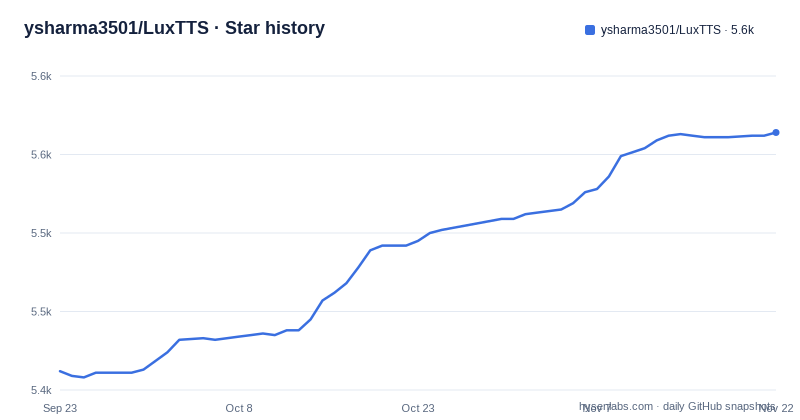
- ysharma3501/LuxTTS5,564 ★ · +152
| Repository | 2026-09-23 | 2026-11-22 |
|---|---|---|
| ysharma3501/LuxTTS | 5.4k | 5.6k |
152 Stars in the last 60 days, measured from the daily GitHub snapshot. Compare with other projects
Editorial analysis
The model is a string you pass in, not a release you download
There is nothing to download from the repository itself. LuxTTS publishes no releases, so the weights arrive by identifier: the constructor is handed the string 'YatharthS/LuxTTS' and fetches what it needs. That single string is the entire version pin available to you, which means a later upload on the model hub can change what your code produces without any change on your side.
Three routes are offered instead of a release tarball. Clone it and run it locally, open the Colab notebook linked at the top of the README, or use the hosted space. The code is Apache-2.0, the primary language is Python, and the last push to the master branch was 2026-06-05. The project describes itself as a lightweight zipvoice based text-to-speech model built for high quality voice cloning and generation at speeds exceeding 150x realtime.
pyproject.toml still calls the package Zipvoice
The packaging metadata has not caught up with the name. Inside pyproject.toml the project field reads Zipvoice at version 0.0.11, and the description line talks about Linacodec being a highly compressive and rapid audio tokenizer for audio models, which describes a dependency rather than this project. So the distribution name, the version string and the summary in the metadata all point somewhere other than LuxTTS.
The build configuration is the part that matters for cloning. The build system requires uv_build>=0.9.6,<0.10.0 with uv_build as the backend, and module-root is set to an empty string, which tells the backend that the zipvoice/ directory at the repository root is the module itself. Python 3.10 is the floor. Linting is handled by ruff with a line-length of 120, and the only optional dependency group is called train, which contains einops and nothing else.
requirements.txt pulls one dependency straight from a git URL
The install path runs through requirements.txt rather than through the package, and one line in that file is a git reference:
git clone https://github.com/ysharma3501/LuxTTS.git
cd LuxTTS
pip install -r requirements.txt
That file opens with a --find-links entry pointing at the icefall piper_phonemize page, then lists torch, torchaudio, numpy, lhotse, huggingface_hub, safetensors, tensorboard, vocos, pydub, onnxruntime, librosa and transformers<=4.57.6. The transformer ceiling and the setuptools<81 pin are both upper bounds rather than exact versions, so an unpinned resolver can land you on a newer library than the author tested against. Between onnxruntime and librosa sits git+https://github.com/ysharma3501/LinaCodec.git, which installs the tokenizer from source instead of an index.
The first encode_prompt call spends ten seconds in librosa
Model loading is three device paths, and only one of them is enabled by default:
from zipvoice.luxvoice import LuxTTS

# load model on GPU
lux_tts = LuxTTS('YatharthS/LuxTTS', device='cuda')

# load model on CPU
# lux_tts = LuxTTS('YatharthS/LuxTTS', device='cpu', threads=2)

# load model on MPS for macs
# lux_tts = LuxTTS('YatharthS/LuxTTS', device='mps')
Inference reads a reference clip, encodes it once, then generates. The reference path can be a wav or an mp3, and the encode step carries a comment worth heeding, because it says the call takes 10s to init because of librosa first time. That delay lands on the first call in a process rather than on every call:
import soundfile as sf
prompt_audio = 'audio_file.wav'
encoded_prompt = lux_tts.encode_prompt(prompt_audio, rms=0.01)
final_wav = lux_tts.generate_speech(text, encoded_prompt, num_steps=4)
final_wav = final_wav.numpy().squeeze()
sf.write('output.wav', final_wav, 48000)
The sample rate on the write call is 48000, which matches the 48 kHz claim rather than the 24 kHz that most TTS models stop at.
t_shift trades pronunciation against quality
The second inference example exists to show the knobs, and the comments on each line are the documentation:
rms = 0.01
t_shift = 0.9
num_steps = 4
speed = 1.0
return_smooth = False
The rms value normalizes loudness, where 0.01 or so is what gets recommended. t_shift is the interesting one: the comment says higher can sound better but worse WER, and the tips section repeats it from the other direction, saying to lower t_shift for less possible pronunciation errors but worse quality and vice versa. So a word error rate improvement is bought with fidelity. num_steps is set to 4 and marked 3-4 as best for efficiency, speed runs at 1.0 where lower is slower, and return_smooth sits at False.
The tips also give a floor for the reference audio, asking for at minimum a 3 second audio file for voice cloning, and a fix for an audible artefact: set return_smooth = True if you hear metallic sounds.
Same architecture as ZipVoice, distilled to four steps
The project answers the comparison question directly rather than leaving you to infer it. LuxTTS uses the same architecture as ZipVoice but distilled to 4 steps with an improved sampling technique, and it swaps in a custom 48khz vocoder instead of the default 24khz version. Both credits are named: ZipVoice from k2-fsa for the code and model, and Vocos from gemelo-ai for the vocoder.
The README states that the model reaches 150x realtime on a single GPU and faster than realtime on CPUs as well. The other claims sit next to that one: voice cloning described as on a par with models 10x larger, clear 48khz speech, and a footprint that fits within 1gb vram, which the text presents as meaning it can fit in any local gpu.
float16 is checked off later, not shipped now
The speed ceiling is set by precision, and the precision has not shipped. The README states that the model currently uses float32 and that float16 should be significantly faster, almost 2x, with the code for float16 inference still sitting unchecked on the roadmap beside an unreleased LuxTTS v1.5. Completed items on that same list are the model and code release, the hosted space demo, and MPS support credited to a contributor.
The conveniences around the model, including the Gradio interface and the ComfyUI nodes, live in other people's repositories rather than in this one. The community list points at a Gradio app, OptiSpeech as a clean UI, nodes for running the model inside ComfyUI, a demo hosted by FalAI, and an ONNX port. None of that is in this repository, whose top level holds .gitignore, LICENSE, README.md, pyproject.toml, requirements.txt and the zipvoice/ directory. Contact for the project goes to the maintainer's address, [email protected].
Editorial conclusion
LuxTTS suits people who need local voice cloning on a laptop or a single GPU and can accept a project whose weights live on a model hub rather than in a tagged release. Read it less favourably if you need float16 inference today, a stable package name, or a documented training path, because the packaging metadata still says Zipvoice and the training extra holds only einops. Before building on it, pin exact transformers and setuptools versions within the ceilings requirements.txt sets, and check whether the reference clip you plan to use clears the three second minimum.
Frequently asked questions
How do I install and run LuxTTS locally?
Clone the repository, enter the directory and install the requirements file with pip install -r requirements.txt. Then construct the model with LuxTTS('YatharthS/LuxTTS', device='cuda'), pass a reference clip of at least three seconds to encode_prompt, and call generate_speech with num_steps=4 before writing the result at 48000.
What is LuxTTS and how does it differ from ZipVoice?
LuxTTS is a lightweight text-to-speech model for voice cloning built on the ZipVoice architecture, distilled to 4 steps with an improved sampling technique. It uses a custom 48khz vocoder instead of the default 24khz version, and the README reports speeds exceeding 150x realtime on a single GPU.
Does LuxTTS have a release I can pin, and does it support float16?
The repository publishes no releases, so the model is fetched by the identifier string 'YatharthS/LuxTTS' passed to the constructor. Inference currently uses float32, and the code for float16 inference is still an open item on the roadmap, alongside an unreleased v1.5.
Which sampling parameters should I change first in LuxTTS?
The defaults are rms 0.01, t_shift 0.9, num_steps 4, speed 1.0 and return_smooth False. Raising t_shift can sound better but worsens the word error rate, so lower it for fewer pronunciation errors at the cost of quality, and set return_smooth to True if you hear metallic sounds in the output.
Official sources
Add this badge to your README
If you maintain this project, the badge below links readers to this analysis and shows its maintenance status from the daily GitHub snapshot. Paste the markdown into your README; add ?metric=license or ?metric=stars to the image URL for a different field.

[](https://hysenlabs.com/projects/ysharma3501-luxtts)Star history chart for your README
[](https://hysenlabs.com/projects/ysharma3501-luxtts)Was this useful?