Prompt-Engineering-Guide-zh-CN still ships the Nextra starter manifest
A comprehensive guide to prompt engineering: papers, lectures, notebooks and resources (automatically and continuously updated).
At a glance
- What is it?
- This repository is the Chinese-language guide to prompt engineering, translated from the dair-ai original. Its README is 95 words, its announcements date from 2022 and 2023, and its package manifest is still the unmodified Nextra template pointing at a third party's repository.
- Who is it for?
- Read this repository as reading material rather than as software. The content is a structured Chinese guide, split into eight chapters on prompts and four reference pages on papers, tools, datasets and further reading, and it is the fastest way to get the field's vocabulary in one place.
- Can I use it commercially?
- Check first. The repository uses a licence we do not classify automatically, so read its LICENSE file before any commercial use.
- Is it still maintained?
- Activity is slowing. The repository last received commits 6 months ago.
- What is it written in?
- Mainly MDX, according to GitHub's language statistics.
Answers come from the project's GitHub data, last synced on November 14, 2026, and from our analysis. They are not legal advice.
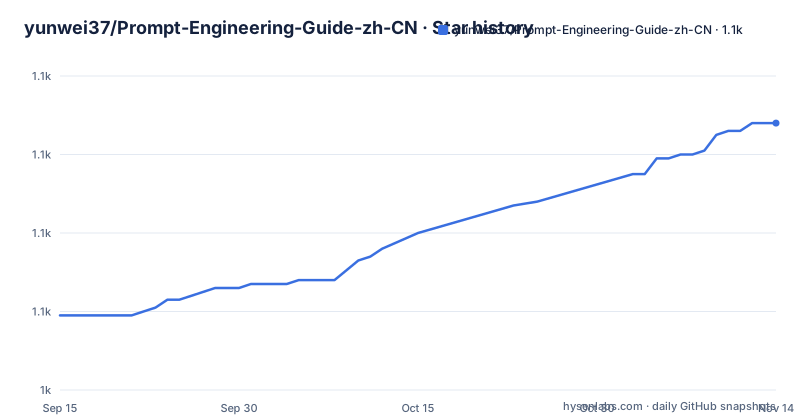
Star history
- yunwei37/Prompt-Engineering-Guide-zh-CN1,108 ★ · +49
| Repository | 2026-09-15 | 2026-11-14 |
|---|---|---|
| yunwei37/Prompt-Engineering-Guide-zh-CN | 1.1k | 1.1k |
49 Stars in the last 60 days, measured from the daily GitHub snapshot. Compare with other projects
Editorial analysis
The package manifest is still the Nextra starter template
The manifest at the root describes a different project from the one you cloned. It is named `nextra-docs-template`, carries the description "Nextra docs template", sits at version `0.0.1`, and lists the author as Shu Ding with a personal email address. Its repository field points at `git+https://github.com/shuding/nextra-docs-template.git`, and both the bugs and homepage fields point at that same repository.
The scripts are the template's three defaults: `next dev`, `next build` and `next start`. The dependencies are the template's too, with Next at 13, React and React DOM at 18, the Nextra packages, and Vercel analytics pinned at 0.1.11.
None of this breaks the site. Nextra reads the Markdown and MDX, not the manifest's name field. But it means every piece of project identity in the build metadata belongs to somebody else, and a reader who opens `package.json` to find out who maintains the guide will find the answer to a different question.
It is also the clearest single signal that this repository is a content contribution laid over an unmodified template rather than a maintained application.
Two lockfiles and two packages pinned to latest
The repository root carries both `package-lock.json` and `pnpm-lock.yaml`. One project, two lockfiles, and nothing in the README saying which package manager is intended.
That matters more here than it would in a normal application, because two of the dependencies are not version ranges at all. `nextra` and `nextra-theme-docs` are both set to `latest`, which resolves to whatever the registry serves at install time rather than to a pinned version. A site built from this manifest today and the same manifest in six months can differ in the framework that renders the documentation, with nothing in the repository to explain why.
The rest of the stack is more conventional but not pinned: Next at `^13.0.6`, React at `^18.2.0`, and TypeScript at `^4.9.3` with `@types/node` at an exact `18.11.10`. One exact pin among four ranged ones, in a project whose lockfiles already disagree.
For a fork, the first piece of work is choosing a package manager and deleting the other lockfile.
The announcements date from 2022 and 2023
The announcements block at the top of the README is a list of things that happened. A new web version of the guide went out at `promptingguide.ai`. A course on prompt engineering for LLMs launched with Sphere. A Hacker News first place is dated 2023-02-21. A lecture video is linked, and a series of composite guides is described as being created, with the link pointing at an anchor called `#guides` while the section heading in the document carries no matching id.
One entry has not been retired. A ChatGPT prompt engineering guide is listed as coming soon, while the guide list further down already includes a ChatGPT chapter at `guides/prompts-chatgpt.md`.
The citation instruction is dated the same way, asking for a BibTeX entry with the year 2022 and the author Elvis Saravia. The last push to main was on 2026-05-13, three years after the newest dated item in the announcements.
None of that makes the announcements wrong. It makes them a poor guide to the current state of the project, and the ChatGPT line is the concrete example: the roadmap entry outlived the thing it was promising.
The licence is reported three different ways
The repository metadata carries no recognised licence identifier. The package manifest declares MIT. And a `LICENSE.md` file sits at the root.
Three surfaces, three answers, and the one that would settle it is a file whose contents are not reproduced here. That is the honest position: the MIT string in the manifest is inherited from the Nextra template, so it describes the template rather than this translation, and it cannot be relied on for the guide's own text or images.
This matters more for a translation than for most repositories. The upstream guide is written by one group and this repository renders it in another language. A translator who assumes the template's MIT string covers their translation, and who has not read the `LICENSE.md` at the root, is making an assumption about someone else's copyright.
The root also carries `CITATION.cff`, which is the machine-readable citation format, sitting alongside a README that asks for a hand-written BibTeX entry instead. Two mechanisms for the same job, and the README's version predates the file.
Eight Markdown guides and four MDX reference pages
The content is split across two extensions and two directories, and the split is meaningful rather than accidental.
Under `guides/` sit eight Markdown files: an introduction, basic usage, advanced usage, applications, a ChatGPT chapter, adversarial prompting, reliability, and miscellaneous topics. Under `pages/` sit four MDX pages: papers, tools, datasets and additional readings.
So the prose is Markdown and the reference lists are MDX. That is the Nextra convention, where a page needs components and a guide does not, and it explains why the repository's recorded primary language is MDX even though eight of the twelve content files are plain Markdown.
The chapter order is a curriculum rather than a reference list. Introduction, then basics, then advanced usage, then applications, then three narrower topics. A reader who wants one thing, say reliability, can jump to it, but the ordering implies a reading order that the adversarial and reliability chapters depend on.
The other content directories are the lecture notebook, the lecture slides, `components/`, `public/` and `img/`.
The lecture, the citation and the homepage all point upstream
Three things in this repository resolve to the original English project rather than to local files.
The declared homepage is `https://github.com/dair-ai/Prompt-Engineering-Guide`. The lecture section links its notebook and its slides as absolute URLs on that same upstream repository, along with the video. And the BibTeX entry readers are asked to use names Elvis Saravia as the author and puts the upstream repository in the journal field.
For a translation that is the right default, and it keeps one set of lecture materials from drifting between languages. It does mean the three assets are not forkable from here, and that anyone reading the citation will cite the upstream guide rather than the translation.
The README also asks for pull requests if something is missing, and points at four channels for following along: the new web guide, a Discord server, a Twitter account and a newsletter.
Ninety-five words define the field, then the links start
The substantive prose is two paragraphs, and they are worth quoting in summary rather than in full.
Prompt engineering is described as a relatively new discipline for developing and optimising prompts so that language models can be used efficiently across applications and research topics. The stated purpose of the skill is to understand the capabilities and limits of large language models better. And it splits its audience: researchers use it to improve model performance on common and hard tasks such as question answering and arithmetic reasoning, while developers use it to design prompt techniques that interact with models and other tools.
That is the whole explanation. The next line says the guide was created because of the level of interest in LLMs, and that it collects recent papers, learning guides, lectures, references and tools.
Everything after that is navigation: twelve content links, six announcement links, four community links, three lecture links and one citation block. For a field that moves quickly, that is a reasonable landing page, and it is also why the repository is worth reading for structure rather than for depth.
Editorial conclusion
Read this repository as reading material rather than as software. The content is a structured Chinese guide, split into eight chapters on prompts and four reference pages on papers, tools, datasets and further reading, and it is the fastest way to get the field's vocabulary in one place. It is not a toolchain you can install, and the site around it is not configured for you. Before you rely on it, settle three things. Treat the announcements as history, since the Hacker News date is 2023-02-21, the citation asks for a 2022 year, and a ChatGPT guide is still listed as coming while the corresponding file already exists. Do not trust the package manifest, whose name, description, repository, author and issue tracker all still belong to the Nextra starter template. And settle the licence for yourself, because the repository reports none, the manifest says MIT, and a `LICENSE.md` file at the root is where the actual terms would be. The last push to main was on 2026-05-13.
Frequently asked questions
What does the Prompt-Engineering-Guide-zh-CN repository contain?
A Chinese-language prompt engineering guide: eight Markdown chapters under `guides/` covering introduction, basic and advanced usage, applications, ChatGPT, adversarial prompting, reliability and miscellaneous topics, plus four MDX reference pages under `pages/` for papers, tools, datasets and further reading. It also carries a lecture notebook, lecture slides, a Next.js and Nextra site under `components/`, and a `CITATION.cff`.
How do I cite this Chinese prompt engineering guide?
The README asks for a BibTeX entry keyed `Saravia_Prompt_Engineering_Guide_2022`, authored by Elvis Saravia, with the journal field set to the upstream `dair-ai/Prompt-Engineering-Guide` repository and the year 2022. A `CITATION.cff` file also sits at the repository root, so two citation mechanisms are in play.
How do I build the prompt engineering guide site?
The manifest carries three scripts and they are the Nextra template defaults: `next dev`, `next build` and `next start`. The root holds both `package-lock.json` and `pnpm-lock.yaml` with nothing stating which package manager is intended, and `nextra` and `nextra-theme-docs` are both set to `latest` rather than a range.
Is this the same as the dair-ai Prompt Engineering Guide?
It is the Chinese-language repository, and its declared homepage is the upstream `dair-ai/Prompt-Engineering-Guide`. The lecture notebook, the lecture slides and the video are all linked as absolute URLs on the upstream repository rather than as files in this one.
What does the README say prompt engineering is?
A relatively new discipline for developing and optimising prompts so language models can be used efficiently across applications and research. It says researchers use it to improve model performance on tasks such as question answering and arithmetic reasoning, and developers use it to design prompt techniques for interacting with models and other tools.
Official sources
Add this badge to your README
If you maintain this project, the badge below links readers to this analysis and shows its maintenance status from the daily GitHub snapshot. Paste the markdown into your README; add ?metric=license or ?metric=stars to the image URL for a different field.

[](https://hysenlabs.com/projects/yunwei37-prompt-engineering-guide-zh-cn)Star history chart for your README
[](https://hysenlabs.com/projects/yunwei37-prompt-engineering-guide-zh-cn)Was this useful?