Yuwen Publish Precheck counts its own rule base three ways
Pre-publish review for Douyin, Xiaohongshu and WeChat Channels: have AI check your post before you publish it, flagging which line crosses the line, which official rule it violates, and giving a ready-to-use fix. Calibrated against 38 real samples with 72 verifiable official rule citations, backed by a local rule base that gets more accurate the more you use it. Does not guarantee approval and does not teach how to evade review.
At a glance
- What is it?
- A Chinese-language Agent Skill that reviews Douyin, Xiaohongshu and WeChat Channels drafts against a local rule base before you post. It is explicit that no tool can promise approval, that it refuses to hand back circumvention tricks, and that its own summary line and its capability table do not agree on how many sources the rule base has.
- Who is it for?
- Use it as a second pair of eyes on wording, not as a clearance system, because the project itself defines a pass as no blocking problem found inside its own check and refuses to promise an approval outcome.
- Can I use it commercially?
- Yes. MIT is a permissive licence: you can use, modify and sell software built on it, as long as you keep its copyright and licence notices.
- Is it still maintained?
- Yes. The repository last received commits 48 days ago.
- What is it written in?
- Mainly Python, according to GitHub's language statistics.
Answers come from the project's GitHub data, last synced on November 25, 2026, and from our analysis. They are not legal advice.
Star history
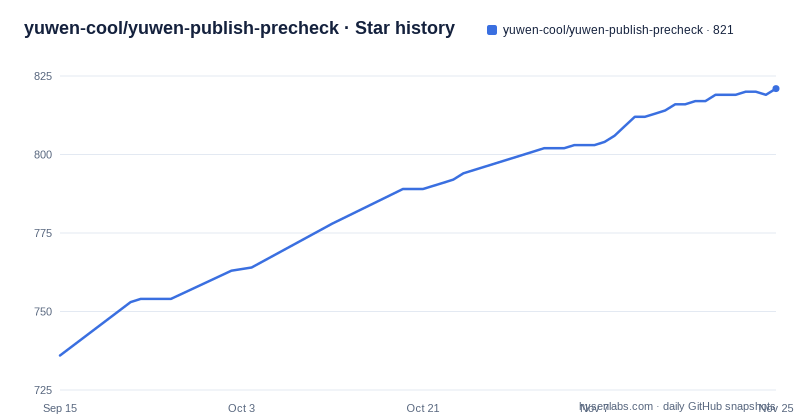
- yuwen-cool/yuwen-publish-precheck821 ★ · +85
| Repository | 2026-09-15 | 2026-11-25 |
|---|---|---|
| yuwen-cool/yuwen-publish-precheck | 736 | 821 |
85 Stars in the last 71 days, measured from the daily GitHub snapshot. Compare with other projects
Editorial analysis
The summary line and the capability table count the base differently
Two sets of numbers describe the same rule base and they do not match. The one-line summary attached to the repository speaks of 38 real samples used to calibrate the decision threshold and 72 verifiable quotations from official sources. The capability table further down speaks of 42 rules, all anchored to named sources, and of more than 80 quotations carrying links and verification dates. The sample count agrees at 38 in both places. The quotation count does not. The table also introduces a third category, 41 built-in detection modes gated by commercial attribute and industry, which the summary line does not mention at all. Rule identifiers appear exactly once in the visible page, inside the worked example, as M02 for a food efficacy claim, R01, R02 and R15 for absolute wording and unverifiable price claims, and R05 for off-platform traffic. So the numbering scheme that a rule base of this shape needs to expose is visible only through a single output sample.
Low false positives is calibrated on 38 approved scripts
The false positive claim rests on one number: an average of 0.8 word-surface candidates per article, measured across those 38 scripts that platforms actually let through. Personal experience figures are not blocked and general encouragement is not blocked, and only expressions that hit a violation anchor are. That is a defensible way to argue about precision, and it is also a narrow one, because 38 scripts from a single vertical, all of them the same oral delivery format, cannot tell you what the tool does on a medical claim or on a financial one. The repository root does contain an `evals/` directory, so the evaluation set may well be published there, but nothing in the visible page connects it to the 0.8 figure or names the scripts that produced it. Treat the number as a claim to check rather than a measurement to rely on.
Never uploaded describes this project, not the agent that answers you
The storage promise is specific and worth repeating accurately. Your profile, rule library, word lists, cases and records live as plain text in a `data/` directory on your own machine, readable and editable at any time, and the page states that drafts and personal data are not uploaded to any third party. Zero third-party dependencies and Python 3.10 or newer are the other two parts of that claim. What the promise covers is this project's own code path. The pipeline it draws has two stages, a word-surface pre-check that runs in seconds as a script, and then a semantic judgement the page attributes to an AI reading the surrounding context. A draft therefore reaches whatever model is answering you, because that model is what produces the second stage. If the distinction matters to you, it is the same distinction as any local tool that calls a hosted model.
Installation is an instruction to your agent, not a command
The primary install path is a sentence to paste into Cursor, Codex, Claude Code or any other tool that supports Agent Skills, and the sentence is a request to install a skill from a git URL. The manual alternative is one clone:
git clone https://github.com/yuwen-cool/yuwen-publish-precheck.git ~/.cursor/skills/yuwen-publish-precheckTwo things follow. The clone path is hardcoded to a Cursor skills directory while the sentence above it names four kinds of tool, so anyone on a different client has to work out their own path from the same command. And the install step itself asks an agent to fetch and act on a repository, which is a different trust decision from the local-runtime promise that follows it. The page also opens with an empty anchor to a workflow file rather than a rendered badge, so the continuous integration status it points at is not visible on the page. The repository does carry the files a serious project would keep: CONTRIBUTING, CHANGELOG, SECURITY, MAINTAINING, ROADMAP and THIRD_PARTY_NOTICES at the root.
The rewrite refuses to reskin the claim it flagged
The worked example is a weight-loss pitch for a fermented plum snack, and the review flags three mandatory changes. The two-week, eight-pound claim is a food making an efficacy statement bound to a definite result, rated M02 and marked extremely high risk. The page is unusually firm about the fix: rewording while keeping the claim would be a reskin, and the tool will not do that. What comes back drops the weight claim altogether and reframes the product as a snack for breaking an afternoon tea habit, keeps the opening hook and the sense of two weeks passing, replaces the lowest-price claim with a group-buy price plus a disclaimer that the offer follows the link page, and removes the WeChat handle in favour of an in-app link. Two details are worth keeping. The messaging app's name on its own is not a violation, the action of pasting a contact handle is, and the output attaches per-platform checklists afterwards.
Whitelists are scoped and self-censorship rumours are refused
The local library has five entry shapes, all reachable by one sentence to your agent: blacklist a term, whitelist one, store a phrase that passed as tested, import your own word list in bulk, and ask for a review of a post that lost reach. Whitelisting is the interesting one. Telling the tool that a term is normal in your fitness content silences the noise for that content, and the page states the commercial case is still judged normally, so a whitelist entry is scoped rather than global. Two guardrails sit on top. One debunks the widespread self-censorship advice that money words must be written as homophones and death words as letters, noting that official clarification already exists and that homophone variants draw separate attention. The other handles survivor bias: if you say a large account published the same thing unpunished, the tool explains it with rules first, records it only if the explanation holds, and otherwise points out that a risk someone else can absorb is not yours to copy.
Text only, three platforms, and a default branch named master
Scope is stated as a table with a roadmap beside it. Platforms today are Douyin, Xiaohongshu and WeChat Channels, with Kuaishou planned. Content is text: spoken scripts, articles, captions, subtitles and titles, with cover and on-screen checklists plus live commerce on the roadmap. Industries are general, medical and health, and financial planning, with education, maternity and beauty to be ordered by community feedback. So a creator whose risk lives in the thumbnail or the livestream gets nothing today. Two smaller facts are worth holding. There is no packaging file among the root entries, no pyproject and no requirements, which is consistent with the zero-dependency claim and with a project distributed as a skill rather than as a library. And the default branch is named master, not main, while the last push and the newest tag, v1.0.6 on 2026-09-16, carry the same date, so an upgrade through git pull lands on a branch whose name differs from the convention most tooling assumes.
Editorial conclusion
Use it as a second pair of eyes on wording, not as a clearance system, because the project itself defines a pass as no blocking problem found inside its own check and refuses to promise an approval outcome. Three things are worth verifying against the repository rather than the page: whether the 38 approved samples behind the false positive figure are published under `evals/`, whether the 42 rules and their verification dates line up with the summary line's 72 quotes, and where your drafts physically go when the semantic stage hands them to whatever model is answering. On that last point the local-storage promise covers this project's own files, not your agent's inference. For a creator publishing text scripts across three platforms, the two-layer design and the refusal to reskin a claim are the parts worth having; the platform coverage is three platforms and text only.
Frequently asked questions
What platforms does Yuwen Publish Precheck cover?
Douyin, Xiaohongshu and WeChat Channels are supported today, with Kuaishou listed as planned. Content coverage is text only: spoken delivery scripts, articles, captions, subtitles and titles. Cover and on-screen checklists plus a live commerce track are on the roadmap, not implemented.
How many rules are in Yuwen Publish Precheck, and where do they come from?
The capability table gives 42 rules anchored to named sources including the advertising law, cyberspace and health authority documents, platform rule centres and community conventions, with more than 80 quotations carrying links and verification dates. The repository summary line instead says 72 official quotations, so the two counts on the page do not match. Sources are shipped separately and are not relicensed.
Does Yuwen Publish Precheck send my drafts to a third party?
The page states the project uploads neither drafts nor personal data, keeps everything as plain text in a local data directory, and has zero third-party dependencies with Python 3.10 or newer required. The judgement stage itself is attributed to an AI reading context, so a draft still reaches whichever model is answering your request.
Will Yuwen Publish Precheck guarantee a post passes review?
No, and the page says so directly. It does not promise approval, because the final decision rests on platform factors that are not visible to any outside tool. A pass is defined as no blocking problem found inside the scope of the check, and the tool states it will not provide homophone, character splitting or occlusion tricks for evading review.
Does upgrading Yuwen Publish Precheck erase my own rule library?
The upgrade path is a git pull in the skill directory with three protections: personal data is not tracked by Git, templates and data are separated so an upgrade only refreshes the shipped templates, and a conflict aborts the update with a prompt rather than overwriting silently.
Official sources
Add this badge to your README
If you maintain this project, the badge below links readers to this analysis and shows its maintenance status from the daily GitHub snapshot. Paste the markdown into your README; add ?metric=license or ?metric=stars to the image URL for a different field.

[](https://hysenlabs.com/projects/yuwen-cool-yuwen-publish-precheck)Star history chart for your README
[](https://hysenlabs.com/projects/yuwen-cool-yuwen-publish-precheck)Was this useful?