unet: thirty training images, five epochs, and no weights file in the repository
unet for image segmentation
At a glance
- What is it?
- zhixuhao/unet is a small Keras implementation of the U-Net segmentation architecture, trained on the ISBI membrane dataset. It reports about 0.97 accuracy after five epochs, ships no trained weights and no dependency file, and its README ends with copy-pasted text about Keras.
- Who is it for?
- This repository is worth reading if you want a U-Net written in the Keras functional API with the data preparation steps next to it, because the two notebooks and the two scripts show how the pipeline was assembled, and the ISBI membrane dataset is already downloaded and pre-processed under `data/membrane`. It is not a drop-in segmentation package.
- Can I use it commercially?
- Yes. MIT is a permissive licence: you can use, modify and sell software built on it, as long as you keep its copyright and licence notices.
- Is it still maintained?
- Activity is slowing. The repository last received commits 7 months ago.
- What is it written in?
- Mainly Jupyter Notebook, according to GitHub's language statistics.
Answers come from the project's GitHub data, last synced on November 15, 2026, and from our analysis. They are not legal advice.
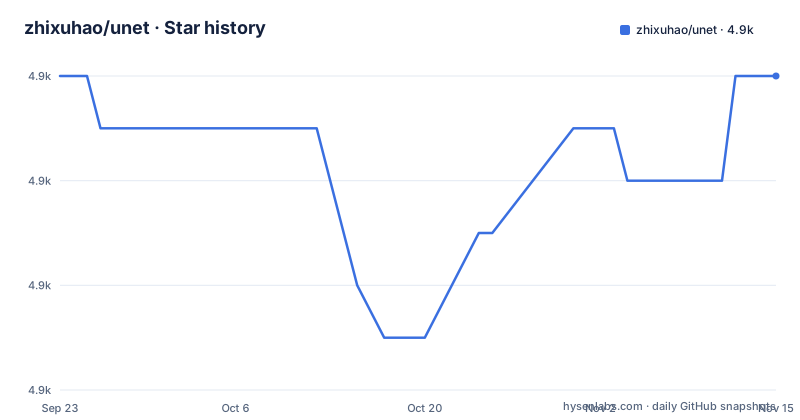
Star history
- zhixuhao/unet4,942 ★ · +0
| Repository | 2026-09-23 | 2026-11-15 |
|---|---|---|
| zhixuhao/unet | 4.9k | 4.9k |
0 Stars in the last 53 days, measured from the daily GitHub snapshot. Compare with other projects
Editorial analysis
Two scripts and two notebooks, with a Keras floor and no ceiling
The repository is small enough to read in one sitting, and its shape tells you what kind of project this is. The root holds `LICENSE`, `README.md`, `data.py`, `main.py` and `model.py` as scripts, `dataPrepare.ipynb` and `trainUnet.ipynb` as notebooks, a `data/` directory and an `img/` directory. GitHub reports the primary language as Jupyter Notebook, which is accurate about where the learning happens: the training itself lives in `trainUnet.ipynb` and the data preparation in `dataPrepare.ipynb`. Two entry points are offered, running `main.py` or following the notebook, and the README says running `main.py` puts the predicted results of test images in `data/membrane/test`. Dependencies are named as two lines, Tensorflow and Keras 1.0 or later, with no upper bound on the Keras version, and the code is described as compatible with Python 2.7 to 3.5. A floor with no ceiling is the first thing to check before running anything.
Thirty images are not enough, so augmentation carries the training set
The data section is blunt about the scale of the problem. The training data contains 30 images of 512 by 512, and the README calls that far from enough to feed a deep learning network. The answer is a module rather than more data: `ImageDataGenerator` from `keras.preprocessing.image`, used for augmentation. That module path is the concrete integration point with the Keras version you install, because the location of the augmentation API has moved across Keras releases, and a bare `Keras >= 1.0` requirement says nothing about which one you get. Two files carry the detail, `dataPrepare.ipynb` for the notebook version and `data.py` for the script version, which is a reasonable pairing for a repository whose purpose is to show the work rather than to hide it. The original data comes from the ISBI challenge, downloaded and pre-processed by the author, and it sits in `data/membrane`. What that pre-processing does is not described in the file.
One 512 by 512 mask, sigmoid output, five epochs
The model section is where the architecture question gets answered, and the answer is about the output rather than the layers. The network is written with the Keras functional API, which the README credits for making it easy to experiment with different architectures, and its output is a single 512 by 512 map that represents the mask to be learned. A sigmoid activation on that output is what keeps every mask pixel inside the 0 to 1 range, which is the behaviour a binary mask needs and also the reason the loss can be a plain binary crossentropy. Training is five epochs. After those five epochs the README reports a calculated accuracy of about 0.97 and describes the result as satisfactory. Those are the project's own figures for its own dataset, with no test protocol, no baseline and no per-image breakdown, so read them as a report of one run rather than as a property of the architecture.
The last third of the README is about Keras, not about this code
The About Keras section is not about the implementation. It describes Keras as a minimalist, highly modular neural networks library written in Python, capable of running on top of either TensorFlow or Theano, developed for fast experimentation, with the documentation link at keras.io. Four bullets follow, about easy prototyping, support for convolutional and recurrent networks and combinations, arbitrary connectivity schemes including multi-input and multi-output training, and running on CPU and GPU. Then the compatibility line repeats Python 2.7 to 3.5. None of it is specific to this repository, and one line is arguably misleading for anyone installing today: Theano is named as a possible backend while the dependency list names only Tensorflow. For a project whose own numbers are one accuracy figure and one training run, the vendor description is doing more work in the file than the results.
No weights file and no requirements file in the root
Here is the practical gap. The root listing is `LICENSE`, `README.md`, `data.py`, `data/`, `dataPrepare.ipynb`, `img/`, `main.py`, `model.py` and `trainUnet.ipynb`. There is no requirements file, no environment file, no pinned versions beyond the Keras floor, and no checkpoint of any kind, no weights file and no model directory. Yet the README's results section starts from the premise that there is a trained model to use, telling you to use the trained model to do segmentation on test images. So a fresh clone gives you data and code and nothing else: you install TensorFlow and a Keras version yourself, you either run `main.py` or follow the `trainUnet` notebook to train a model. For a repository whose dataset is committed, that asymmetry is worth knowing before you plan an hour around it.
The dataset ships with the repository, the pre-processing does not ship with it
The data is the most generous thing here. The original dataset is from the ISBI challenge, the author downloaded it and did the pre-processing, and the result is committed under `data/membrane`, including the `test` subdirectory the inference step reads from. That removes the two steps that usually block a first run of a segmentation tutorial, which is finding the data and writing the loader. The gap is that the pre-processing is not written down. The README says the data was pre-processed but not how; the `dataPrepare.ipynb` and `data.py` files it points to are named under data augmentation. Two practical consequences follow. Anyone wanting to reproduce the exact split has to read the notebook rather than follow the prose, and anyone who wants their own images in this pipeline has to reverse engineer the same steps. The augmentation from `ImageDataGenerator` is the only part of the pipeline the README describes in words.
Last push 2026-03-27, no releases, and one sentence of results
Two things to record before drawing conclusions from the accuracy figure. The repository's last push was on 2026-03-27, and there are no GitHub releases, so there is no version to install and no history of what changed between attempts; the branch is the whole artefact. The licence is MIT with a LICENSE file at the root, which is the cleanest thing in the listing. The other is the results section itself, which is one sentence: use the trained model on test images, the result is satisfactory, spelled statisfactory in the file. There is no loss curve, no comparison with another architecture and no statement of what the model does on the harder cases, for a membrane dataset where the boundary is the hard part. The architecture itself is credited to the original paper, U-Net: Convolutional Networks for Biomedical Image Segmentation, which is the right thing to read next if you want the design rather than the demo.
Editorial conclusion
This repository is worth reading if you want a U-Net written in the Keras functional API with the data preparation steps next to it, because the two notebooks and the two scripts show how the pipeline was assembled, and the ISBI membrane dataset is already downloaded and pre-processed under `data/membrane`. It is not a drop-in segmentation package. There is no trained model in the tree, no requirements file and no version pinning above a Keras floor of 1.0, so you supply TensorFlow, you supply any weights, and you retrain if you want a checkpoint. Read the numbers as the project's own report rather than a benchmark: five epochs, binary crossentropy, accuracy about 0.97, with no per-image results, no comparison and no metrics beyond that one figure. And check the maintenance state yourself, since the last push was on 2026-03-27 and there are no releases at all. MIT licensed, one LICENSE file, and a README whose final section is about Keras rather than about this code.
Frequently asked questions
What exactly is U-Net, in the context of this repository?
This repository is a Keras implementation of the U-Net architecture, and it names its inspiration, U-Net: Convolutional Networks for Biomedical Image Segmentation. It does not restate the architecture's structure, only that the model is built with the Keras functional API and outputs one 512 by 512 mask with a sigmoid activation.
What data does zhixuhao/unet use?
The original dataset from the ISBI challenge, downloaded and pre-processed by the author and stored under `data/membrane`, with test images in `data/membrane/test`. Training uses 30 images of 512 by 512, which the README calls far from enough, so augmentation is done with ImageDataGenerator from `keras.preprocessing.image`.
How is zhixuhao/unet trained and what does it report?
The model is trained for five epochs with a binary crossentropy loss, and the README reports a calculated accuracy of about 0.97 after those epochs. The output is a 512 by 512 mask with sigmoid activation so that pixels fall in the 0 to 1 range.
How do I run zhixuhao/unet?
Run `main.py`, or follow the `trainUnet` notebook, and the predicted result for a test image appears in `data/membrane/test`. The listed dependencies are Tensorflow and Keras 1.0 or later, and the README says the code should be compatible with Python 2.7 to 3.5.
Does zhixuhao/unet ship trained weights or a dependency file?
Neither. The root holds `LICENSE`, `README.md`, `data.py`, `data/`, `dataPrepare.ipynb`, `img/`, `main.py`, `model.py` and `trainUnet.ipynb`, with no weights file and no requirements file, so the libraries and any trained model have to be supplied from outside the repository.
Official sources
Add this badge to your README
If you maintain this project, the badge below links readers to this analysis and shows its maintenance status from the daily GitHub snapshot. Paste the markdown into your README; add ?metric=license or ?metric=stars to the image URL for a different field.

[](https://hysenlabs.com/projects/zhixuhao-unet)Star history chart for your README
[](https://hysenlabs.com/projects/zhixuhao-unet)Was this useful?