obsidian-excalidraw-plugin answers the audit reports with a function you can run
A plugin to edit and view Excalidraw drawings in Obsidian
At a glance
- What is it?
- An AGPL-3.0 Obsidian plugin that stores and edits Excalidraw drawings inside a vault, and whose readme spends a long section explaining why the findings published by plugin scanners do not apply to a local-first application. The disclosure includes the way to list every URL in the codebase from the developer console.
- Who is it for?
- This plugin fits an Obsidian user who wants drawings stored as files in the vault rather than in a separate app, and who wants to verify the privacy claims rather than take them on trust, because the plugin ships the means to enumerate its own URLs. It does not fit anyone needing an enterprise support commitment, and the author is direct that there is none.
- Can I use it commercially?
- Yes, with strict conditions. AGPL-3.0 is a network copyleft licence: if people use a modified version over a network, for example as a hosted service, you must offer them its source code under the same licence.
- Is it still maintained?
- Yes. The repository received new commits within the last day.
- What is it written in?
- Mainly TypeScript, according to GitHub's language statistics.
Answers come from the project's GitHub data, last synced on November 15, 2026, and from our analysis. They are not legal advice.
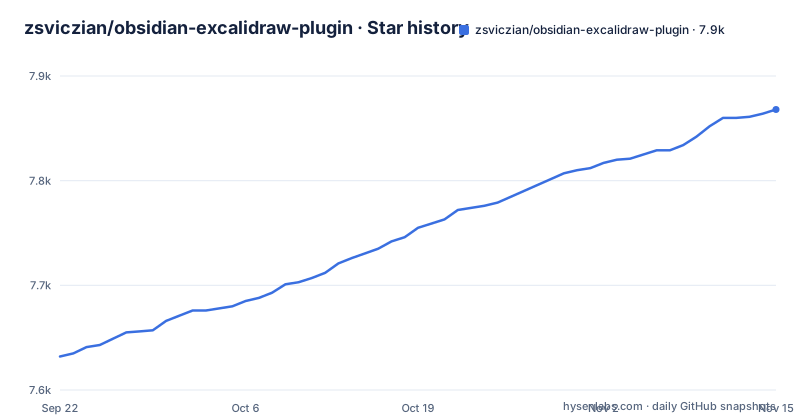
Star history
- zsviczian/obsidian-excalidraw-plugin7,868 ★ · +236
| Repository | 2026-09-22 | 2026-11-15 |
|---|---|---|
| zsviczian/obsidian-excalidraw-plugin | 7.6k | 7.9k |
236 Stars in the last 54 days, measured from the daily GitHub snapshot. Compare with other projects
Editorial analysis
The disclosure starts from scanner findings, not from features
The readme's longest section is a response to security audits, and the argument it makes is structural. Obsidian is fundamentally a locally executed web application, and automated code scanners apply the same vulnerability rules used for public-facing websites, even though the risk model inside a local vault is very different. Manipulation of innerHTML or outerHTML is the example given: it matters on a public site because visitors may be shown malicious third-party content, which is not the threat in a local-first application.
The author also states that findings published on plugin audit sites can be misleading without proper context, and that the plugin is large and feature-rich with many integrations and performance optimisations, so the scanner output needs to be read against actual use.
The first structural reason offered is a platform gap. Obsidian does not provide plugin developers with proper mechanisms for deploying local assets such as fonts or auxiliary packages, nor official APIs for features like Obsidian Publish or PDF generation. The consequence is that workarounds such as IPC calls or dynamic code execution appear in plugin code by necessity rather than by choice.
You can print every URL in the codebase yourself
The most useful line in the whole disclosure is a method rather than a promise. To see the complete list of URLs referenced in the code, whether as links, as images or in API calls, you open the Obsidian developer console with CTRL+SHIFT+i or CMD+OPT+i and run ExcalidrawAutomate.printURLsInCodebase().
That converts a claim into something you verify against your own vault in a minute. It is also a much better answer to a security question than an assurance, because the enumeration is performed by the plugin itself and reflects the build you actually installed.
The stated default is that the plugin works fully offline and locally. Network access then attaches to specific opt-in features, which are listed one by one rather than as a blanket warning.
Every network call belongs to a feature you can decline
The list of external contacts is short and each entry names the condition that triggers it. AI providers are contacted only if you configure API keys for AI features and explicitly use those features. The Taskbone OCR service needs a separate API key and explicit opt-in in the plugin settings. Iframely is optionally used to resolve reader-friendly titles when you drag a website link into a drawing, and that feature is disabled by default. The Ko-fi support button, when enabled, downloads its image from cdn.ko-fi.com.
Two more are worth separating. The Excalidraw Script Library reaches GitHub to download scripts, but only when you explicitly choose to install them. And requestUrl is used to retrieve images from external sources so you can embed them, which is a feature working as intended rather than telemetry.
So the pattern is consistent: a URL exists in the code only because a documented, disableable feature needs it.
The CJK font package is over 12 MB, so it is not bundled
One line in the disclosure is a packaging decision rather than a privacy one. The CJK font package exceeds 12 MB in size, and to avoid significantly increasing plugin startup time and bundle size those fonts are downloaded from GitHub only when required.
That is the honest engineering trade for a plugin, and it has a side effect worth understanding: a first launch on a machine that needs CJK fonts makes a network request. If you are auditing for offline behaviour, that request is expected and appears in the URL list.
The rest of the vault access is equally mundane and equally necessary. The plugin reads files in your vault to detect legacy .excalidraw files and support conversion workflows, to search for and load custom fonts stored inside the vault, and to populate file picker dialogs such as Insert any file. Clipboard access exists to copy and paste scenes between Obsidian and excalidraw.com, and to copy links to scene elements into markdown documents as embeds.
Local storage holds caches, chat history and backups
Three things are persisted in local storage, and each has a stated purpose. Image caches are stored locally to improve loading performance for large and complex scenes, which is the kind of thing that would be unusable if it were not. Mermaid text-to-diagram chat history is stored locally. And backup versions of drawings are stored locally to support crash recovery.
That last one is the most consequential: the plugin keeps previous versions of your drawings so a crash does not cost you the file.
Together with the disclosure's general statement that the plugin is 100% local apart from the listed exceptions, the local storage section is where a reviewer should look first, since it determines what leaves your machine if you copy a vault elsewhere and what you would lose if you uninstall.
Two manifests and a committed zip
The repository carries manifest.json and manifest-beta.json side by side, which is how a plugin ships a beta channel without disturbing the stable one in Obsidian's plugin directory. The release history is frequent: 2.28.1 on 29 September 2026, 2.29.0 on 12 October and 2.29.1 on 1 November.
Two other root entries are unusual enough to explain. obsidian-excalidraw.zip sits in the tree, and versions.json exists alongside it, which suggests the shipped archive and the version metadata are tracked in the repository rather than produced only in a release pipeline. There is also a release-process.md, plus RefactorPlan.md and ScriptSupportPlan.md at the root, which are working documents kept alongside the code rather than in an issue tracker.
eslint runs with zero warnings allowed, and madge checks for cycles
The scripts show how much checking surrounds the build. test:contracts runs node --test over scripts/testing/hostContracts.test.mjs, and there are test:fast, test:regression, test:fixtures, test:features and test:acceptance scripts plus verify:obsidian profiles for smoke, regression, full, devices and soak runs. The repository root also carries eslint.config.mts.
The build itself is rollup driven by rollup.config.mjs, with the dev and build scripts setting development or production through cross-env NODE_ENV. The root also has esbuild.config.json and three tsconfig files: tsconfig.json, tsconfig.dev.json and tsconfig-lib.json.
Editorial conclusion
This plugin fits an Obsidian user who wants drawings stored as files in the vault rather than in a separate app, and who wants to verify the privacy claims rather than take them on trust, because the plugin ships the means to enumerate its own URLs. It does not fit anyone needing an enterprise support commitment, and the author is direct that there is none. Before adopting, check the AGPL-3.0 terms against your plans, read the disclosure list rather than a scanner summary, and remember that the beta manifest is a separate channel.
Frequently asked questions
Can I use Excalidraw inside Obsidian?
Yes, through this plugin. It integrates Excalidraw into Obsidian so you can store and edit Excalidraw files in your vault, embed drawings into documents, and link to documents and other drawings to and from Excalidraw.
Is there a drawing plugin for Obsidian other than this one?
The readme does not compare other plugins. Its own scope covers storing and editing drawings in the vault, embedding them in documents, bidirectional linking, a script library, and features such as Mermaid text-to-diagram chat, with a community wiki and a NotebookLM workbook as the documentation.
Does the Obsidian Excalidraw plugin send my data anywhere?
By default no. The plugin is described as 100% local and running without network access apart from a few technical exceptions. AI providers are contacted only when you configure keys and use those features, the Taskbone OCR service needs its own key and opt-in, Iframely title resolution is disabled by default, and the CJK font package over 12 MB is fetched from GitHub only when required.
How can I check which URLs the Obsidian Excalidraw plugin references?
Open the Obsidian developer console with CTRL+SHIFT+i or CMD+OPT+i and run ExcalidrawAutomate.printURLsInCodebase(). The readme states that this prints the complete list of URLs referenced in the code, whether as links, images or API calls.
Official sources
Add this badge to your README
If you maintain this project, the badge below links readers to this analysis and shows its maintenance status from the daily GitHub snapshot. Paste the markdown into your README; add ?metric=license or ?metric=stars to the image URL for a different field.

[](https://hysenlabs.com/projects/zsviczian-obsidian-excalidraw-plugin)Star history chart for your README
[](https://hysenlabs.com/projects/zsviczian-obsidian-excalidraw-plugin)Was this useful?