1c7/Crash-Course-Computer-Science-Chinese: a Chinese subtitle archive for the 40-episode Crash Course CS series
Chinese translation of Crash Course Computer Science (40 episodes, 10 minutes each, 5.09 million views), completed in 2018, with many positive comments.
At a glance
- What is it?
- The repository is not software. It is a translation project: 40 Chinese-subtitled episodes of Crash Course Computer Science, plus Chinese and English subtitle text files, with the polished cut hosted on Bilibili. Useful if you want to learn or teach introductory CS in Chinese; useless if you wanted a program to install.
- Who is it for?
- Adopt this if you want a free Chinese-language introduction to computer science and are willing to watch on Bilibili, or if you want the subtitle text files as a reference for terminology. Do not adopt it if you need a maintained application, an actively updated translation, or a downloadable video archive, because the repository holds only a README and a content directory.
- Can I use it commercially?
- Not without permission. GitHub finds no licence file in the repository, and without a licence all rights are reserved by default: you may read the code but not reuse it. Check the README, or ask the authors, before using it.
- Is it still maintained?
- Yes. The repository last received commits 79 days ago.
- What is it written in?
- Mainly JavaScript, according to GitHub's language statistics.
Answers come from the project's GitHub data, last synced on November 15, 2026, and from our analysis. They are not legal advice.
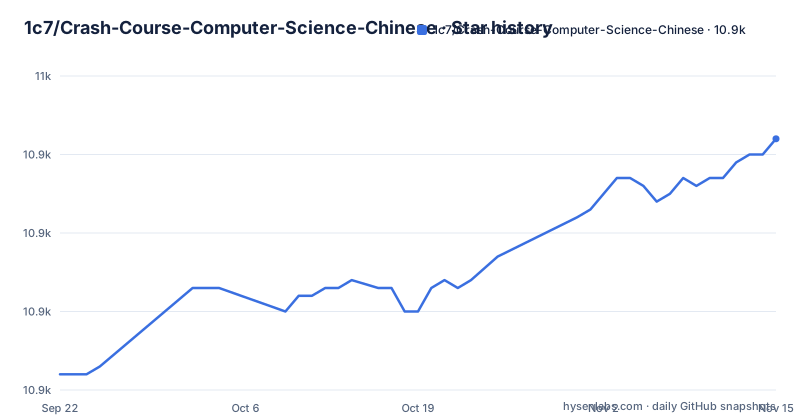
Star history
- 1c7/Crash-Course-Computer-Science-Chinese10,942 ★ · +30
| Repository | 2026-09-22 | 2026-11-15 |
|---|---|---|
| 1c7/Crash-Course-Computer-Science-Chinese | 10.9k | 10.9k |
30 Stars in the last 54 days, measured from the daily GitHub snapshot. Compare with other projects
Editorial analysis
What 1c7/Crash-Course-Computer-Science-Chinese actually is
This repository is a translation deliverable, not a codebase. The README says the project covers all 40 episodes of Crash Course Computer Science, each about 10 minutes long, translated into Chinese between 2017 and 2018. The first episode of the Chinese version was published on 2017-02-27, all 40 translations were finished on 2018-03-24, and the polished version was completed on 2018-05-01.
The audience is Chinese-speaking learners who want an introductory survey of computing, and the people who teach them. The README lists the topics covered across the series: early computing, electronic computing, boolean logic and logic gates, binary, the ALU, registers and RAM, the CPU, instructions and programs, advanced CPU designs, the history of programming, programming languages, statements and functions, algorithms, data structures, Alan Turing, software engineering, integrated circuits and Moore's Law, operating systems, memory and storage, file systems, compression, command line interfaces, screens and 2D graphics, the Cold War and consumerism, the personal computer revolution, graphical user interfaces, 3D graphics, computer networks, the internet, the World Wide Web, cybersecurity, hackers and cyber attacks, cryptography, machine learning and AI, computer vision, natural language processing, robots, the psychology of computing, educational technology, and the final episode on the singularity and the future of computing.
The repository is written in JavaScript according to its primary language field, but the top-level entries are .gitignore, README.md and content/. Nothing in the README describes runnable code, and no releases are listed. Treat the language field as an artifact of tooling rather than a signal that there is a program here.
The subtitle files are the real artifact
The README states that subtitles for all 40 episodes, in both Chinese and English, are included. They come in two forms: one file containing the subtitle text for all 40 episodes, and a directory holding one file per episode, 40 files in total.
That structure matters more than it first appears. A single concatenated file is convenient for searching terminology across the whole series, for example if you want to check how a translator rendered a term in an early episode against a later one. The per-episode directory is the better fit if you want to align a specific subtitle file with a specific video, or if you are building study material episode by episode. The single-file version is a .txt text file, so check by opening the files whether they drop directly into a video player.
The README also points to three study notes produced by viewers, hosted on Shimo and ProcessOn. Those are external links, not files in the repository, and they are the work of named Bilibili users, not of the translation team. If a link rots, nothing in this repository replaces it.
How the translation was produced and what that means for quality
The README credits ten translators by name, with links to their GitHub, Weibo or Bilibili accounts, and names 糖醋陈皮 as the person responsible for the polished version. The workflow is visible in the dates: episodes were translated and published one at a time starting in February 2017, the full set was translated by March 2018, and a separate polishing pass finished on 2018-05-01.
This two-pass structure is the most useful quality signal in the repository. The README explicitly says the first version is not recommended for viewing and that viewers should watch the polished version instead. It keeps the first-version directory for two stated reasons: to let people scan the topic list quickly, and to let them revisit the older version if they need to. That is an honest arrangement, and it also means the repository contains two generations of translation with different quality, under episode titles that are similar enough to be confused. If you link to an episode, link to the polished one.
The episode-by-episode summaries in the README, which list timestamps and the people and machines mentioned in each episode, are the closest thing to a terminology index.
Watching it: the Bilibili route and the older per-episode uploads
There is nothing to install. The README gives the polished version as a single Bilibili link, av21376839, and that is the entry point the project recommends. The older first-version translations are listed as 40 separate Bilibili links, one per episode, each with its own av number and its Chinese and English title.
If you are setting this up for a class or a study group, the practical sequence is: open the polished Bilibili page first, confirm the episode you need is there, and only fall back to the per-episode links if you specifically want the earlier cut. The README's own wording is that the polished version is better quality and that the first-version directory is kept for scanning and for reference.
The original English series is on YouTube as the Crash Course Computer Science playlist, linked from the README, and the README credits Crash Course and Carrie Anne. The repository does not host video. It links out, and the video lives on Bilibili and YouTube.
Where this repository is the wrong tool
If you arrived expecting a JavaScript project to run, you will be disappointed. The primary language is listed as JavaScript, but the top-level entries are .gitignore, README.md and content/. There is no package manifest, no build step and no entry point described in the README. Cloning it gives you documentation and subtitle text.
The second limitation is currency. The translation was finished in 2018 and the README dates the original English run to 2017. The subject matter is largely historical and conceptual, so the early episodes on the abacus, Babbage and the ENIAC do not go stale. The later episodes on machine learning, AI, computer vision and natural language processing were written for a 2017 audience.. The last push to the repository was on 2026-08-28, which tells you the repository was touched recently, but the README does not describe what changed, and no releases are listed. A recent push is not evidence that the translation content was updated.
The third limitation is licensing: GitHub lists no licence for the repository, and the visible README gives no terms for reusing the subtitle text. The README does credit the original Crash Course team and links to their Patreon and website, which indicates the project treats itself as a derivative of that work, but it does not resolve what you may do with the Chinese subtitle files.
Compared with self-directed CS curricula
The obvious alternative for a Chinese-speaking learner is a self-study curriculum built from university course lists.. The difference in approach is structural. A self-learning curriculum is a sequence of courses with prerequisites, assignments and a progression from programming fundamentals to systems and theory. Crash Course Computer Science is a 40-episode survey, roughly 10 minutes each, that moves from the abacus to the singularity without exercises or assessment.
That makes them complements rather than substitutes, and the choice depends on what you need. If you want breadth and a mental map of the field before committing to a specialization, the survey format is the cheaper entry. If you need to be able to write and debug code, the survey will not get you there.. The viewer-made study notes, the Shimo documents and the ProcessOn mind map linked in the README, are what viewers built on top of the videos to turn them into study material.
The other comparison worth naming is the English original. Watching the English playlist gives you the source material with no translation layer and no dependence on Bilibili. The reason to use this repository instead is the Chinese subtitle text itself, both for viewers who prefer reading Chinese and for anyone who wants a bilingual terminology reference across the series.
Maintenance, licensing and what to check before citing it
The repository is not archived, and the last push was on 2026-08-28. That is recent, but the README describes the translation as complete since 2018-05-01, and no releases are listed, so there is no changelog to tell you what a 2026 push contained. If your use depends on a specific subtitle file, verify it is present in the content directory rather than assuming the recent push added anything.
Licensing is unresolved in what the repository publishes. GitHub lists no licence for the repository, and the visible README gives no reuse terms for the Chinese subtitles. The README credits Crash Course, links to the original YouTube playlist, and links to Crash Course's Patreon and website, which shows the project positions itself as a translation of someone else's work. If you plan to redistribute the subtitle files or use them in course material, that is the open question to resolve, and it is not something the README answers.
The upgrade cost is close to zero in the software sense, because there is nothing to upgrade. The cost that does exist is link maintenance: the polished Bilibili page, the 40 first-version episode links, the three external study-note links, and the YouTube playlist are all external, and none of them are mirrored in the repository.
Editorial conclusion
Adopt this if you want a free Chinese-language introduction to computer science and are willing to watch on Bilibili, or if you want the subtitle text files as a reference for terminology. Do not adopt it if you need a maintained application, an actively updated translation, or a downloadable video archive, because the repository holds only a README and a content directory. Before relying on it, open the two subtitle paths listed in the README and confirm the episode you need is present, and check the Bilibili page for the polished cut rather than the earlier per-episode uploads.
Frequently asked questions
What is computer science called in Chinese, and does this repository use that term?
The README's heading is 计算机科学速成课, which translates as computer science crash course, and its first episode summary is titled 计算机早期历史, early computing history.
Does 1c7/Crash-Course-Computer-Science-Chinese include the English subtitles as well as the Chinese ones?
Yes. The README states that subtitles for all 40 episodes are provided in both Chinese and English, in two forms: one file containing all 40 episodes and a directory with one file per episode, 40 files in total.
How many episodes does the Chinese version of Crash Course Computer Science have, and how long is each one?
The README describes 40 episodes, each about 10 minutes long. It states that all 40 translations were finished on 2018-03-24 and the polished version was completed on 2018-05-01.
Is there a way to watch Crash Course Computer Science in Chinese outside Bilibili?
The README only gives Bilibili links for the Chinese versions: one link for the polished cut and 40 per-episode links for the first version. It links to YouTube only for the original English playlist.
Does the repository contain the video files or only the subtitles?
Only the subtitles and the README. The top-level entries are .gitignore, README.md and content/, and the README links out to Bilibili and YouTube for the actual video.
Official sources
Add this badge to your README
If you maintain this project, the badge below links readers to this analysis and shows its maintenance status from the daily GitHub snapshot. Paste the markdown into your README; add ?metric=license or ?metric=stars to the image URL for a different field.

[](https://hysenlabs.com/projects/1c7-crash-course-computer-science-chinese)Star history chart for your README
[](https://hysenlabs.com/projects/1c7-crash-course-computer-science-chinese)Was this useful?