DeepPaperNote is a skill file, and that is the whole product
DeepPaperNote is an agent skill for deep-reading a single paper and generating high-quality Obsidian-style research notes. Works with Claude Code, Codex, Cursor, Copilot, Gemini CLI, and more.
At a glance
- What is it?
- DeepPaperNote is not an application but an agent skill: a markdown contract that tells Claude Code, Codex, Cursor, Copilot or the Gemini CLI how to read one paper and write an Obsidian page, plus one Python dependency, PyMuPDF, for the PDF work. The interesting decisions are the scope, one paper at a time, and the instruction to stop rather than produce a summary it cannot justify.
- Who is it for?
- Adopt DeepPaperNote if you keep a research wiki in Obsidian, you already pay for an agent that can read a PDF, and the bottleneck is the note rather than the reading, because the output contract and the refusal rule are the parts you would otherwise write yourself each time.
- Can I use it commercially?
- Yes. MIT is a permissive licence: you can use, modify and sell software built on it, as long as you keep its copyright and licence notices.
- Is it still maintained?
- Yes. The repository last received commits 4 days ago.
- What is it written in?
- Mainly Python, according to GitHub's language statistics.
Answers come from the project's GitHub data, last synced on November 22, 2026, and from our analysis. They are not legal advice.
Star history
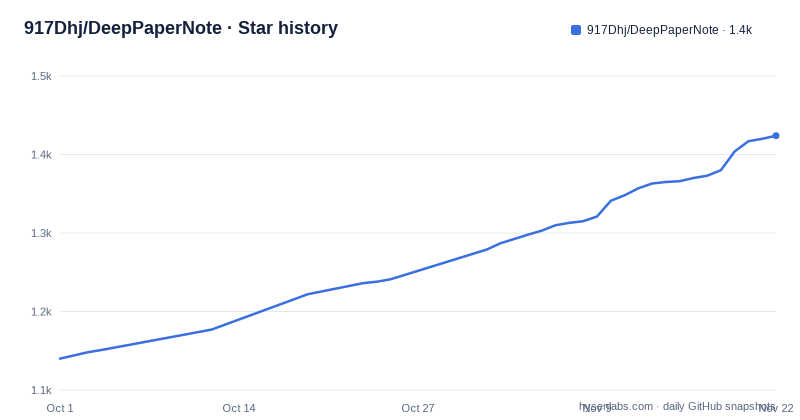
- 917Dhj/DeepPaperNote1,424 ★ · +284
| Repository | 2026-10-01 | 2026-11-22 |
|---|---|---|
| 917Dhj/DeepPaperNote | 1.1k | 1.4k |
284 Stars in the last 52 days, measured from the daily GitHub snapshot. Compare with other projects
Editorial analysis
What you install is a markdown contract and one library
Strip away the presentation and DeepPaperNote is a skill definition. The project description calls it an agent skill for deep-reading a single paper and generating Obsidian-style research notes, and the pyproject.toml description calls it an agent-neutral skill for turning one research paper into a high-quality Obsidian note. The dependency list is the proof: certifi and PyMuPDF, with PyMuPDF at 1.24 or later doing the PDF extraction and the rest handled by whatever model your agent already runs. There is no server, no API key of its own, no account and no database. The canonical execution contract lives in skills/deeppapernote/SKILL.md and the output format is specified separately in skills/deeppapernote/references/obsidian-format.md, which is the reference the badge in the README points at. For an engineer this means the thing you evaluate is a prompt and a format specification, and the thing that could go wrong is that the model ignores them.
The trigger is a sentence with a paper in it
There is no interface to learn. You hand your agent one of two prompt shapes, with the paper identifier filled in: a request to generate a deep-reading note for a title, DOI, URL, arXiv ID or local PDF, or a request to turn a specific paper into an Obsidian note. The accepted inputs are worth listing because they determine what you have to have: a title alone is enough if the agent can resolve it, a DOI or arXiv ID is unambiguous, a URL works if the PDF is reachable, and a local path removes every network dependency. Zotero items are also accepted when a compatible integration is available, which is a hedge rather than a promise. The README is explicit that this is a single-paper tool, and the same core skill runs in Claude Code and Codex with the other hosts supported through the same distribution. Two people reading the same paper with different agents will get different prose, which is the nature of the approach and the reason the format contract matters more than the model.
One paper at a time is a scope decision, not a limitation
The README insists on the single-paper framing several times, and it is worth treating that as a design choice rather than a missing feature. A deep-reading note is supposed to carry the research question, the method chain, the central experiments and the limitations, and the README's own table of complaints describes the alternative people keep ending up with, which is a polished-looking AI summary that is not worth revisiting. That kind of note takes a full pass over the paper, figures included, and a survey workflow that does that for fifty papers inside one session produces fifty thin notes. Scoping to one paper keeps the depth budget per item and makes the cost predictable. The practical consequence for you is that building a literature review means running the skill repeatedly and stitching the pages together, which the companion skill described later partly addresses. If you wanted a batch ingest today, this is not the tool, and no amount of prompting will make it one.
The part worth copying is that it is allowed to stop
The quality promise section says three things, and the third is the one that separates this from a summariser. The result should be a deep-reading note rather than an abstract rewrite, and important methods, results, figures and limitations should be explained rather than listed. Then: if the available source is not strong enough for a real deep read, the workflow should stop and ask for better material instead of pretending the note is complete. That is an instruction to a model, which means it is a request rather than a guarantee, and a model that has already been asked to produce a note has an obvious incentive to produce one. Still, stating the refusal behaviour in the contract is the difference between a skill that degrades silently and one that tells you the PDF you gave it was a scan. The complementary commitment is preservation: formulas, numbers, figure context and the boundaries of what the evidence actually supports, which is exactly the material a fluent summary tends to smooth away.
paper-glossary reuses the artefacts, not the paper
The second skill in the repository is the interesting piece of engineering, and it is not a second product. paper-glossary is an optional companion that works from the artefacts DeepPaperNote has already saved, so it selects terms out of the existing paper files, builds reusable Obsidian terminology notes, and can link those glossary entries back to the paper note. The README is precise that it does not take over or rerun the paper reading workflow. That is a cost decision with a design lesson in it. Re-reading a PDF to build a glossary burns tokens and time for material you already extracted, and any agent workflow that has to stay affordable over a year has to make exactly this move: separate extraction from reuse. For an adopter, the pattern is what to copy. Read once, write many, and let later skills consume files instead of sources. Install it only if you want terminology notes, since the installer lets you choose.
Zotero first, so the same paper is not fetched twice
One row of the README's problem table is about a paper already sitting in Zotero. The stated answer is that DeepPaperNote prefers local records and attachments when they exist, which reduces repeated work and, more usefully, reduces the chance of ending up with a note about a different version of a paper than the one you saved. Preprint versus camera-ready, a revised arXiv version, a corrected PDF: those are the failure modes this avoids, and they are the kind of mistake that is invisible in a finished note. The limit is in the same sentence, since Zotero support applies when a compatible integration is available. Nothing in the repository describes which integrations qualify or how the lookup is performed, so treat Zotero as a convenience that may be absent rather than a feature you can plan around. The local PDF path has no such uncertainty, and for a workflow where citation accuracy is the point, that is the input to prefer.
Two plugin manifests, five agent hosts, one installer
Distribution is the part of this project that keeps moving, and the tree shows it. There is a .claude-plugin directory and a .codex-plugin directory, plus an AGENTS.md and a CLAUDE.md at the root, which is the convention each host reads. Installation is a single command:
npx skills add 917Dhj/DeepPaperNoteThe installer prompts for which skills to install and which agents should receive them, so the same repository serves the core skill and the glossary without installing both. The hosts named in the project description are Claude Code, Codex, Cursor, Copilot and the Gemini CLI, which is a broad claim resting on two manifest directories, so the honest reading is that the skill is plain markdown and any host that can read a skill file can run it. The Python side is one install, and it has to land in the environment the agent will shell out to:
python3 -m pip install PyMuPDFwith uv pip install PyMuPDF given as the alternative. Python 3.10 or newer is required. Nothing here compiles anything, which is why the whole setup fits in a minute.
MIT, version 2.3.0, and an eval suite the README does not explain
The licence is MIT with the LICENSE file at the root, and the package version in pyproject.toml is 2.3.0, matching the release tag from 2026-08-29 whose headline change was complete English note support across the note structure, figure callouts, validation and the Formal Save step. Before that, v2.2.0 shipped on 2026-07-27, v2.1.1 on 2026-07-23, and the multi-agent plugin distribution arrived on 2026-07-16 with the paper-glossary companion alongside it. The last push was 2026-09-19, so the project is active. The gap is evaluation. The repository contains evals and tests directories and a dev extra with pytest and ruff, and a ruff configuration pinning a line length of 100 for py310, but the README does not explain how to run the evals or what they assert. For a product whose quality is entirely a property of a model's behaviour, that is the part to ask about, and the alternative to a maintained skill file is simply writing the same prompt and format rules into your own repository, where you own the test cases and the version history.
Editorial conclusion
Adopt DeepPaperNote if you keep a research wiki in Obsidian, you already pay for an agent that can read a PDF, and the bottleneck is the note rather than the reading, because the output contract and the refusal rule are the parts you would otherwise write yourself each time. Do not adopt it to survey fifty papers, since the skill is explicitly scoped to one at a time, and do not adopt it expecting a Zotero replacement, because the integration only prefers local records when a compatible one is available. Verify three things: that PyMuPDF installs into the same Python environment your agent shells out to, that the note format in skills/deeppapernote/references/obsidian-format.md matches the conventions your vault already uses, and how to run the evals and tests directories that ship in the repository but are not documented. The project is MIT, version 2.3.0 shipped on 2026-08-29, and the last push was 2026-09-19.
Frequently asked questions
How do I install DeepPaperNote?
Run npx skills add 917Dhj/DeepPaperNote, which lets you choose which skills to install and which agents receive them, then install PyMuPDF with python3 -m pip install PyMuPDF. Python 3.10 or newer is required.
Which agents can run the DeepPaperNote skill?
The project description names Claude Code, Codex, Cursor, Copilot and the Gemini CLI, and the repository ships a .claude-plugin directory and a .codex-plugin directory. The skill itself is plain markdown with an execution contract in skills/deeppapernote/SKILL.md.
Can DeepPaperNote read a paper from Zotero?
Zotero items are accepted when a compatible integration is available, and the skill prefers local records and attachments when they exist to avoid re-fetching a paper. The documentation does not name which integrations qualify.
What does the paper-glossary skill do?
It is an optional companion that works from artefacts DeepPaperNote has already saved, selecting terms to build reusable Obsidian glossary notes and optionally linking them back to the paper note, without rerunning the paper reading workflow.
What happens if the source material is not good enough?
The quality promise says the workflow should stop and ask for better material instead of pretending the note is complete, rather than producing an abstract rewrite with methods and limitations merely listed.
Does DeepPaperNote handle several papers at once?
No. The project is scoped to reading one paper at a time, and the README presents the single-paper deep read as the point rather than a constraint to work around. Building a survey means running the skill repeatedly.
Official sources
Add this badge to your README
If you maintain this project, the badge below links readers to this analysis and shows its maintenance status from the daily GitHub snapshot. Paste the markdown into your README; add ?metric=license or ?metric=stars to the image URL for a different field.

[](https://hysenlabs.com/projects/917dhj-deeppapernote)Star history chart for your README
[](https://hysenlabs.com/projects/917dhj-deeppapernote)Was this useful?