medical-datasets: a keyworded catalogue of medical imaging sets
tracking medical datasets, with a focus on medical imaging
At a glance
- What is it?
- adalca/medical-datasets is a hand maintained Markdown list of medical imaging datasets, organised by free text keywords rather than clustering, where the useful detail sits in the counts, the access conditions and the link to the external host. It is a shortlisting tool for researchers who already know the field, not a catalogue software.
- Who is it for?
- Treat adalca/medical-datasets as a first pass shortlist for people who already know the medical imaging vocabulary, not as a dataset browser or a download tool, because every entry is a pointer to a third party host and the size tags range over several orders of magnitude.
- Can I use it commercially?
- Not without permission. GitHub finds no licence file in the repository, and without a licence all rights are reserved by default: you may read the code but not reuse it. Check the README, or ask the authors, before using it.
- Is it still maintained?
- Yes. The repository last received commits 23 days ago.
- What is it written in?
- GitHub does not report a main language for this repository.
Answers come from the project's GitHub data, last synced on November 7, 2026, and from our analysis. They are not legal advice.
Star history
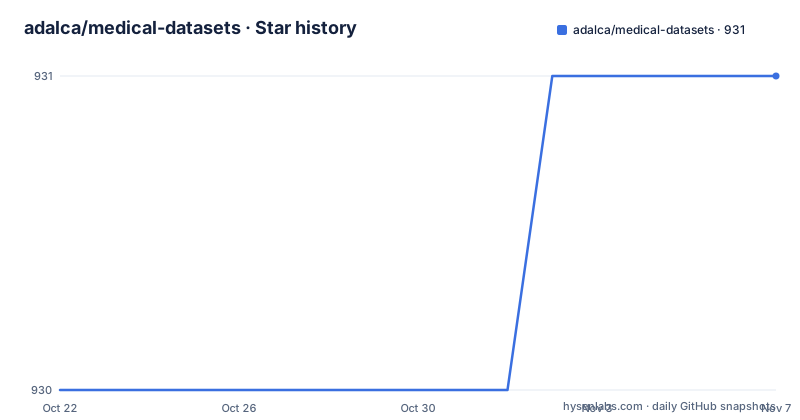
- adalca/medical-datasets931 ★ · +1
| Repository | 2026-10-22 | 2026-11-07 |
|---|---|---|
| adalca/medical-datasets | 930 | 931 |
1 Stars in the last 16 days, measured from the daily GitHub snapshot. Compare with other projects
Editorial analysis
A braindump that was meant to be read by one person first
adalca/medical-datasets is a repository of Markdown, not of data. The stated intention is narrow and honest: "I maintain this list mostly as a personal braindump of interesting medical datasets, with a focus on medical imaging." That framing matters, because it tells you what kind of reader gets value here. Someone already working in medical imaging knows that MRNet is knee MRI, that fastMRI ships k-space, that PadChest labels findings against a UMLS taxonomy, and knows which of those names they have not yet tried. Such a person can open README.md, scan a few dozen lines, and get a shortlist in five minutes. Someone starting from nothing gets a wall of proper nouns with no ordering logic, because the ordering logic is the reader's own head.
The scope is imaging rather than all of medicine. The topics attached to the repository are collection, datasets, imaging, learning, list, medical and medical imaging, and the main section is called Main Medical Imaging List. Chest radiographs, CT, MRI, ultrasound, fMRI, k-space and segmentation maps are the recurring vocabulary. There is also a separate section of libraries, and files for online courses, so the repository has grown past a bare list without becoming a full reference portal.
Keyword tags in place of clustering, and what that costs
The design choice that defines the list is stated directly: "Rather than try to group / cluster datasets, I'm going to try to maintain a set of keywords for each." Every entry therefore carries a Keywords line, and those lines are the only classification scheme. You will see tags such as very-large, large, medium, small, X-ray, CT, MRI, fMRI, ultrasound, labels, segmentations, annotations, k-space, reconstruction, multi-modal, brain masks, brain extraction, skull stripping and genetics.
This is free text, not a controlled vocabulary. Nothing enforces that a CT dataset is tagged CT, and the tags are as inconsistent as a personal notes file tends to be. Segmentation appears both as segmentations and as segmentation. Two sizes sit on the same list without a defined boundary between them. The payoff for accepting that mess is speed of adding: a new dataset needs a link, one sentence and a tag line, with no taxonomy work. The cost is that the tags cannot be filtered reliably by a machine, so finding a brain MRI set with segmentation masks means reading the lines rather than querying them. For a human skimming, that is often faster than it sounds. For anything programmatic, there is no schema to target.
Nothing to install: the first real use is opening the README
There is no install step here, because there is no software. The top level entries are README.md, images/, libraries.md, neurite-oasis.md and online-courses.md, and the repository publishes no GitHub releases. Nothing is fetched, no environment is created, no dependency has to be pinned.
A practical first session looks like this. Open README.md and jump to the Main Medical Imaging List. For each entry, capture three things: the numeric description line, the Keywords line, and the access note if there is one. Then follow the outbound link to the host that actually serves the data. Cross reference the host against your own constraints, because several of these sites gate access behind registration or an application.
To see what has been added since you last looked, use the commit log the README points to. The README explicitly refers readers to the commit history as the record of additions over time, which is the closest thing the project has to a changelog. One caveat worth stating plainly: the version of the README available for inspection here is truncated partway through the Lung Image Database Consortium entry, so the tail of the list was not available to check. Treat the entries you can see as the confirmed portion.
Access conditions decide which entries are actually usable
The most consequential line in many entries is not the size, it is the permission note. MIMIC-CXR is described as 371,920 chest x-rays associated with 227,943 imaging studies, with a v2 that adds free-text radiology reports, and it carries the flat instruction "Need to request access". The same entry also carries a dated note that as of 3/16/2019 it was not yet linked with MIMIC ICU data, with a pointer to a news article. The National Lung Screening Trial entry lists 50000+ patients with CT data and some pathology, then adds "limited availability".
So the size tags tell you nothing about whether you will have files this week. A researcher planning a timeline has to read the access sentence first and the volume count second. The list is good at recording that these constraints exist, which is more than most hand written notes do, but it does not track whether a specific application is still open, how long credentialing takes, or whether a particular host changed its terms. That verification always lands back on the external site, and the list cannot answer it for you.
Two entries the maintainer processed himself
The section called Datasets processed by us is categorically different from the rest, because here the raw acquisition is not what you get. Neurite-OASIS is 414 T1 MRIs taken from the OASIS dataset and processed with FreeSurfer and SAMSEG. The entry states that it includes the original images alongside processed volumes and the resulting anatomical segmentation maps, and the keyword line adds processed on top of large, MRI, segmentations, labels and annotations. A per dataset file, neurite-oasis.md, sits in the repository, and the linked URL points into the repository itself rather than to a third party host.
SynthStrip is listed the same way but points outward, to w3id.org/synthstrip. It offers full-head images and ground-truth brain masks from 622 MRI, CT and PET scans, with a landscape or MRI scans differing in contrast, resolution and population from infants through glioblastoma patients, and anatomical segmentation maps for a subset of the images. The keywords read large, diverse, multi-modal, brain masks, segmentations, brain extraction, skull stripping.
Both entries matter for a specific reason. Everywhere else in the list you are choosing which corpus to download and then doing the preprocessing yourself. Here the preprocessing step is already done and, in the case of the brain masks, is the actual deliverable.
Size tags span orders of magnitude, so read the counts
The size vocabulary looks tidy and is not. MRNet, 1,370 knee MRI exams with diagnosis covering healthy, ACL tear and meniscal tear, is tagged large. fastMRI, with 1500 fully sampled knee MRIs, 10K clinical MRIs and 6.5K brain MRIs, is also tagged large. CheXpert, at 224,316 chest radiographs of 65,240 patients, is tagged very-large. PadChest, 160,000 images from 67,000 patients, is very-large too. Studyforrest, described as few subjects but many modalities, is tagged small. The keyword is therefore a rough bin rather than a count, and the count line is where the real information sits.
Coverage is also uneven in a way that a keyword line can partly reveal. SynthStrip is tagged multi-modal and Studyforrest is too, but most other entries carry a single modality. The AAPM Sparse-View CT Reconstruction Challenge entry is tagged reconstruction rather than labels, and OCMR is tagged k-space, which marks it as raw data rather than a ready training set. Reading the tag against the description is how you separate a curated dataset from a raw archive.
Additions come through the commit log, and the repository publishes nothing
Maintenance here has a specific shape. The repository is not archived, and the last push was on 2026-10-16. It publishes no GitHub releases, so there is no version to pin, no changelog to read and no upgrade step to plan. Updates arrive as additions to the Markdown and are visible in the commit history the README points at. For a list this is arguably the right shape, since nothing can break at upgrade time, but it also means there is no signal about when a specific entry was last checked against its source.
That has a direct cost for anyone building on top of the list. A dataset host can change its access process, its file layout or its licensing terms, and the list will keep the old description until someone revisits it. The commit log shows that a line was touched, not that a line was revalidated. Licencing is also thinner than it should be for a document other people may reuse: no licence is named for the list itself, so anyone copying descriptions or keyword lines into their own work should check the licence field on the repository directly before assuming permission.
Editorial conclusion
Treat adalca/medical-datasets as a first pass shortlist for people who already know the medical imaging vocabulary, not as a dataset browser or a download tool, because every entry is a pointer to a third party host and the size tags range over several orders of magnitude. Teams picking a corpus for a benchmark should first read the count line and the access note on the linked site, then confirm what the licence field on the repository currently states before reusing any of the descriptions or redistributing derived lists, since the list itself carries no stated licence and no release history.
Frequently asked questions
How do I find a brain MRI dataset with segmentation masks in adalca/medical-datasets?
There is no search function, so you scan the Main Medical Imaging List for entries carrying the keywords segmentations or segmentation alongside MRI. Candidates in the list include Medical Segmentation Decathlon, 2000+ CT and MR images of various organs from different sources, and the Brain MRI LGG FLAIR abnormality segmentation entry, 110 subjects from the TCIA LGG collection with manual FLAIR abnormality segmentation masks.
Does adalca/medical-datasets host the data files itself?
No. It is a list of links, and the data is served by third party hosts such as PhysioNet, the Cancer Imaging Archive, Kaggle, Box, OpenNeuro and site specific portals. The only files kept in the repository are Markdown, an images folder, libraries.md, neurite-oasis.md and online-courses.md.
Is the medical-datasets list actively maintained?
The repository is not archived and the last push was on 2026-10-16. It publishes no GitHub releases, so additions are traced through the commit log that the README links to rather than through release notes.
Can I use a dataset from the list without requesting permission?
It depends entirely on the entry. MIMIC-CXR states that you need to request access, and the National Lung Screening Trial entry is marked limited availability, while other entries such as the Brain MRI LGG FLAIR abnormality segmentation set are hosted on Kaggle with manual masks. Read the access note on the linked site before planning around a dataset.
Official sources
Add this badge to your README
If you maintain this project, the badge below links readers to this analysis and shows its maintenance status from the daily GitHub snapshot. Paste the markdown into your README; add ?metric=license or ?metric=stars to the image URL for a different field.

[](https://hysenlabs.com/projects/adalca-medical-datasets)Star history chart for your README
[](https://hysenlabs.com/projects/adalca-medical-datasets)Was this useful?