AtlasRepo: A Machine-Readable Catalog for Coding Agents
A living, machine-readable catalog of open-source projects with practical summaries, categories, quality signals and transparent scoring.
At a glance
- What is it?
- AtlasRepo is an auto-curated, MIT-licensed catalog of over 33,000 open-source projects, designed to give coding agents a grounded starting point before deeper review. The scoring is transparent but directional, and the catalog's breadth comes with uneven category depth.
- Who is it for?
- Adopt AtlasRepo if you are building a coding agent or a discovery workflow that needs a broad, machine-readable starting point with multilingual summaries and transparent scoring. Skip it if you need deep, curated coverage in a niche category or if your use case demands strict data provenance and freshness guarantees.
- Can I use it commercially?
- Yes. MIT is a permissive licence: you can use, modify and sell software built on it, as long as you keep its copyright and licence notices.
- Is it still maintained?
- Yes. The repository received new commits within the last day.
- What is it written in?
- GitHub does not report a main language for this repository.
Answers come from the project's GitHub data, last synced on October 22, 2026, and from our analysis. They are not legal advice.
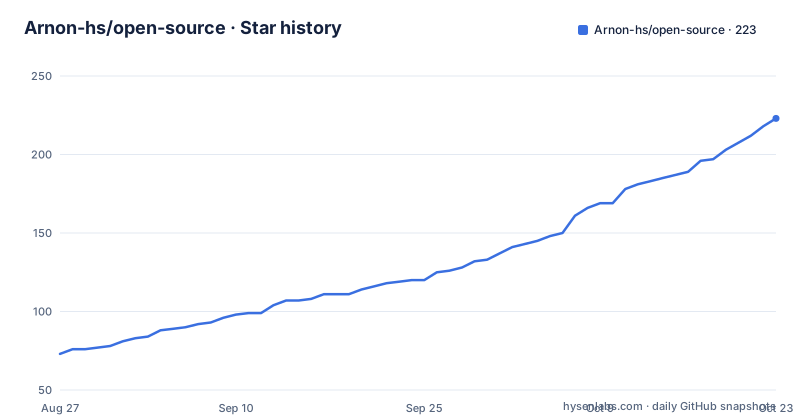
Star history
- Arnon-hs/open-source218 ★ · +145
| Repository | 2026-08-27 | 2026-10-22 |
|---|---|---|
| Arnon-hs/open-source | 73 | 218 |
145 Stars in the last 56 days, measured from the daily GitHub snapshot. Compare with other projects
Editorial analysis
What AtlasRepo Solves and Who It Serves
AtlasRepo addresses a specific pain: coding agents, such as ChatGPT plugins or Claude Code skills, need to find open-source projects quickly but lack a grounded, structured way to filter the noise. The repository is a living catalog of 33,641 projects across 60 categories, each enriched with practical summaries, quality signals, and a transparent score. The intended audience is developers building agentic workflows, not humans browsing for fun. The README is explicit: it is a decision layer before deeper technical, security, and license review. That positioning matters. This is not a replacement for a security audit or a license check. It is a triage tool that gives an agent a ranked, categorized starting point.
The Mechanism: Scout, Score, Publish
The pipeline is visible in the README's Mermaid diagram and the numbered steps. AtlasRepo Scout collects candidates from approved discovery sources, then normalizes and deduplicates them. After that, it evaluates each project across six dimensions: usefulness, quality, integration, readiness, outlook, and adoption. The result is a directional score, not a precise metric. The catalog then enriches entries with categories, summaries, use cases, and risk notes. Finally, it publishes to both the AtlasRepo platform and this open catalog. The word 'directional' is key. The scoring is a heuristic, a way to rank candidates for further inspection, not a certification of quality. The README says the top projects are 'by score,' and the table shows entries like langchain with 145k stars sitting next to smaller projects, which suggests the score is not purely star-driven.
What Each Entry Actually Contains
Each catalog entry includes repository activity signals: stars, forks, language, and last update. It also carries a practical summary in English, Russian, and Chinese, which is a distinctive feature. Multilingual summaries lower the barrier for non-English-speaking teams and agents that operate across languages. The entry also includes fit and readiness notes: use cases, integration notes, quality signals, and production-readiness observations. The transparent score is broken down across the six dimensions. This structure is useful for an agent because it can parse a single markdown file and extract both qualitative and quantitative signals. The README does not show a sample entry, so the exact format of a .md file is not confirmed, but the signal table defines the fields.
Getting It Running: MCP and Plugin Installation
AtlasRepo is not a library you install; it is a data source and an MCP server. The README gives two concrete installation paths. For ChatGPT, you enable Developer mode in Settings, then open ChatGPT Plugins, create a connection named AtlasRepo, and set the MCP endpoint to https://mcp.atlasrepo.com/mcp. The README notes that developer mode availability depends on your account and workspace policy. For Claude Code, the command is '/plugin marketplace add Arnon-hs/a' (the README is truncated there, so the full command is not visible). There is also an npm package, atlasrepo-mcp, and a hosted MCP endpoint. The documentation lives at atlasrepo.com/docs. The MCP approach is the core integration point: it exposes read-only tools to the agent.
The Catalog's Shape: Breadth Over Depth
The category table reveals a lopsided distribution. Misc holds 15,203 projects, nearly half of the catalog. AI/ML has 3,284, Mcp has 2,535, and Orchestration has 2,184. At the other end, dozens of categories have exactly one project: Dns, Cms, Java, Rails, Azure, Docker. This is a real limitation. If you are looking for a specific niche, the catalog may have a single entry or none. The Misc bucket is a dumping ground, which reduces its usefulness for targeted discovery. The top-projects table also raises questions. It lists projects like 'Panniantong/Agent-Reach' with 44.7k stars, but the README does not explain how the score is computed or how the star counts are verified. The catalog is broad, but breadth without depth means an agent can find candidates, not validate them.
The Scoring System: Transparent but Directional
The README emphasizes 'transparent scoring' and lists six dimensions: usefulness, quality, integration, readiness, outlook, and adoption. It says the score is 'directional,' which is an honest admission. The score is a composite heuristic, not a precise measure. The problem is that the README does not document the weights or the algorithm. Without that, 'transparent' means the dimensions are named, not that the computation is reproducible. For a coding agent, this is acceptable as a ranking signal, but it is not a substitute for human judgment. The README also does not state how often the catalog refreshes, only that it is 'continuously maintained by AtlasRepo Scout.' That is a gap. If you rely on the catalog for current data, you need to check the last-update field in each entry yourself.
Alternatives and the Difference in Approach
The obvious alternative is GitHub's own search API, which gives you direct access to repository metadata, stars, forks, and topics. The difference is that GitHub search returns raw data with no scoring, no summaries, and no categorization. You would have to build the evaluation layer yourself. Another alternative is a curated list like 'awesome' repositories, which are human-curated and often high quality, but they are not machine-readable in a structured way and they cover far fewer projects. AtlasRepo sits in between: it is automated, broad, and structured, but it inherits the weaknesses of automation, such as category misassignment and the Misc overflow. For an agent, the MCP integration is the real differentiator; you get a structured query interface rather than scraping the GitHub API. But if you need high-confidence curation, a human-maintained list is more reliable.
Maintenance, Licensing, and What to Verify
The repository itself is MIT-licensed, which means you can reuse the catalog data freely, subject to the license terms. The README does not specify the license of the underlying project data, so check each entry for its own license before adopting a project. The catalog is maintained by an automated Scout, not by human reviewers. That means the summaries and scores are generated, and they may contain errors. The README explicitly says to use the catalog as a 'grounded starting point before deeper technical, security and license review.' The maintenance cost for you is low: you can clone the repo or query the MCP endpoint. The upgrade cost is also low because it is a data source, not a dependency. However, you should verify the freshness of the catalog, the accuracy of a sample of entries in your domain, and the exact scoring weights if you plan to rely on the score for ranking.
Editorial conclusion
Adopt AtlasRepo if you are building a coding agent or a discovery workflow that needs a broad, machine-readable starting point with multilingual summaries and transparent scoring. Skip it if you need deep, curated coverage in a niche category or if your use case demands strict data provenance and freshness guarantees. Before relying on it, verify the actual content of a few entries in your target category, check the last refresh timestamp, and confirm that the scoring weights match your own quality criteria. The catalog is a useful index, not a final verdict.
Frequently asked questions
What is the AtlasRepo open source catalog?
A machine-readable index of open-source projects with practical summaries, categories, quality signals and transparent scoring, published as one directory per category. The readme describes it as a decision layer for discovering candidates and giving coding agents grounded starting points, and it places that step before deeper technical, security and licence review.
How many projects and categories does Arnon-hs/open-source list?
The readme states 37,642 projects across 186 categories, with the largest single category holding 14,622 entries. Refresh is credited to a named automated agent, and the metadata is described as repository signals, multilingual summaries and practical evaluations.
How is the open source catalog meant to be used by a coding agent?
The readme says it gives coding agents grounded starting points, and points at a hosted Model Context Protocol endpoint, a package on the npm registry and a separate skills repository as the ways to consume it. It also states that the catalog is a starting point before deeper technical, security and licence review rather than a replacement for it.
What license does the Arnon-hs open-source repository use?
MIT, with the licence file at the repository root. There are no tagged releases, GitHub does not identify a programming language for it, and the last push to the main branch is dated September 30, 2026, so category directories can appear and disappear between commits.
Official sources
Add this badge to your README
If you maintain this project, the badge below links readers to this analysis and shows its maintenance status from the daily GitHub snapshot. Paste the markdown into your README; add ?metric=license or ?metric=stars to the image URL for a different field.

[](https://hysenlabs.com/projects/arnon-hs-open-source)Star history chart for your README
[](https://hysenlabs.com/projects/arnon-hs-open-source)