BakaSU picks its hook mode by kernel version, and most devices only get two of the three
A KernelSU based root solution for Android
At a glance
- What is it?
- BakaSU is a downstream of KernelSU that adds theme tweaks, built-in susfs management and multi-manager support, and it picks between three hook mechanisms depending on your kernel. The default hook does not work on the older kernels the project otherwise supports, and the SUSFS mode comes from another project entirely.
- Who is it for?
- Adopt BakaSU if you run a GKI 2.0 device on kernel 5.10 or newer with arm64-v8a or x86_64 and want KernelSU's kernel-based su model. Do not adopt it if your device needs a pre-5.10 kernel unless you are prepared to build one yourself, since the README states older kernels require manual compilation.
- Can I use it commercially?
- Yes, with conditions. GPL-3.0 is a copyleft licence: if you distribute software that includes it, you must release that software's source code under the same licence. Running it internally without distributing it does not trigger that obligation.
- Is it still maintained?
- Yes. The repository received new commits within the last day.
- What is it written in?
- Mainly Kotlin, according to GitHub's language statistics.
Answers come from the project's GitHub data, last synced on October 23, 2026, and from our analysis. They are not legal advice.
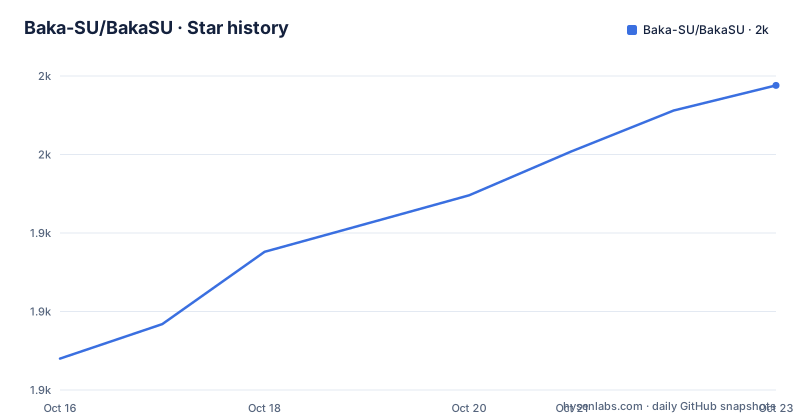
Star history
- Baka-SU/BakaSU1,972 ★ · +87
| Repository | 2026-10-16 | 2026-10-23 |
|---|---|---|
| Baka-SU/BakaSU | 1.9k | 2k |
87 Stars in the last 7 days, measured from the daily GitHub snapshot. Compare with other projects
Editorial analysis
A downstream, and that word does most of the work
BakaSU describes itself as a downstream of tiann/KernelSU with personal changes added, and it was formerly known as ReSukiSU. The fork source is SukiSU-Ultra, and the underlying idea is credited to Kernel-Assisted Superuser, with Magisk listed as the reference root tool.
Understanding the lineage matters because the interesting decisions in this project are mostly about which upstream behaviour to keep. The root mechanism itself is kernel-based: su and root access are managed by the kernel. That is why the repository is laid out with a kernel directory, userspace with a Rust ksud component, a manager written in Kotlin, and uapi.
The build is driven by a justfile with two aliases, bk for build_ksud and bm for build_manager. The Rust binary is cross-compiled first and then copied into the manager as a native library before Gradle assembles the app:
build_ksud:
    cross build --target aarch64-linux-android --release --manifest-path ./userspace/ksud/Cargo.toml

build_manager: build_ksud
    cp userspace/ksud/target/aarch64-linux-android/release/ksud manager/app/src/main/jniLibs/arm64-v8a/libksud.so
    cd manager && ./gradlew aDebug
Note that this recipe produces an arm64-v8a debug build only, which is narrower than the ABI list the project claims to support.
Three hook modes and a table of what actually supports what
This is the part of the project with real technical substance, and the compatibility notes below the feature list deserve to be read alongside it.
The Tracepoint Syscall Redirect hook is the default and comes from upstream KernelSU. The README states it only supports GKI2 kernels with the arm64-v8a or x86_64 ABI.
Manual Hook is described as the most compatible mode, supporting Linux kernel 3.4 through 6.18. It is the fallback when the tracepoint path is unavailable.
SUSFS Inline Hook comes from the SuSFS project rather than from BakaSU. The README is explicit that it is provided by that project, not this one, and that SUSFS here only supports a backport to kernel 4.3 and newer.
Read those three statements together and the coverage is narrower than the feature list suggests. The default mode excludes pre-5.10 kernels and excludes arm64-v8a-unrelated ABIs such as armeabi-v7a. SUSFS needs 4.3 or newer. Manual Hook covers the widest version range but is manual, which means the out-of-tree patching work lands on whoever builds the kernel.
There is a repack-config.example.json and repack_apk.py plus repack_apk_multi.py at the repository root for the APK repack path, which is what you use when you did not build the kernel yourself.
Metamodules and app profiles: what root management looks like here
Two features come straight from KernelSU documentation and define the model. The module system is metamodule based, a pluggable infrastructure for systemless modifications rather than the classic overlay or Magisk module format. App Profile is the mechanism for granting or denying root per application, described in the README as caging the root power.
On top of that, BakaSU adds tweaks to the manager theme and to the built-in susfs management tool. BakaSU includes management for its built-in susfs tool.
Multi manager support is the fourth addition worth naming. The default arrangement uses BakaSU's kernel with BakaSU's manager, but the README states that Official KernelSU and KOWSU managers also work as managers against BakaSU's kernel. That flexibility is useful when you want one kernel with a different interface, though it also means a kernel and manager version mismatch is a support question this README does not address.
Split licensing: GPL-2.0-only kernel, GPL-3.0 elsewhere, layered artwork
The licence arrangement is unusually explicit and has three parts.
Files in the kernel directory are under GPL-2.0-only. Everything except the listed exceptions is under GPL-3.0 or later. The exceptions are artwork and visual files, specifically docs/BakaSU_Clean.svg, docs/BakaSU_Full.svg and the launcher foreground drawable, which were created by OukaroMF under a layered licence arrangement documented separately in ASSETS_LICENSE.md and its Simplified Chinese counterpart.
If you repackage the manager APK or redistribute artwork, the artwork terms are the ones to read first, and they are not the same terms as the code. This is a note on where the licences differ, not legal advice.
Translations are handled on Weblate, and the repository is not archived.
Release cadence is currently three release candidates deep
The recent tags are v4.2.0-rc1 on 2026-08-13, v4.2.0-rc2 on 2026-09-14 and v4.2.0-rc3 on 2026-09-22. There is no stable 4.2.0 tag among them, so anyone pinning this project today is pinning a release candidate.
That interacts with the hook mode table above. A release candidate is exactly where ABI coverage and kernel version boundaries tend to still move, and the README's compatibility notes are written in a way that suggests ongoing adjustment, particularly around susfs backports.
Nightly builds are published through nightly.link off the build-manager workflow, which is the pragmatic way to track upstream between tags if you tolerate rebuilds.
When BakaSU is the wrong choice
On an old device it is a build project, not an install project. The README states that older kernels from 3.4 upward are compatible but the kernel has to be built manually, and the only ABI support listed is arm64-v8a, armeabi-v7a and X86_64. Anything outside that set is outside the project.
If you cannot compile a kernel for your device, this is not the tool. The alternative approaches differ in kind.
SukiSU-Ultra is the closer comparison since BakaSU forked from it, and the difference is the set of downstream changes rather than the architecture.
One more caveat: the credit list names Diamorphine for rootkit skills, which tells you where to look if you are evaluating the security posture of a kernel-based root implementation.
Editorial conclusion
Adopt BakaSU if you run a GKI 2.0 device on kernel 5.10 or newer with arm64-v8a or x86_64 and want KernelSU's kernel-based su model. Do not adopt it if your device needs a pre-5.10 kernel unless you are prepared to build one yourself, since the README states older kernels require manual compilation. First check your ABI and kernel version against the hook mode table, because the default mode silently narrows support to a subset of what the project claims to cover.
Frequently asked questions
What is BakaSU and how does it relate to KernelSU?
BakaSU is a downstream of tiann/KernelSU, formerly known as ReSukiSU, forked from SukiSU-Ultra. It keeps the kernel-based su model and adds manager theme tweaks, built-in susfs management and multi manager support.
Which hook modes does BakaSU support?
There are three: Tracepoint Syscall Redirect hook as the default from upstream, which only supports GKI 2.0 kernels with arm64-v8a or x86_64; Manual Hook, which supports Linux kernel 3.4 through 6.18; and the SUSFS Inline Hook, which comes from the SUSFS project and only supports a backport to kernel 4.3 and newer.
Which Android devices does BakaSU officially support?
The README states official support for Android GKI 2.0 devices on kernel 5.10 or newer. Older kernels from 3.4 are compatible but require building the kernel manually, and only arm64-v8a, armeabi-v7a and X86_64 are supported.
What licence applies to BakaSU code and artwork?
Files in the kernel directory are GPL-2.0-only and everything else is GPL-3.0 or later, except the artwork and visual files, which are under a separate layered arrangement documented in ASSETS_LICENSE.md.
Can I use the official KernelSU manager with a BakaSU kernel?
The README states that multi manager support is provided and that the default Official KernelSU or KOWSU manager works as manager with BakaSU's kernel.
Official sources
Add this badge to your README
If you maintain this project, the badge below links readers to this analysis and shows its maintenance status from the daily GitHub snapshot. Paste the markdown into your README; add ?metric=license or ?metric=stars to the image URL for a different field.

[](https://hysenlabs.com/projects/baka-su-bakasu)Star history chart for your README
[](https://hysenlabs.com/projects/baka-su-bakasu)Was this useful?