MteH: A Curated Endgame Corpus of Simplified Chinese Characters
More than enough Hanzi
At a glance
- What is it?
- MteH is a hand-curated set of about 4,540 simplified Chinese characters aimed at advanced learners who want to stop studying character lists. It merges 30 source corpora, adds handwriting PDFs and an Anki deck, but its licensing and maintenance status require attention.
- Who is it for?
- Adopt MteH if you are an advanced simplified Chinese learner who wants a single, defensible character list to master, especially if you value the merged HSK and TOCFL coverage and the printable handwriting PDFs. Do not adopt it if you need traditional characters, if you expect active maintenance (the last push is v0.1.3 from February 2026, with no license file in the repository), or if you require a tool with built-in spaced repetition beyond a work-in-progress Anki deck.
- Can I use it commercially?
- Not without permission. GitHub finds no licence file in the repository, and without a licence all rights are reserved by default: you may read the code but not reuse it. Check the README, or ask the authors, before using it.
- Is it still maintained?
- Yes. The repository last received commits 39 days ago.
- What is it written in?
- Mainly Python, according to GitHub's language statistics.
Answers come from the project's GitHub data, last synced on October 22, 2026, and from our analysis. They are not legal advice.
Star history
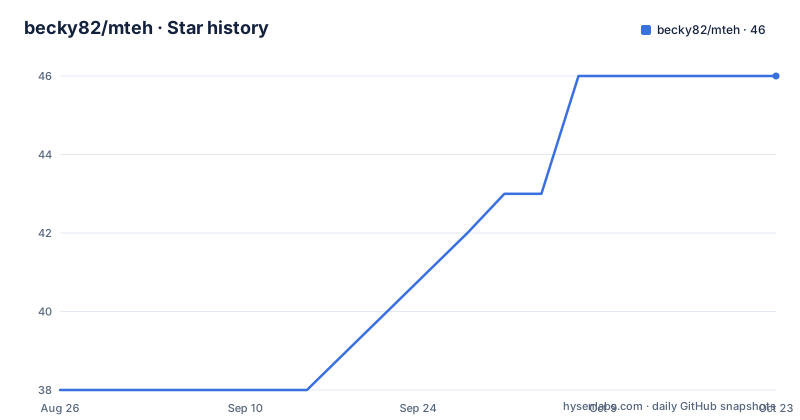
- becky82/mteh46 ★ · +8
| Repository | 2026-08-26 | 2026-10-22 |
|---|---|---|
| becky82/mteh | 38 | 46 |
8 Stars in the last 57 days, measured from the daily GitHub snapshot. Compare with other projects
Editorial analysis
What MteH solves and who it is for
MteH addresses a specific pain point for advanced learners of simplified Chinese: the endless feeling that there is always one more character to learn. The project's README calls itself an "endgame corpus". The goal is to provide a curated set of roughly 4,540 characters that, once learned, covers almost everything a fluent reader will encounter in mainland China and in HSK exams. The author explicitly acknowledges that more characters exist in proper nouns, scientific terms, chengyu, historical texts, and online usernames, but draws a line at a practical stopping point. This is not a beginner's list. It is aimed at people who have already passed intermediate levels and want a definitive target. The corpus is also designed to minimize "missing" characters, meaning any character not included should be extremely rare or niche. That claim is backed by the merging of 30 different source lists, from HSK versions to Wikipedia and classical texts.
How the corpus is built: merging 30 sources with a purpose
The core mechanism is a union of character lists. The README documents 30 source corpora, each with a character count and a "used" count. The used count is what actually enters the final set after filtering. For example, HSK 1.0 contributes 2,866 characters, HSK 2.0 contributes 2,663, and HSK 3.1 contributes 3,088. The TOCFL list from Taiwan contributes 3,009 characters after conversion from traditional to simplified. Other sources include the 通用规范汉字表 (3,495 used), the 现代汉语常用字表 (3,491 used), primary school lists from China and Singapore, Heisig's Remembering Simplified Hanzi (3,017 used), and frequency-based corpora like Jun Da (4,254 used) and SUBTLEX (4,184 used). There are also domain-specific lists: food terms, species names, Chinese surnames, names, city-geo terms, company proper nouns, medical organizations, chengyu, and Xinhua chengyu and xiehouyu. The starred entries in the table indicate that extraction steps were needed, such as selecting top-N words or converting traditional to simplified. The final set is ordered by Unicode, with an attempt to group visually or structurally related forms. That ordering is a deliberate design choice, not a random sort.
Getting it running: what you actually download and use
MteH is not a software package you install. It is a data repository. The primary artifact is a plain text file at versions/v0.1.3/mteh_v0.1.3.txt, which contains the character list. There are also PDFs for handwriting practice in the same version folder. The README links to an Anki deck file (mteh_anki_deck.apkg) that you can import into Anki. The deck is described as "work-in-progress" but should already work. For handwriting on a computer, the README suggests the AnkiDraw add-on; on AnkiDroid, the built-in whiteboard feature works. To use the corpus, you simply download the text file and process it as you wish, for example, by importing it into a flashcard app or a custom script. There is no command-line interface, no API, and no Python code to run in the main repository. The primary language is listed as Python, but the README does not mention any Python scripts or installation steps. The only concrete usage path is manual: download the file, print the PDFs, or import the Anki deck.
Limitations and failure modes: what the corpus does not cover
The most obvious limitation is that MteH focuses exclusively on simplified Chinese characters. Traditional characters appear only in the TOCFL source, and even then they are converted to simplified. If you need to read Taiwanese or Hong Kong materials, this corpus will not help. The README also admits that the corpus excludes many characters used in proper nouns, scientific terminology, chengyu, and historical texts. The author even lists extra character files for repeated-component characters, the periodic table, musical instruments, province abbreviations, and insects, birds, fish, trees, and mammals. Those extras are explicitly "good to know, but not part of MteH". Another failure mode is the reliance on frequency-based sources. Jun Da, SUBTLEX, Tsai, and Wikipedia all have extraction steps that involve selecting top-N characters. That selection can miss characters that are rare in general corpora but common in a specific domain, such as a rare surname or a technical term. The README provides a missing characters report and a modification report, which suggests the author tracked these gaps, but the reports are not summarized in the README. You would need to open those files to see what was left out.
The Anki deck and handwriting materials: useful but unfinished
The Anki deck is a notable addition because it turns the static character list into a usable study tool. However, the README explicitly labels it as a work-in-progress. That means you should not assume the deck is error-free or perfectly ordered. The handwriting PDFs are another practical resource, but they are likely simple printouts of the character list, not structured lessons. The inclusion of character structure data and drawings from Make Me a Hanzi and cjkvi-ids suggests that the corpus files may contain more than just characters, but the README does not describe the format of those data files. If you are looking for a polished, self-contained learning system, the Anki deck and PDFs are a starting point, not a finished product. The repository also includes debug reports, such as a corpus histogram and a syllables report, which are useful for verifying the list's coverage but are not user-facing documentation.
Alternatives: how MteH compares to official and frequency lists
The most direct alternative is the official HSK 3.1 character list, which is one of the 30 sources. HSK 3.1 contains 3,088 characters, while MteH contains about 4,540. The difference comes from the union of many other sources, so MteH is broader. However, HSK 3.1 is maintained by the Chinese government and is the official standard for the exam. If your goal is to pass HSK, you do not need MteH; you need the HSK list. Another alternative is the Jun Da frequency list, which provides a rank-ordered list of characters by frequency in a modern corpus. Jun Da is a source for MteH, but it is a raw frequency list, not a curated set. MteH adds domain-specific lists like surnames and food terms, which a pure frequency list would miss. If you want a character list that is purely based on frequency, Jun Da is simpler and more transparent. If you want a list that covers exam requirements plus practical vocabulary, MteH's union approach is more comprehensive but also more complex to audit.
Maintenance, licensing, and what to verify before adoption
The repository's last push was v0.1.3 on 2026-02-12, and the project is not archived. That suggests active development, but the cadence is slow: v0.1.2 was in December 2025, and v0.1.1 in October 2025. The license field in the repository metadata says "(unknown)", but the README states "© 2025 Rebecca J. Stones" and "Licensed under CC BY-SA 4.0". That inconsistency is a red flag. You should check the repository for a LICENSE file before redistributing the corpus. CC BY-SA 4.0 is a share-alike license, which means any derivative work must also be CC BY-SA 4.0. That could be a problem if you want to incorporate the corpus into a proprietary app or a differently licensed project. The README also credits external data sources, such as Make Me a Hanzi and cjkvi-ids, which may have their own licenses. The maintenance cost is low if you just download the text file, but if you rely on the Anki deck, you will need to update it manually when new versions are released. There is no indication of an automated update mechanism.
Editorial conclusion
Adopt MteH if you are an advanced simplified Chinese learner who wants a single, defensible character list to master, especially if you value the merged HSK and TOCFL coverage and the printable handwriting PDFs. Do not adopt it if you need traditional characters, if you expect active maintenance (the last push is v0.1.3 from February 2026, with no license file in the repository), or if you require a tool with built-in spaced repetition beyond a work-in-progress Anki deck. Before relying on it, verify the license status by checking the repository directly, confirm that the CC BY-SA 4.0 notice in the README applies to the corpus files, and review the missing characters report and modification report to see exactly which characters were added or removed from each source. If you need a more actively maintained or differently scoped character list, compare it with the HSK 3.1 official list or the Jun Da frequency list, but MteH's value is its consolidation, not its novelty.
Frequently asked questions
How many characters are in the MteH corpus?
About 4,540 simplified Chinese characters, presented as an endgame corpus for advanced learners. Focus is on simplified forms, especially those encountered in mainland China and in HSK exams.
Which source lists does MteH merge?
Thirty-nine of them, from the four HSK versions and the Ministry of Education lists through frequency studies, film and TV subtitles, Chinese Wikipedia, Chinese Stack Exchange as of January 2026, and Xinhua chengyu and xiehouyu. Entries marked with an asterisk went through extraction steps such as top-N selection or traditional to simplified conversion.
Does MteH include traditional Chinese characters?
The corpus is simplified only, with one documented exception: the TOCFL contribution is Taiwan's TOCFL 3100 plus 33 traditional characters. Extra characters that are good to know live outside the corpus, in extra_chars/知有其字.md.
Is there an Anki deck for the MteH corpus?
Yes, mteh_anki_deck.apkg sits in the repository root, and the README says it should already work while also saying it should be thought of as a work in progress. Handwriting works through AnkiDraw on a computer and the built-in whiteboard on AnkiDroid.
What license is MteH released under?
CC BY-SA 4.0, with copyright held by Rebecca J. Stones for 2025. The share-alike terms are what matter in practice, since learners copy characters into their own decks and notes.
Official sources
Add this badge to your README
If you maintain this project, the badge below links readers to this analysis and shows its maintenance status from the daily GitHub snapshot. Paste the markdown into your README; add ?metric=license or ?metric=stars to the image URL for a different field.

[](https://hysenlabs.com/projects/becky82-mteh)Star history chart for your README
[](https://hysenlabs.com/projects/becky82-mteh)