firehol-mirror: A Git-Based Cache for Firehol IP Lists Without Private Networks
Cron caching of https://iplists.firehol.org (without private networks a.k.a RFC1918)
At a glance
- What is it?
- borestad/firehol-mirror caches Firehol blocklists in a Git repository, strips RFC1918 private addresses, and fixes inconsistencies between .netset and .ipset files. It is a maintenance tool for engineers who need stable, auditable copies of these lists.
- Who is it for?
- Adopt firehol-mirror if you need a stable, git-versioned copy of Firehol blocklists with private networks removed, and if you can tolerate a cron-based workflow that depends on the upstream Firehol site. Do not use it if you require real-time updates or if you need the original private-IP addresses.
- Can I use it commercially?
- Not without permission. GitHub finds no licence file in the repository, and without a licence all rights are reserved by default: you may read the code but not reuse it. Check the README, or ask the authors, before using it.
- Is it still maintained?
- Yes. The repository received new commits within the last day.
- What is it written in?
- GitHub does not report a main language for this repository.
Answers come from the project's GitHub data, last synced on October 23, 2026, and from our analysis. They are not legal advice.
Star history
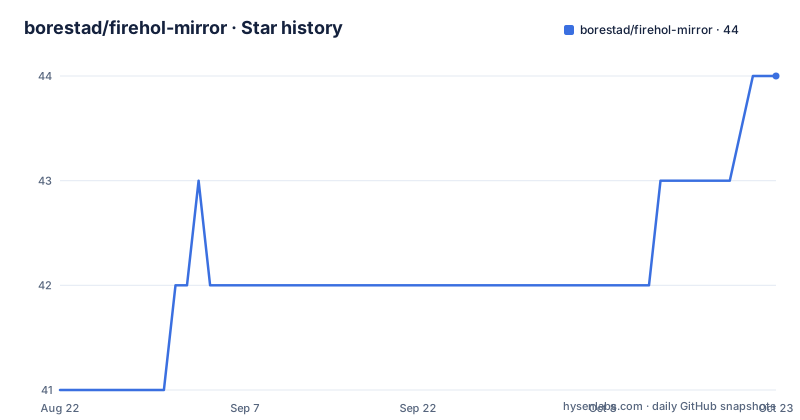
- borestad/firehol-mirror44 ★ · +3
| Repository | 2026-08-22 | 2026-10-23 |
|---|---|---|
| borestad/firehol-mirror | 41 | 44 |
3 Stars in the last 62 days, measured from the daily GitHub snapshot. Compare with other projects
Editorial analysis
What Problem It Solves
Firehol maintains a large collection of IP blocklists at iplists.firehol.org. These lists are updated on a schedule, and fetching them directly can be inefficient. The mirror solves a specific annoyance: the original lists include private network addresses (RFC1918), which are useless for public-facing firewall rules. It also addresses two data-quality issues. The .netset files contain subnets, while the .ipset files contain single IPs, and the two can drift out of sync. Old or deprecated lists clutter the collection, and there is no easy way to see which lists are falling behind. The mirror provides a git repository that caches the lists, strips private IPs, archives old lists, and makes the data easier to analyze.
The Mechanism: Cron, Git, and TTL
The project works by running on a cron schedule. It fetches the blocklists from iplists.firehol.org, but it does not fetch every time. The README states that it sets a proper TTL to avoid spamming the upstream site. That means the mirror respects the freshness of the data and only pulls when the lists are due for an update. The fetched content is committed to a Git repository. Git becomes the transport protocol, which is more efficient than repeatedly downloading plain text files. Each commit captures a snapshot of the lists, so you can diff between versions. The README also mentions that it auto-archives old or deprecated blocklists that are older than one month. This keeps the active set clean without deleting history.
Removing Private Networks and Fixing Inconsistencies
A key transformation is the removal of all private IPs. The README says it removes all private IPs, which means RFC1918 ranges like 10.0.0.0/8, 172.16.0.0/12, and 192.168.0.0/16 are excluded from the cached lists. This is useful for firewall rules that only care about public internet traffic. The project also fixes inconsistencies between .netset and .ipset files. The .netset format uses CIDR subnets, while .ipset format uses individual IP addresses. If a list says a subnet is blocked but the corresponding .ipset does not include all the IPs in that subnet, the mirror corrects that. The exact method is not documented in the README, but the goal is to make the two representations agree.
Getting It Running
The README does not include installation or configuration commands. That is a gap. The repository is a cron-based script, but the exact invocation is not shown. You would need to clone the repository and inspect the code to find the cron entry. The project likely expects you to set up a cron job that runs the mirror script on a schedule. The TTL is a configuration value, but the README does not name the file or key. You will have to read the source to determine how to set the TTL and where the output goes. This is a limitation for users who want a plug-and-play solution.
Limitations and Failure Modes
The mirror depends entirely on the upstream Firehol site. If iplists.firehol.org is down or changes its format, the mirror will fail. The cron-based approach means updates are not real-time. There is always a delay between an upstream update and the next cron run. The removal of private IPs is a feature, but it is also a limitation if you need the original lists for any reason. The consistency fixes between .netset and .ipset could introduce changes that are not present upstream. The README does not explain how it resolves conflicts, so you must trust the implementation. Also, the project is a personal effort, not officially maintained by Firehol. The license is unknown, which may be a concern for some users.
Alternatives: Direct Fetching or Other Mirrors
The obvious alternative is to fetch the lists directly from iplists.firehol.org using curl or wget on your own schedule. That approach gives you full control over the TTL and the exact content, but it does not give you git history or automatic consistency fixes. Another alternative is to use Firehol's own tools, such as the firehol scripts that generate these lists, but that is a heavier dependency. The key difference is that firehol-mirror adds a git layer, which enables diffing and statistical analysis. If you do not need those features, a simple cron fetch is simpler. If you need a public mirror, other projects exist, but they may not strip private IPs or fix .netset/.ipset mismatches.
Maintenance and Upgrade Cost
The maintenance cost is tied to the cron job. You must keep the mirror script running, and you must monitor the git repository for failed fetches. The TTL setting reduces the load on the upstream, but you still need to ensure the cron environment has network access and git installed. Upgrades are manual: you pull the latest changes from the repository. Since the project has no releases, you cannot rely on tagged versions. The unknown license is a risk for commercial use. You should contact the author or check the repository files for a license file before adopting it. The README says the project is fun, which suggests it is a hobby project, so support may be limited.
Editorial conclusion
Adopt firehol-mirror if you need a stable, git-versioned copy of Firehol blocklists with private networks removed, and if you can tolerate a cron-based workflow that depends on the upstream Firehol site. Do not use it if you require real-time updates or if you need the original private-IP addresses. Before adopting, verify that the mirror's TTL and archiving policy match your update frequency, and inspect the git history to confirm the consistency fixes behave as expected for the specific lists you consume.
Frequently asked questions
What is a FireHOL?
The repository does not define the term. What it documents is a mirror of an upstream blocklist site, refreshed on a schedule, with the credit going to that project and to the maintainers of the individual lists. The mirror's own contribution is three modifications: private address ranges removed, dormant lists archived after a month, and a maintained distinction between files of single addresses and files of networks.
What does borestad/firehol-mirror actually publish?
A flat directory of blocklist files in two formats, one for single addresses and one for networks, covering emergency threat level sets, anonymiser, proxy, web client and web server lists, Tor and router lists, DShield, bot and brute force feeds, php dictionary, commenters and harvester feeds, country blocklists under a per country directory, and an archive directory for retired lists. There are no releases and no licence file.
How does the mirror avoid hammering the upstream site?
It fetches with git rather than over HTTP, which the goals list names as a more efficient protocol for text files, so a consumer pulls one repository with incremental content instead of polling dozens of endpoints. A separate goal is giving the mirrored files a proper expiry so that consumers cache them rather than refetching, and the upstream site is the target of both.
Why is the repository named firehol-mirror and then qualified with almost?
Because it is not a byte for byte copy. The description states the cache is built without private networks, and the first goal states that all private addresses have been removed. Anything that resolved to an internal range is absent here, so a list from this repository and the same list upstream differ in that one specific way.
Official sources
Add this badge to your README
If you maintain this project, the badge below links readers to this analysis and shows its maintenance status from the daily GitHub snapshot. Paste the markdown into your README; add ?metric=license or ?metric=stars to the image URL for a different field.

[](https://hysenlabs.com/projects/borestad-firehol-mirror)Star history chart for your README
[](https://hysenlabs.com/projects/borestad-firehol-mirror)Was this useful?