NootedRed is a macOS kernel extension that patches AMD GPU behaviour
The macOS kext for GPU bug fixes, QoL improvements, and extended hardware support.
At a glance
- What is it?
- NootedRed is a C++ kext for macOS that the author describes as a fix for GPU bugs plus extended hardware support, and it ships under a custom licence that forbids use in training or developing artificial intelligence. The project is small, releases quickly, and tells you plainly that it will crash sometimes.
- Who is it for?
- Adopt NootedRed if you are running macOS on AMD hardware and you have a specific graphics problem the project claims to address, and you are comfortable with a kernel extension that the author says will crash. Do not adopt it if you are building anything that touches artificial intelligence, because the licence forbids that use, and do not treat it as a general purpose driver replacement.
- Can I use it commercially?
- Check first. The repository uses a licence we do not classify automatically, so read its LICENSE file before any commercial use.
- Is it still maintained?
- Yes. The repository last received commits 14 days ago.
- What is it written in?
- Mainly C++, according to GitHub's language statistics.
Answers come from the project's GitHub data, last synced on October 24, 2026, and from our analysis. They are not legal advice.
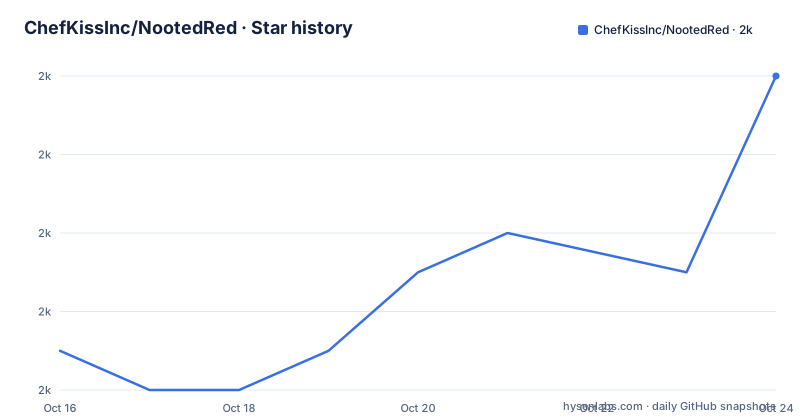
Star history
- ChefKissInc/NootedRed1,992 ★ · +7
| Repository | 2026-10-16 | 2026-10-24 |
|---|---|---|
| ChefKissInc/NootedRed | 2k | 2k |
7 Stars in the last 8 days, measured from the daily GitHub snapshot. Compare with other projects
Editorial analysis
A kext, not a driver, and the difference matters
The project describes itself in one line: the macOS kernel extension for GPU bug fixes, QoL improvements and extended hardware support. The word that matters is extension. NootedRed is not a replacement driver for AMD graphics hardware, it is a kernel extension that sits alongside what macOS already ships. That distinction shapes everything about the project. It is a patch layer working around behaviour in the existing stack, which is why the author calls the project glue between the existing buggy AMD drivers. The topic tags reinforce the scope: amdgpu, vega, apu, amd64, macos, hackintosh, kext, and both lilu and lilu-plugin alongside whateverred and noot. The tags describe the territory the project works in, and they are a fast way to understand that this belongs to the Hackintosh ecosystem rather than to a general graphics stack.
The licence bans use in AI training, which is unusual
The licence is the most distinctive thing about this repository. GitHub cannot classify it, so the LICENSE.md file at the root is the document that governs. The README reproduces the notice, and the key sentence is short enough to quote:
Licensed under the ChefKiss Open Knowledge License version 1.

This work may not be used to train or develop artificial intelligence,
and may not be used with artificial intelligence in any other way. See
the ChefKiss Open Knowledge License for details.
There is a companion badge in the README header stating the project is written by humans and not by AI, and a link to the full licence text on the project's own git server. In practical terms this is a copyleft-style notice with an extra restriction, and it means an organisation that builds AI tooling cannot take this code, and by the wording, cannot use the project with AI in any other way either. If you are reading this as part of a software supply chain review, this is the line that decides whether the dependency is allowed. It also means the full terms live in a document you must fetch separately, since the README excerpt is a summary rather than the licence itself.
Version 0.8.x releases landed in a single afternoon
The release history shows a project that ships in bursts. Three tags appear close together: v0.8.8 on 2026-05-12, v0.8.9 on 2026-05-15, and v0.8.10 later the same day on 2026-05-15. The last push to the master branch was on 2026-10-10, five months after that run of tags, so the code is still moving even though the version numbers have not advanced. Two things follow for anyone tracking it. First, a patch release is a normal event here rather than an exception, so an installation guide that pins a version will age quickly. Second, because the numbering sits at 0.8.x, the author is signalling that the interface is not settled, and the CHANGELOG.md file at the repository root is where you would look to see what actually changed between two of these rapid tags. Nothing in the project promises a support window, so treat each release as a snapshot of the author's current fix set rather than a maintained long term release.
The project admits it will crash
The README carries a warning that is worth repeating here because it is unusual to see stated so plainly: the project is under active research and development, there will be crashes here and there, and the reason given is that the project is glue between the existing buggy AMD drivers. That sentence is the honest summary of the whole approach. A kext that sits in the kernel path and intercepts graphics behaviour is working in territory the author does not fully control, and when the operating system updates, the assumptions the patch was built on may no longer hold. The README points to the repository issues and the project site for more information rather than documenting a support matrix. So the honest reading is that this is a moving target maintained by one developer, and the risk of a broken graphics stack after a macOS update is a real cost you would be accepting, not an edge case.
An xmake build with clang-format and clang-tidy configured
The repository root is small and tells you what the project is made of: a `NootedRed/` source directory, an `xmake.lua` build script, a CHANGELOG.md, a LICENSE.md, a `.clang-format` and a `.clang-tidy`, and a `.github/` directory holding the workflow whose badge sits at the top of the README. Using xmake rather than a Makefile or CMake is a choice that speeds up a C++ project of this size considerably, since the build description lives in one Lua file. The presence of `.clang-format` and `.clang-tidy` at the root indicates the author has settled on a house style and runs static analysis over the code, and the continuous integration workflow produces the status badge in the README header. The README itself does not give a build command, so anyone wanting to compile from source has to read `xmake.lua` and the workflow files to learn the expected toolchain, which is also where you would find the macOS version the extension targets.
The project asks for money in the first paragraph
The README opens with a request for donations, and it is unusually direct about the reason: donations keep the author alive and pay costs, and without funding for the Hackintosh projects the author will have to stop working on them. The README then lists the accepted routes, including a PayPal or credit and debit card option, a Bitcoin address, a Solana address and an Ethereum address. The site linked in the README header, chefkiss.dev/applehax/nootedred, is the project page, and the releases live on GitHub as tagged versions with a downloads badge. Practically, this tells you something about the risk profile that a licence file cannot: the maintenance of the project depends on one person being able to afford to keep working on it, and that person says so in writing. For a kernel extension that you will install into the kernel of your machine, that is a continuity question worth asking before you rely on it.
Editorial conclusion
Adopt NootedRed if you are running macOS on AMD hardware and you have a specific graphics problem the project claims to address, and you are comfortable with a kernel extension that the author says will crash. Do not adopt it if you are building anything that touches artificial intelligence, because the licence forbids that use, and do not treat it as a general purpose driver replacement. Verify first which macOS and GPU combination you have, read the CHANGELOG.md for the specific fixes in the release you plan to install, and read the licence file in the repository rather than relying on the summary in the README.
Frequently asked questions
What does NootedRed do?
The project describes itself as the macOS kernel extension for GPU bug fixes, QoL improvements and extended hardware support, aimed at AMD hardware in the Hackintosh ecosystem. Its topic tags cover amdgpu, vega, apu, kext and lilu-plugin.
Can I use NootedRed in a project that involves artificial intelligence?
No. The ChefKiss Open Knowledge License version 1 states that the work may not be used to train or develop artificial intelligence, and may not be used with artificial intelligence in any other way. The full text is referenced from the README and lives in the LICENSE.md file in the repository.
Is NootedRed safe to install on a Hackintosh?
The project warns that it is under active research and development and that there will be crashes, describing itself as glue between the existing buggy AMD drivers. The README points to the repository issues and the project site for more information rather than documenting a supported configuration list.
How do I build NootedRed from source?
The README does not give a build command. The repository root holds an `xmake.lua` build script, a `.clang-format` and a `.clang-tidy` configuration, and a `.github/` directory with the continuous integration workflow whose badge appears at the top of the README, so the toolchain details are in those files.
How often is NootedRed updated?
Three tags landed in May 2026, with v0.8.8 on 2026-05-12, v0.8.9 on 2026-05-15 and v0.8.10 the same day, and the last push to the master branch was on 2026-10-10. The CHANGELOG.md file in the repository root records what changed between releases.
Official sources
Add this badge to your README
If you maintain this project, the badge below links readers to this analysis and shows its maintenance status from the daily GitHub snapshot. Paste the markdown into your README; add ?metric=license or ?metric=stars to the image URL for a different field.

[](https://hysenlabs.com/projects/chefkissinc-nootedred)Star history chart for your README
[](https://hysenlabs.com/projects/chefkissinc-nootedred)Was this useful?