Hutool: a Java utility library you can copy, not just depend on
🍬A set of tools that keep Java sweet.
At a glance
- What is it?
- Hutool bundles string, IO, crypto, JSON, HTTP and JDBC helpers into one Maven artifact. Its licence and its copy-friendly philosophy are the real story; the module count is what you have to manage.
- Who is it for?
- Adopt Hutool if you are on JDK 8 or later and want a single dependency for the small tasks that would otherwise be scattered across three or four helper classes. Do not adopt it if you need a supported Android target, or if you want an HTTP client or ORM layer that you can tune per call; the README explicitly says Android is untested and the HTTP module is built on HttpURLConnection.
- Can I use it commercially?
- Check first. The repository uses a licence we do not classify automatically, so read its LICENSE file before any commercial use.
- Is it still maintained?
- Yes. The repository last received commits 9 days ago.
- What is it written in?
- Mainly Java, according to GitHub's language statistics.
Answers come from the project's GitHub data, last synced on November 13, 2026, and from our analysis. They are not legal advice.
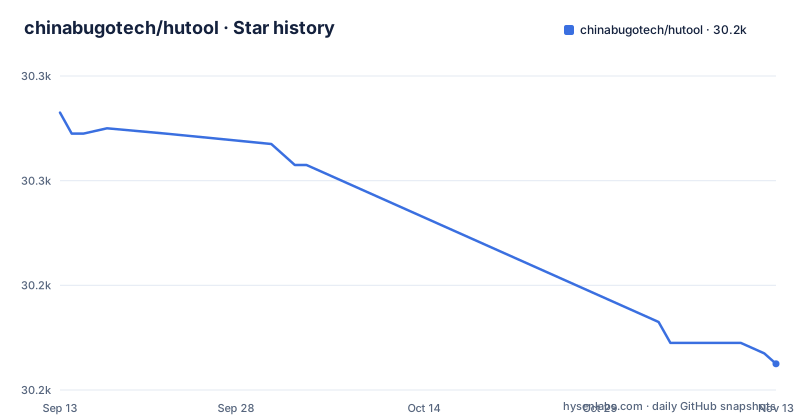
Star history
- chinabugotech/hutool30,225 ★ · -48
| Repository | 2026-09-13 | 2026-11-13 |
|---|---|---|
| chinabugotech/hutool | 30.3k | 30.2k |
-48 Stars in the last 61 days, measured from the daily GitHub snapshot. Compare with other projects
Editorial analysis
The gap Hutool fills between the JDK and a framework
Java's standard library gives you the primitives and leaves the conveniences to you. Reading a file into a string, formatting a date, parsing a JSON fragment, or opening a JDBC connection all take more lines than the task deserves. Hutool is a collection of static utility classes that wrap those operations. The README describes it as a set of tools covering strings, numbers, collections, encoding, dates, files, IO, encryption, JDBC, JSON and an HTTP client. The intended user is a Java developer who wants those helpers without adopting Spring, Apache Commons or a heavier framework. The project's own framing is unusually honest about provenance: the README says most utility classes are '搬运' (carried over) and that you can copy and modify them without attribution. That is a statement about how the code is meant to circulate, and it shapes both the licence choice and the support model.
Module layout: hutool-all versus picking one artifact
The README lists twenty modules. hutool-core holds Bean operations, dates and general utilities. Around it sit hutool-aop (JDK dynamic proxy, for aspect support outside an IoC container), hutool-bloomFilter, hutool-cache, hutool-cron (Crontab-style scheduling), hutool-crypto (symmetric, asymmetric and digest algorithms), hutool-db (a JDBC wrapper following the ActiveRecord idea), hutool-dfa (multi-keyword search on a DFA model), hutool-extra (template engines, mail, Servlet, QR codes, Emoji, FTP, word segmentation), hutool-http (an HTTP client built on HttpUrlConnection), hutool-log (a logging facade that detects the implementation), hutool-script, hutool-setting, hutool-system, hutool-json, hutool-captcha, hutool-poi, hutool-socket (NIO and AIO), hutool-jwt and hutool-ai. The README states each module can be pulled in separately, or all of them through hutool-all. That choice matters more than the feature list. A single artifact is convenient, but it brings in every module. The README says Hutool follows a no-dependency principle, with third-party wrappers confined to hutool-extra, so check the pom of the modules you use, especially hutool-extra.
Getting it into a build: Maven, Gradle and the JDK 8 floor
The README gives the Maven coordinates as groupId cn.hutool, artifactId hutool-all, version 5.8.48, and the Gradle equivalent as implementation 'cn.hutool:hutool-all:5.8.48'. The same version is linked on Maven Central for a direct jar download. The stated baseline is JDK 8 or later. For JDK 7 the README points to Hutool 4.x and notes that line is no longer updated, so a JDK 7 shop is choosing between an unmaintained branch and an upgrade. There is also a note that Android is untested and that not all utility classes or methods are guaranteed to work there; that is a real constraint, not a formality, because reflection-heavy Bean and system utilities are exactly the kind of code that behaves differently on Android. Building from source means downloading the repository from Gitee (either v5-master or v5-dev) and running ./hutool.sh install from the project directory, after which the Maven coordinates resolve locally.
v5-master is frozen, v5-dev is where changes land
The branch table in the README is the most operationally useful part of the document. v5-master is the release branch, matches the jar published to Maven Central, and does not accept pull requests or modifications. v5-dev is the development branch, defaults to the SNAPSHOT version of the next release, and accepts changes and pull requests. The practical consequence: if you fork to fix a bug, a patch against v5-master has nowhere to go. You either target v5-dev or you carry the change yourself. The same table explains why the master branch can look quiet while the project is active. The README asks bug reports to include the JDK version, the Hutool version and the versions of related dependencies, which tells you the maintainers treat version skew as a likely cause. Release history is steady rather than dramatic: 5.8.46 in May 2026, 5.8.47 in July 2026 and 5.8.48 in October 2026. There is no stated long-term support window and no published deprecation policy in the README, so treat the 5.8.x line as a moving target and pin an exact version.
MulanPSL-2.0 and the copy-without-attribution stance
Hutool is licensed under MulanPSL-2.0, and the README links the licence text at license.coscl.org.cn. The README's philosophy section goes further than the licence requires: it says you may copy and modify the utility classes without marking anything, and only asks that bugs be reported back. If you vendor a class into your own source tree, you own it from that moment, including the bug fixes the upstream project ships later. This is a description of the licence and the stated intent, not legal advice; if MulanPSL-2.0 compatibility with your distribution model matters, have someone qualified read the licence text rather than this article.
Where Hutool is the wrong dependency
The HTTP module is the clearest example. It wraps HttpUrlConnection, which the README states plainly. That is fine for a health check or a webhook POST. It is a poor fit for connection pooling, HTTP/2, fine-grained timeouts or interceptors, because HttpUrlConnection does not offer those in a form a wrapper can expose. Teams that reach for hutool-http and later need a pooled client end up rewriting the call sites. The database module carries a similar shape: hutool-db follows the ActiveRecord idea, which means table rows map to objects with attached persistence methods. That is compact for small applications and awkward when you want a repository boundary or explicit transaction control across several aggregates. The Android caveat applies to the whole library rather than one module. And hutool-all as a dependency in a published library is a decision you should make deliberately, since it hands your consumers every module whether they use it or not.
Comparing the approach with Apache Commons and Spring
The nearest well-known alternative for the same job is Apache Commons, split across commons-lang3, commons-io, commons-codec, commons-collections4 and others. The difference in approach is scope and cohesion. Commons libraries are narrow and conservative: each artifact does one thing, changes slowly, and keeps its API stable across major versions. Hutool is broad and opinionated, covering JSON, HTTP, cron, captcha and JWT in one project with a shared naming style, and it evolves faster. If you want a small, stable surface that you rarely think about, Commons is the lower-risk pick. If you want one dependency that answers most small questions without adding four coordinates, Hutool is the lower-friction pick. The trade is that Hutool's breadth means more of your application's behaviour is decided by one project's release cadence. For JSON specifically, Jackson and Gson are the alternatives, and both have larger ecosystems around them than hutool-json; the reason to use hutool-json is consistency with the rest of Hutool, not capability.
Upgrade cost and what to check before you pin a version
Upgrading within 5.8.x looks routine from the release list, but the safe procedure is to read CHANGELOG.md for the specific version you are moving to and to run your test suite against it. The bigger cost is the v5-dev branch: if you need a fix that has not been released, you are either building a SNAPSHOT or patching locally, and the README's own branch table says v5-master will not take your change. Budget for that before you file an issue expecting a backport. Two things are worth verifying first. Open the pom of the module you actually intend to use rather than assuming hutool-all's dependency set, and confirm the exact artifact and version on Maven Central instead of trusting a branch name. Hutool's value is that it removes a hundred small decisions from a Java project; the cost is that you are trusting one library's judgement on all of them at once.
Editorial conclusion
Adopt Hutool if you are on JDK 8 or later and want a single dependency for the small tasks that would otherwise be scattered across three or four helper classes. Do not adopt it if you need a supported Android target, or if you want an HTTP client or ORM layer that you can tune per call; the README explicitly says Android is untested and the HTTP module is built on HttpURLConnection. Before committing, open the pom for the specific module you plan to use and check what it drags in, because hutool-all is not the same dependency as hutool-core, and verify the exact version string you pin against Maven Central rather than the branch name.
Frequently asked questions
What is Hutool?
Hutool is a Java utility library that wraps JDK methods for files, streams, encryption, transcoding, regular expressions, threads and XML into utility classes, and adds modules for JDBC, JSON, an HTTP client, JWT, captchas and more. Its philosophy section says most tool classes were carried over from other projects and that you may copy and modify them without attribution.
How do I add Hutool to a Maven project?
Add a dependency with the groupId `cn.hutool`, the artifactId `hutool-all` and an explicit version such as `5.8.48`. If you would rather not take every module, depend on the individual artifacts instead, for example `cn.hutool:hutool-core` or `cn.hutool:hutool-json`, since each area is published separately.
Which JDK versions does Hutool support, and does it work on Android?
Hutool 5.x supports JDK 8 and newer. The project states that Android is not tested and that it cannot guarantee every utility class or method works there. For JDK 7 the documented answer is Hutool 4.x, which is no longer updated.
Official sources
Add this badge to your README
If you maintain this project, the badge below links readers to this analysis and shows its maintenance status from the daily GitHub snapshot. Paste the markdown into your README; add ?metric=license or ?metric=stars to the image URL for a different field.

[](https://hysenlabs.com/projects/chinabugotech-hutool)Star history chart for your README
[](https://hysenlabs.com/projects/chinabugotech-hutool)Was this useful?