This uBlacklist subscription merges other people's blocklists into one file
🚫 uBlacklist subscription 订阅合集
At a glance
- What is it?
- The uBlacklist subscription compilation is a Go workflow that gathers blocklists published by other projects into a single uBlacklist.txt, updated weekly by GitHub Actions, and the README documents which search engines it covers and how to add or unblock individual domains. The licence is an unusual one, the GLWT public licence, and the compilation inherits whatever terms the upstream lists carry.
- Who is it for?
- Adopt this subscription if you use uBlacklist and want one maintained list instead of configuring several, since the value is that the merge is refreshed weekly and the per-search-engine support is handled for you. Do not adopt it as a neutral list, because the compilation is oriented towards blocking Chinese content farms and machine-translated or AI-generated pages, which is a deliberate editorial choice.
- Can I use it commercially?
- Check first. The repository uses a licence we do not classify automatically, so read its LICENSE file before any commercial use.
- Is it still maintained?
- Yes. The repository last received commits 5 days ago.
- What is it written in?
- Mainly Go, according to GitHub's language statistics.
Answers come from the project's GitHub data, last synced on November 6, 2026, and from our analysis. They are not legal advice.
Star history
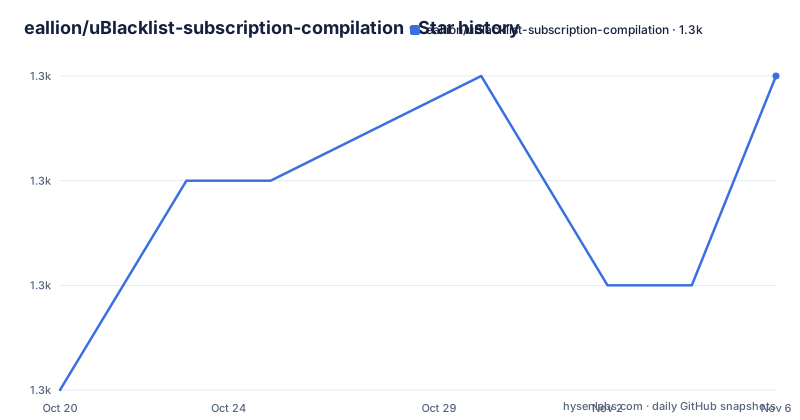
- eallion/uBlacklist-subscription-compilation1,324 ★ · +3
| Repository | 2026-10-20 | 2026-11-06 |
|---|---|---|
| eallion/uBlacklist-subscription-compilation | 1.3k | 1.3k |
3 Stars in the last 17 days, measured from the daily GitHub snapshot. Compare with other projects
Editorial analysis
It is a compilation, not a list of its own
The repository is described as a uBlacklist plugin subscription collection, a set of subscription addresses gathered from around the web and merged into one. The single subscription address is served through a short link, and the real target is a plain text file in the repository. The merge is automated: a GitHub Actions workflow updates the subscription weekly, and the repository carries a badge for that workflow. The upstream contributors are listed in the acknowledgements, more than a dozen separate blocklist projects, and the README states that the subscription sources are all under the MIT licence or no licence, with a note that infringing content will be removed as soon as it is identified. The repository itself is a Go project, so the merge logic is a program rather than a hand-edited file.
The supported search engines are the plugin's, not the list's
The README is explicit that the set of supported search engines is decided by the uBlacklist plugin. The table shows full support for web, image, video and news across Google, Bing, Brave, DuckDuckGo, Ecosia, Kagi, SearXNG and Startpage, with Yahoo! JAPAN marked for web, image and video and Yandex for web and video only. There is no plan to add more built-in engines, and the recommendation is to use SERPINFO to add support for any search engine yourself. That separation is worth understanding, because it means the list is engine-agnostic data and the plugin decides what it can apply it to. The repository also has a `reverse_url.txt` file, which is effectively a whitelist, and there is a separate `uBlocklist.txt` alongside the main `uBlacklist.txt`.
The list is aimed at Chinese content farms
The feature the README leads with is blocking Chinese content farms, and it explains the mechanism as matching domains to filter search results, mainly targeting Chinese SEO spam sites such as machine-translated and AI-generated content. A separate optional block of rules in the settings section targets a different shape of URL, the search redirect patterns used by some of those sites:
*://*/so.php
*://*/so.php?s=*
*://*/cha.php?s=*
*://*/list.php?s=*
*://*/?s=*
*://*/so/*
A separate AI blocklist from another project is referenced for the same purpose. This tells you what the compilation is for and, by implication, what it is not for. It is a Chinese-language search hygiene list, and treating it as a general quality filter would be a misreading of its intent.
Adding and unblocking a domain
There are two documented routes, and they differ in how much friction they carry. For a small number of domains you add them yourself in the plugin's general settings, with a leading `@` character on the line meaning unblock rather than block:
# 加入屏蔽
*://*.baidu.com/*

# 取消屏蔽
@*://*.baidu.com/*
For anything you want to land in the shared list, you submit a pull request to the separate uBlacklist-Subscription repository. Anything unusual enough to be worth an exception can be added to `reverse_url.txt` in this repository, which the README describes as the equivalent of a whitelist. The distinction between the two list files and the per-user rules is the whole extension model: shared blocklist, shared whitelist, and local overrides in the plugin.
The licence is unusual and the file is not the whole story
The licence section reproduces the GLWT, Good Luck With That, public licence, whose text is blunt about what it permits and disclaims. Anyone is allowed to copy, distribute, modify, merge, sell, publish, sublicense or do anything else with the software, at their own risk. The author of the licence knows nothing about the behaviour of the code in the project, the code is presented as usable or not usable with no third option, and in no case is the author responsible for any claim, infringement or other damage arising from the use. The practical reading is that this is a permissive licence with a disclaimer of responsibility rather than a conventional software licence, and the README notes that the upstream subscription sources carry their own MIT or no-licence terms. So if you redistribute the compiled file rather than just subscribing to it, both sets of terms apply.
What the repository actually contains
The top level is small and reveals the shape of the work. There is the compiled `uBlacklist.txt`, a separate `uBlocklist.txt`, the `reverse_url.txt` whitelist, a `source/` directory holding the upstream lists as submodules given the `.gitmodules` file, a `tools/` directory, and the GitHub Actions workflow under `.github/`. The Go project in the repository is the compiler that assembles the output, and the only tagged release is dated 2025-04-29, while the last push to the main branch was on 2026-10-12. The README also recommends other tools for related jobs, including a content farm terminator plugin and a separate search engine filter, and it notes that uBlacklist itself has no effect on Baidu, so a different plugin is needed there. That is a useful limit to know before you install it expecting a specific effect.
Editorial conclusion
Adopt this subscription if you use uBlacklist and want one maintained list instead of configuring several, since the value is that the merge is refreshed weekly and the per-search-engine support is handled for you. Do not adopt it as a neutral list, because the compilation is oriented towards blocking Chinese content farms and machine-translated or AI-generated pages, which is a deliberate editorial choice. Verify first which search engines the uBlacklist plugin you use actually supports, since the supported set is determined by the plugin rather than by this list, and read the GLWT licence before redistributing the compiled file.
Frequently asked questions
What is the uBlacklist subscription compilation?
It is a Go project and GitHub Actions workflow that gathers blocklists published by other projects into a single uBlacklist.txt subscription, updated weekly. The subscription is served through a short link that redirects to the raw file in the repository.
Which search engines does this uBlacklist subscription support?
The set is determined by the uBlacklist plugin rather than by this list. The README's table shows full support for Google, Bing, Brave, DuckDuckGo, Ecosia, Kagi, SearXNG and Startpage, with Yahoo! JAPAN and Yandex partially covered, and it points at SERPINFO for adding other engines.
What is this subscription actually blocking?
Chinese content farms, chiefly Chinese SEO spam such as machine-translated and AI-generated pages, matched by domain. A separate optional set of rules covers the search redirect URL patterns those sites use, and an AI blocklist from another project is also referenced.
How do I add or unblock a domain?
For a few domains, add them in the plugin's general settings, prefixing the line with `@` to unblock instead of block. To change the shared list, submit a pull request to the separate uBlacklist-Subscription repository, and unusual exceptions can go into the reverse_url.txt file in this repository.
What licence does this repository use?
The GLWT, Good Luck With That, public licence, which permits copying, distributing, modifying, merging, selling and sublicensing at your own risk and disclaims any responsibility for the code's behaviour. The upstream subscription sources are stated to be under the MIT licence or no licence.
Official sources
Add this badge to your README
If you maintain this project, the badge below links readers to this analysis and shows its maintenance status from the daily GitHub snapshot. Paste the markdown into your README; add ?metric=license or ?metric=stars to the image URL for a different field.

[](https://hysenlabs.com/projects/eallion-ublacklist-subscription-compilation)Star history chart for your README
[](https://hysenlabs.com/projects/eallion-ublacklist-subscription-compilation)Was this useful?