periodic-table: A Cross-Domain System Design Taxonomy
A Periodic Table of System Design Principles
At a glance
- What is it?
- jarulraj/periodic-table organizes 40+ recurring system design principles into eight thematic groups. It is a conceptual reference for comparing design trade-offs across databases, operating systems, networking, architecture, security, and other systems fields.
- Who is it for?
- Students, researchers, and practitioners who need a shared vocabulary for comparing system designs should use this repository as a reading map and annotation aid. People seeking implementation recipes, a complete catalogue, or guidance for one specialized domain should consult domain-specific sources as well.
- Can I use it commercially?
- Yes. MIT is a permissive licence: you can use, modify and sell software built on it, as long as you keep its copyright and licence notices.
- Is it still maintained?
- Yes. The repository last received commits 4 days ago.
- What is it written in?
- Mainly HTML, according to GitHub's language statistics.
Answers come from the project's GitHub data, last synced on November 7, 2026, and from our analysis. They are not legal advice.
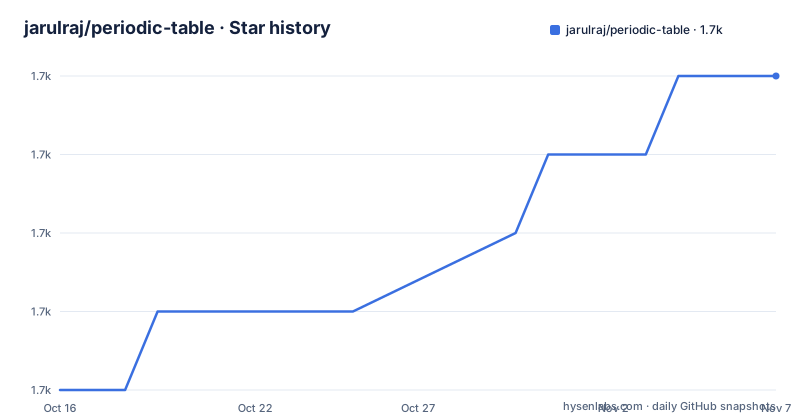
Star history
- jarulraj/periodic-table1,718 ★ · +4
| Repository | 2026-10-16 | 2026-11-07 |
|---|---|---|
| jarulraj/periodic-table | 1.7k | 1.7k |
4 Stars in the last 22 days, measured from the daily GitHub snapshot. Compare with other projects
Editorial analysis
Why jarulraj/periodic-table Exists
jarulraj/periodic-table addresses a vocabulary problem in computer systems. The same design concern can appear under different names in databases, operating systems, architecture, networking, programming languages, and security. A learner who encounters consistency relaxation in a database paper may not recognize its relationship to weakly ordered memory or distributed coordination unless someone supplies the cross-domain connection.
The project seeks a shared, concise vocabulary for reasoning about structure and trade-offs. Its stated audience includes students, researchers, and practitioners. For students, the table offers a map across unfamiliar traditions. For researchers, it provides terms that can help locate a contribution in relation to earlier work. For practitioners, it offers a way to annotate design documents and discuss intent without immediately diving into a domain-specific mechanism.
This is the repository's main value. It does not present itself as a replacement for books, surveys, or system design guides. Instead, it extracts recurring principles so readers can connect designs that otherwise look unrelated. The README uses Consistency Relaxation as an example, linking database isolation concerns with weakly ordered memory hierarchies and eventual-consistency protocols.
That makes the project most useful as a comparative index or teaching aid. It is less suitable as an operational checklist because its principles describe design intent rather than commands, configurations, or implementation procedures.
How the Principle Taxonomy Is Built
The methodology is based on a review of more than 100 influential papers spanning operating systems, computer architecture, databases, networking, programming languages, security, and other areas of computer systems. The documented selection includes historically important and currently relevant work, including papers on concurrency control, consensus, machine learning in systems, and cloud system design.
For each paper, the project asks what high-level design principle appears beneath the concrete mechanism. To enter the taxonomy, a principle must meet two stated conditions. It must be abstract, meaning it is independent of a particular technology or implementation. It must also be general, meaning it appears in more than one systems domain. These filters explain why the repository records aims such as preserving correctness under concurrency or prioritizing the common case instead of naming a particular locking protocol or query planner.
The result is described as a curated set of more than 40 general-purpose principles. Each entry has a short symbol, such as `Co` for composability or `Op` for optimistic design. The symbols support compact reference when annotating papers, lectures, or design documents.
The taxonomy is intentionally selective. The README says it does not attempt to catalogue every principle and describes the work as preliminary. That boundary matters. The table is best read as a hypothesis about recurring patterns, not as proof that the set is complete or that every specialist community uses the terms in the same way.
The Eight Groups and Their Design Boundaries
The principles are arranged into eight groups that reflect familiar dimensions of system design. Structure covers controlling complexity through boundaries that make components understandable, replaceable, and extensible. Efficiency concerns reducing unnecessary work and matching effort to dominant costs. Semantics focuses on making behavior explicit enough to reason about, transform, and preserve.
The remaining groups cover concerns that become clearer when systems operate beyond a single component. Distribution addresses state, computation, and coordination across machines. Planning turns goals and constraints into concrete choices among designs or execution paths. Operability concerns keeping systems understandable and adjustable as workloads, resources, and requirements change.
Reliability covers preserving acceptable behavior under failure, interference, concurrency, and weaker guarantees. Security addresses limiting authority, isolating effects, and reducing what attackers can predict or infer. These definitions are valuable because they separate the intended outcome from the mechanisms used to obtain it.
That separation allows one group to connect several implementation choices without claiming they are interchangeable. For example, Distribution is a design boundary, while eventual consistency could be a domain-specific realization of a broader consistency trade-off. The table therefore invites annotation of intent first and mechanism selection second. This is more precise than treating a technology name as the design principle itself.
Reading the HTML Repository and Starting a First Review
This is primarily an HTML reference project, and the repository does not document an installation command, package name, runtime dependency, or service startup procedure. There is also no documented homepage. The README is therefore the correct entry point: open it on GitHub, read the methodology and table of contents, then follow the in-page references to individual principles.
A useful first exercise is to select one paper from a familiar domain and identify the design question it addresses. Start by asking whether the paper is primarily about boundaries, efficiency, explicit behavior, distribution, planning, operability, reliability, or security. Then inspect the linked principles and record their short symbols. This creates an annotation in the same compact form the project intends for lectures and design documents.
The repository layout includes an `assets/` directory for presentation resources, an `examples/` directory, and a `use-cases/` directory. The visible repository structure therefore suggests examples and applied material beyond the README. However, the available documentation does not describe how to run anything, so there is no justified command or configuration example to reproduce.
For a first real use, remain inside the static content. Compare two papers from different domains, mark each with relevant symbols, and record whether they address the same principle through different mechanisms. That exercise follows the project's stated purpose without pretending the table is executable software.
Where the Taxonomy Can Mislead
The largest limitation is scope. The README explicitly calls the taxonomy preliminary, and its qualifying rules favor principles that transfer across domains. That selection bias is sensible for teaching shared ideas, but it can hide domain-specific distinctions. A general label such as consistency relaxation does not by itself tell a reader whether a design concerns isolation, memory ordering, replication, synchronization, or application-level semantics.
The method also depends on interpreting more than 100 papers through a single analytical question. The README does not provide a detailed paper-selection protocol, coding procedure, inter-reviewer check, or formal validation method. It identifies the domains and the two inclusion criteria, which makes the approach understandable, but it does not establish that the taxonomy is exhaustive or uncontested.
The table can also be mistaken for implementation guidance. The README stresses design intent rather than prescribed mechanisms. A principle such as optimistic design does not tell an engineer which algorithm, protocol, data structure, or configuration to select. Domain expertise remains necessary to move from an annotated design goal to a working design.
For these reasons, the repository is the wrong tool when the immediate need is a production-ready procedure, a complete standards list, or a framework-specific architecture guide. It is better suited to orientation, comparison, vocabulary building, and identifying questions worth investigating.
The Alternative to Domain-Specific System Design Reading
The real alternative is to learn system design through separate domain-specific histories, methods, and examples without this cross-domain taxonomy. Database readers can focus on isolation and transaction processing, operating systems readers on concurrency and scheduling, and networking readers on coordination and failure behavior. That approach preserves local terminology and may expose details that the periodic table deliberately abstracts away.
The difference is in organization and retrieval. Domain-specific reading connects principles to one community's mechanisms and constraints. jarulraj/periodic-table connects mechanisms that appear in different communities, then gives them common labels and short symbols. It can reveal that a familiar database trade-off has a counterpart elsewhere, but it cannot replace the surrounding paper or documentation needed to understand that counterpart's implementation.
The two approaches are complementary rather than competing products. Use the repository first to form a question or connect readings across fields, then consult the cited papers for the technical detail. For a beginner, that sequence reduces fragmented vocabulary. For a specialist, it may function as an index to ideas that fall outside the usual disciplinary boundaries.
Maintenance Signals and the MIT License
The repository is not archived, and its last push was on 2026-10-16. Those are the available maintenance signals. No GitHub releases are listed, so the README does not provide a release history or versioned upgrade path to inspect. Based on the repository layout and primary language, there is also no documented package upgrade procedure or migration task to assess.
The project is licensed under MIT. That permits use, modification, distribution, and private reuse under the license's stated conditions, including preservation of its copyright and permission notice. This is a factual summary of the license category, not legal advice. Organizations should review the actual `LICENSE` file for the complete terms before redistribution.
Because the deliverable is a static HTML reference rather than a documented service, maintenance cost appears lower than for a deployed application. That observation does not mean content review is unnecessary. The methodology is preliminary, the publication includes no releases, and readers still need to assess whether citations, classifications, and terminology remain appropriate for their work.
Editorial conclusion
Students, researchers, and practitioners who need a shared vocabulary for comparing system designs should use this repository as a reading map and annotation aid. People seeking implementation recipes, a complete catalogue, or guidance for one specialized domain should consult domain-specific sources as well. Before adoption, verify that each relevant principle and its cited source fit the paper or design document being studied, since the README explicitly describes the taxonomy as preliminary and incomplete.
Frequently asked questions
What is jarulraj/periodic-table?
It is an HTML-based periodic table of system design principles drawn from more than 100 papers across several computer systems domains. It groups more than 40 abstract, cross-domain principles into eight themes.
How do I install and run jarulraj/periodic-table?
The README does not document an installation command, runtime dependency, or startup process. Open the repository and use the README's table of contents and links as a static reference.
Is jarulraj/periodic-table a complete system design framework?
No. The README explicitly describes the taxonomy as preliminary and says it does not catalogue every principle. It also emphasizes design intent rather than concrete implementation mechanisms.
Official sources
Add this badge to your README
If you maintain this project, the badge below links readers to this analysis and shows its maintenance status from the daily GitHub snapshot. Paste the markdown into your README; add ?metric=license or ?metric=stars to the image URL for a different field.

[](https://hysenlabs.com/projects/jarulraj-periodic-table)Star history chart for your README
[](https://hysenlabs.com/projects/jarulraj-periodic-table)Was this useful?