The-Complete-FAANG-Preparation: A Curated Study Repository for Coding Interviews
Dive into this repository, a comprehensive resource covering Data Structures, Algorithms, 450 DSA by Love Babbar, Striver DSA sheet, Apna College DSA Sheet, and FAANG Questions! 🚀 That's not all! We've got Technical Subjects like Operating Systems, DBMS, SQL, Computer Networks, and Object-Oriented Programming, all waiting for you.
At a glance
- What is it?
- A review of AkashSingh3031's MIT-licensed interview-prep repository, covering its DSA sheets, technical-subject folders and notebook-based solutions, plus the gaps a self-directed candidate should expect.
- Who is it for?
- Adopt this repository if you are a self-directed candidate who wants one MIT-licensed place to hold the 450 DSA by Love Babbar, the Striver DSA sheet, the Apna College DSA Sheet, technical-subject notes and notebook solutions, and you are willing to pick your own path through it. Do not adopt it if you need a scheduled curriculum with progress tracking, graded feedback or maintained per-problem explanations; the repository is a collection, not a course.
- Can I use it commercially?
- Yes. MIT is a permissive licence: you can use, modify and sell software built on it, as long as you keep its copyright and licence notices.
- Is it still maintained?
- Yes. The repository last received commits 34 days ago.
- What is it written in?
- Mainly Jupyter Notebook, according to GitHub's language statistics.
Answers come from the project's GitHub data, last synced on November 15, 2026, and from our analysis. They are not legal advice.
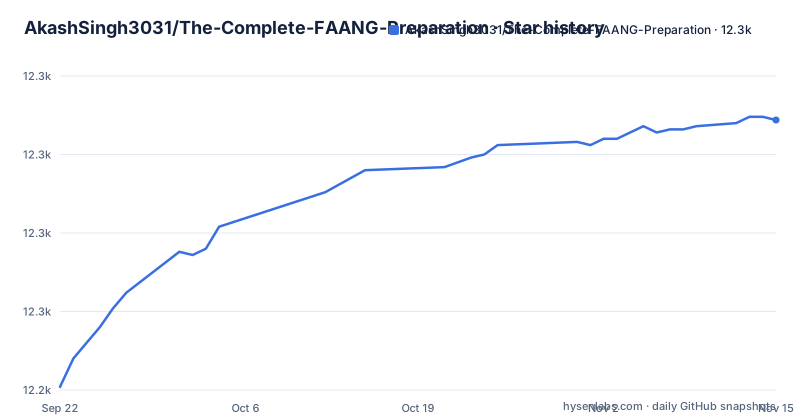
Star history
- AkashSingh3031/The-Complete-FAANG-Preparation12,311 ★ · +85
| Repository | 2026-09-22 | 2026-11-15 |
|---|---|---|
| AkashSingh3031/The-Complete-FAANG-Preparation | 12.2k | 12.3k |
85 Stars in the last 54 days, measured from the daily GitHub snapshot. Compare with other projects
Editorial analysis
What The-Complete-FAANG-Preparation Actually Solves
Interview preparation material is scattered. A candidate typically ends up with one PDF of DSA problems, a second list from a different creator, a set of hand-written notes on operating systems, and a folder of half-finished code. Nothing shares a directory structure, and nothing agrees on ordering. This repository is an attempt to put those pieces under one roof. The README describes it as a resource covering Data Structures, Algorithms, 450 DSA by Love Babbar, Striver DSA sheet, Apna College DSA Sheet, and FAANG Questions, with Technical Subjects like Operating Systems, DBMS, SQL, Computer Networks, and Object-Oriented Programming. The audience is the self-taught candidate or the student preparing without a bootcamp or a paid cohort. It is not a judge, not a course platform, and not a spaced-repetition tool. It is a GitHub repository you clone, and the primary language listed is Jupyter Notebook, which tells you the solutions are largely presented as notebooks rather than as a compiled, testable project.
How the Repository Is Organised on Disk
The layout is the mechanism. The top level has no build system or package manifest. What you get is a numbered top-level structure: 1]. DSA + CP/, 2]. Technical Subjects/, 3]. System Design/, 4]. Projects/, 5]. Important Books and Resources/, 6]. Behavioural Interview/, plus a 0]. Miscellaneous Stuff/ folder, README.md, CONTRIBUTING.md, CODE_OF_CONDUCT.md, Learn.md, Repository_Status.md and images/. The numbered prefixes are deliberate: they impose an order on the browser view of the repository, so a newcomer sees DSA before system design before behavioural material. The folder names point to DSA material, technical-subject notes, system design, projects, books and resources, and behavioural interview preparation. The repository is a reading and practice surface rather than a software project, so a clear directory map is the main structure it offers.
Cloning It and Opening a First Notebook
There is no package to install. The repository has no GitHub releases. The route in is to clone the repository from the URL given in the README, then open a notebook in whatever environment you already use for Python work. The README's own link points at the master branch, which is the default branch listed for the repository. Run the clone from a directory where you keep study material.
A First Real Use: Pick One Sheet and One Subject
The repository contains several overlapping problem lists, and working through all of them is redundant. A more practical first pass is to choose one DSA sheet and one technical subject, then treat the rest as reference. Once the clone is on disk, open the repository in your file browser or editor and confirm the numbered folders are present. What you should see is the set of directories described in the repository layout: 0]. Miscellaneous Stuff/, 1]. DSA + CP/, 2]. Technical Subjects/, 3]. System Design/, 4]. Projects/, 5]. Important Books and Resources/, 6]. Behavioural Interview/, alongside LICENSE and README.md. From there, open a notebook inside 1]. DSA + CP/ in Jupyter and run the cells to see the solution for that problem. The exact invocation depends on your local Jupyter setup.
Where the Repository Stops Short
The clearest limitation is that this is a collection, not a curriculum. Nothing in the repository enforces that you finish the 450 DSA by Love Babbar list before touching the Striver DSA sheet, and nothing tracks which problems you have solved. If you need a schedule, streak tracking or graded feedback, this is the wrong tool; a platform that runs your code against hidden tests will serve you better. The second limitation is verification. With Jupyter Notebook as the primary language and no test harness at the top level of the tree, a notebook solution is only as trustworthy as the last person who ran it. The third is that the material is broad by design, which means depth varies by folder. Finally, there are no GitHub releases; if a folder is reorganised, you have no release to fall back to.
How It Compares with LeetCode and NeetCode
LeetCode is an execution and judging platform: you submit code, it runs against hidden test cases, and it reports pass or fail with runtime and memory figures. NeetCode is a curated problem list with video walkthroughs, structured as a path. This repository differs on both axes. It does not execute your code, and it does not gate content behind a subscription or an account. Its value is that it aggregates several named sheets, the 450 DSA by Love Babbar, the Striver DSA sheet and the Apna College DSA Sheet, into one MIT-licensed tree that you can clone, fork and read offline. The practical consequence is that you would typically use this repository for the reading and the reference notes, and a judge platform for the practice loop. Using it as a substitute for a judge means you write solutions with no external confirmation that they are correct.
Licence, Maintenance and Upgrade Cost
The repository is MIT licensed, and a LICENSE file sits at the top level. MIT permits reuse, modification and redistribution with the copyright notice and permission notice retained. That matters here because the repository covers named problem sheets from other creators and has a folder called 5]. Important Books and Resources/. The licence covers the repository's own contents; it does not automatically settle the status of every third-party item or external list, and that is a question for whoever owns those works, not something the LICENSE file answers. On maintenance, the last push was on 2026-10-12, which is recent. There are no GitHub releases, so the upgrade path is a fresh clone or a pull against master. Because the content is notebooks and markdown, an upgrade is cheap to take and cheap to ignore: there is no dependency graph to resolve and no migration script. The cost is that a pull can move files you have bookmarked, and without releases you cannot pin a known-good state except by recording a commit hash yourself.
Editorial conclusion
Adopt this repository if you are a self-directed candidate who wants one MIT-licensed place to hold the 450 DSA by Love Babbar, the Striver DSA sheet, the Apna College DSA Sheet, technical-subject notes and notebook solutions, and you are willing to pick your own path through it. Do not adopt it if you need a scheduled curriculum with progress tracking, graded feedback or maintained per-problem explanations; the repository is a collection, not a course. Before you invest weeks, verify three things yourself: that the specific sheet you intend to follow is present and complete in the branch you cloned, that the solutions open and run in your local tooling, and that the folders for the technical subjects you are weakest in contain more than a placeholder. The last push was on 2026-10-12, so the tree is recent; the absence of GitHub releases means you should pin a commit hash rather than assume a stable snapshot.
Frequently asked questions
How do I prepare for FAANG interviews using The-Complete-FAANG-Preparation?
The repository gathers several DSA sheets, technical-subject notes and behavioural material under one tree, so the practical approach is to clone it, pick one DSA sheet rather than working through all of them, and pair it with a platform that executes your code, since this repository does not run or grade solutions.
Is Blind 75 enough for FAANG, or do I need The-Complete-FAANG-Preparation?
The repository description does not mention Blind 75, so it gives no answer on whether that list alone is sufficient. What it does provide is several named sheets, including 450 DSA by Love Babbar, the Striver DSA sheet and the Apna College DSA Sheet, alongside technical-subject notes.
Can I prepare for FAANG in 3 months with The-Complete-FAANG-Preparation?
The repository description mentions no schedule, timeline or progress tracking, so it cannot tell you whether three months is enough. It does let you choose a single sheet and a single technical subject, which is the only pacing decision the repository structure supports.
Official sources
Add this badge to your README
If you maintain this project, the badge below links readers to this analysis and shows its maintenance status from the daily GitHub snapshot. Paste the markdown into your README; add ?metric=license or ?metric=stars to the image URL for a different field.

[](https://hysenlabs.com/projects/akashsingh3031-the-complete-faang-preparation)Star history chart for your README
[](https://hysenlabs.com/projects/akashsingh3031-the-complete-faang-preparation)Was this useful?