EventSourceProxy: Turning Plain .NET Interfaces into ETW Log Sources
EventSourceProxy (ESP) is the easiest way to add scalable Event Tracing for Windows (ETW) logging to your .NET program
At a glance
- What is it?
- EventSourceProxy generates ETW logging from plain C# interfaces and abstract EventSource classes, with IL emission and transform rules. It cuts boilerplate but carries .NET Framework baggage and a licensing question mark.
- Who is it for?
- Adopt EventSourceProxy if you own a .NET Framework codebase, want to add ETW logging to existing interfaces without hand-writing EventSource classes, and can live with the NOASSERTION license. Skip it if you are on .NET Core or need a maintained, clearly licensed library.
- Can I use it commercially?
- Check first. The repository uses a licence we do not classify automatically, so read its LICENSE file before any commercial use.
- Is it still maintained?
- Probably not. The repository last received commits 20 months ago, on February 25, 2025.
- What is it written in?
- Mainly C#, according to GitHub's language statistics.
Answers come from the project's GitHub data, last synced on October 22, 2026, and from our analysis. They are not legal advice.
Star history
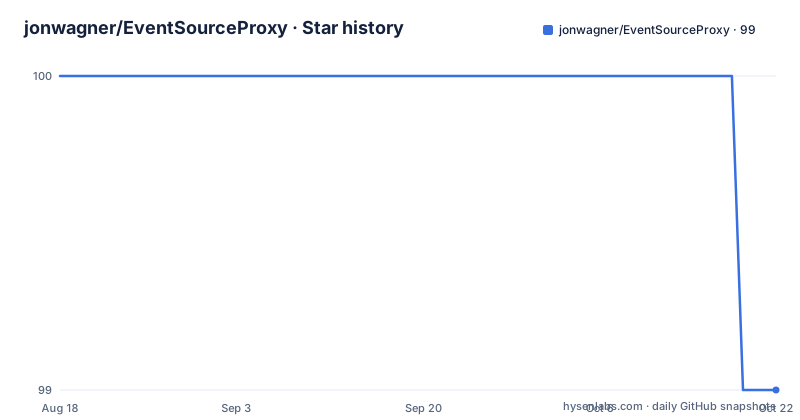
- jonwagner/EventSourceProxy99 ★ · -1
| Repository | 2026-08-18 | 2026-10-22 |
|---|---|---|
| jonwagner/EventSourceProxy | 100 | 99 |
-1 Stars in the last 65 days, measured from the daily GitHub snapshot. Compare with other projects
Editorial analysis
The Boilerplate Problem in ETW Logging
ETW is the Windows-native tracing subsystem, and the .NET EventSource class is the managed way to feed it. The catch is that writing an EventSource by hand means declaring each event method, decorating it with EventAttribute, assigning opcodes and tasks, and keeping the manifest in sync. For a large interface, that is a lot of repetitive code. EventSourceProxy attacks that by generating the implementation for you. You declare an interface or an abstract EventSource, and the library emits the concrete type at runtime. The README's example is a two-method ILog interface: call EventSourceImplementer.GetEventSourceAs<ILog>() and you have a working log source. The intended audience is .NET developers on Windows who want ETW's low overhead without hand-writing every event.
Three Modes of Code Generation
The library supports three distinct usage patterns. First, it implements a plain interface as an EventSource, so any interface can become a log source with zero extra code. Second, it fills in an abstract class that derives from EventSource, letting you keep the familiar EventSource shape while ESP generates the method bodies. Third, it wraps an existing object: TracingProxy.CreateWithActivityScope<ICalculator>(calculator) returns a proxy that logs every method call on the interface when the ETW source is enabled. The proxy also exposes _Completed and _Faulted events, which is useful for tracking async or long-running operations. The README stresses that generated IL keeps overhead low and is almost nothing when tracing is off, meaning the runtime cost of the generated code is meant to be acceptable for high-frequency logging.
Transform Rules for Logged Data
Not every interface method signature maps cleanly to what you want in the log. The README shows a configuration API for reshaping parameters. For an IEmailer interface, you can tell ESP to trace only certain fields of an Email object, rename them (From becomes Sender), combine Subject and Body into a single JSON message, and ignore the when parameter entirely. The fluent syntax chains methods like .Trace(e => e.From).As("Sender") and .TogetherAs("message"). You can also add context that is not part of the method signature, such as .AddContext("user", () => SomeMethodThatChecksIdentity()). This is the feature that separates ESP from a simple proxy generator. It lets you keep the logging shape independent of the code shape, which is exactly what you need when an interface carries data you do not want in the trace.
Getting It Running: NuGet and Two Package Variants
The README points to NuGet for installation. There are two packages: EventSourceProxy for the .NET Framework's System.Diagnostics.Tracing, and EventSourceProxy.NuGet for the separate Microsoft.Diagnostics.Tracing NuGet library. That split matters because the two libraries have different APIs and versioning. The setup is minimal: reference the package, then call EventSourceImplementer.GetEventSourceAs<T>() or TracingProxy.CreateWithActivityScope<T>(instance). No configuration file is needed for the basic case. For transform rules, you configure TraceParameterProvider.Default in code, as shown in the IEmailer example. The wiki is referenced for full documentation, but the README itself gives enough to start. There is no mention of .NET Core or .NET Standard support, which is a red flag for modern projects.
Limitations: Framework Lock-In and Missing Maintenance Signals
The most obvious limitation is the .NET Framework focus. The two-package split exists because the framework's tracing library and the NuGet one diverged, and the README does not mention .NET Core at all. If you are on a modern runtime, this is likely the wrong tool. Second, the license field says NOASSERTION, which means the repository does not declare a standard open-source license. That is a legal risk for adoption, and you should resolve it before using the code. Third, the repository shows no recent releases and no last-push date in the supplied material, so maintenance status is unclear. The README references a v2.0 feature, but there is no evidence of ongoing development. For a library that generates IL at runtime, lack of updates can be a problem because it may break with new framework versions or security patches.
Alternatives: Hand-Written EventSource and SLAB
The obvious alternative is to write your own EventSource subclass by hand. That gives you full control over event definitions, keywords, and opcodes, but it is exactly the boilerplate ESP eliminates. A more comparable option is the Microsoft Enterprise Library Semantic Logging Application Block (SLAB), which the README itself recommends for consuming ETW data. SLAB is not a generator; it provides listeners that route ETW events to console, rolling files, or databases. So the two tools are complementary: ESP produces the events, SLAB consumes them. If you do not need the transformation rules, a hand-written EventSource is simpler and has no runtime code generation. If you need cross-platform tracing, look at modern alternatives like OpenTelemetry, though the README does not mention it.
Maintenance and Upgrade Considerations
Upgrade cost depends on which package you use. The framework version ties you to the .NET Framework's System.Diagnostics.Tracing, which is stable but not evolving. The NuGet version tracks Microsoft.Diagnostics.Tracing, but that library has its own release cycle and versioning, so you must match ESP's expectations. The README does not document a migration path between the two. There is also the question of runtime IL generation: any change to the .NET runtime's access rules or the introduction of obfuscation or partial-trust environments could break the generated proxies. The README does not address these scenarios. Before upgrading, you should check the wiki for version-specific notes, and test the generated code in your actual deployment environment.
Editorial conclusion
Adopt EventSourceProxy if you own a .NET Framework codebase, want to add ETW logging to existing interfaces without hand-writing EventSource classes, and can live with the NOASSERTION license. Skip it if you are on .NET Core or need a maintained, clearly licensed library. Before adopting, verify the license terms with your legal team, confirm the NuGet package still installs on your target framework, and test that the generated IL works under your obfuscator or partial-trust environment, since those are common failure points for runtime code generation.
Frequently asked questions
What is EventSourceProxy?
EventSourceProxy is the easiest way to add scalable Event Tracing for Windows logging to a .NET program. It automatically implements logging for any interface or for a class derived from EventSource, taking the boilerplate out of writing an EventSource by hand.
Which EventSourceProxy package should I install?
There are two. EventSourceProxy works with the .NET Framework and System.Diagnostics.Tracing, while EventSourceProxy.NuGet works with the EventSource library from NuGet and Microsoft.Diagnostics.Tracing.
Can EventSourceProxy log an interface I already have?
Yes. TracingProxy.CreateWithActivityScope wraps an instance and returns a proxy of the interface type, and all calls are automatically logged when the ETW source is enabled. Proxies also implement _Completed and _Faulted events.
How do I change what EventSourceProxy logs for a method?
Register rules on TraceParameterProvider.Default. You can rename and reshape parameters with Trace(e => e.From).As("Sender"), drop one with Ignore("when"), and add a value that is not an argument with AddContext("user", () => SomeMethodThatChecksIdentity()).
How do I get the data out of ETW after EventSourceProxy records it?
The recommended reference is the Microsoft Enterprise Library Semantic Logging Application Block, which has ETW listeners that log to the console, a rolling flat file, and databases.
Official sources
Add this badge to your README
If you maintain this project, the badge below links readers to this analysis and shows its maintenance status from the daily GitHub snapshot. Paste the markdown into your README; add ?metric=license or ?metric=stars to the image URL for a different field.

[](https://hysenlabs.com/projects/jonwagner-eventsourceproxy)Star history chart for your README
[](https://hysenlabs.com/projects/jonwagner-eventsourceproxy)