KasperZutterman/Second-Brain: A Public Digital Garden Directory
A curated list of awesome Public Zettelkastens 🗄️ / Second Brains 🧠 / Digital Gardens 🌱
At a glance
- What is it?
- Second-Brain is a curated directory of public Zettelkastens, second brains, notes sites, wikis, and digital gardens. It helps readers discover personal knowledge systems, but it is not the note-taking software itself.
- Who is it for?
- Second-Brain is appropriate for readers who want examples of public personal knowledge systems and need inspiration before choosing a notes or publishing approach. It is not appropriate for teams expecting an application, a searchable knowledge-management platform, or a documented evaluation method.
- Can I use it commercially?
- Yes. MIT is a permissive licence: you can use, modify and sell software built on it, as long as you keep its copyright and licence notices.
- Is it still maintained?
- Yes. The repository last received commits 24 days ago.
- What is it written in?
- GitHub does not report a main language for this repository.
Answers come from the project's GitHub data, last synced on November 7, 2026, and from our analysis. They are not legal advice.
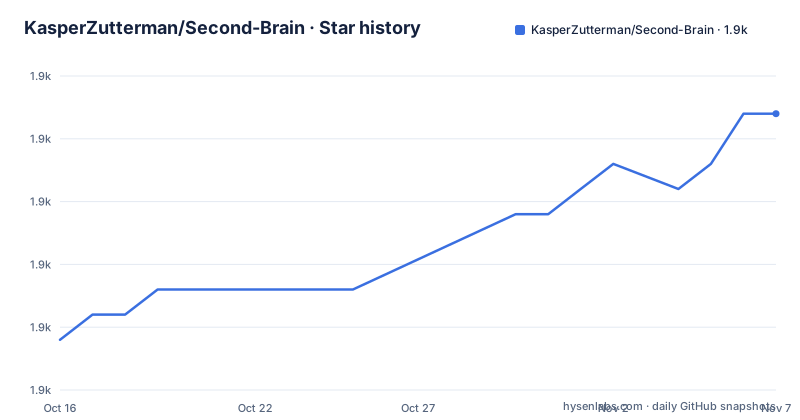
Star history
- KasperZutterman/Second-Brain1,861 ★ · +9
| Repository | 2026-10-16 | 2026-11-07 |
|---|---|---|
| KasperZutterman/Second-Brain | 1.9k | 1.9k |
9 Stars in the last 22 days, measured from the daily GitHub snapshot. Compare with other projects
Editorial analysis
What Second-Brain Solves
KasperZutterman/Second-Brain solves a discovery problem rather than a software problem. Its README describes the repository as a curated list of awesome Public Zettelkastens, Second Brains, and Digital Gardens. The entries point to personal sites, notebooks, wikis, knowledge bases, notes collections, and garden-style publishing pages. This is useful for a reader who understands the broad idea of connected personal knowledge but does not yet know where to find examples.
The directory is aimed at people exploring how other individuals organize and publish notes. A reader can compare a conventional personal site with a notebook, a GitHub repository, a wiki, or a dedicated notes path. The list includes entries such as Andy Matuschak's notes, Andrew Tang's notes, Aaron Parecki's site, and several GitBook and GitHub-hosted collections. These links illustrate that a second brain can mean several different publishing arrangements.
It is important not to confuse this repository with a personal knowledge-management application. The repository has a README, a LICENSE, and a .github directory, but its visible entries do not show a package manifest, application source code, configuration schema, or command-line interface. It is therefore a directory project. Its value comes from the set of linked destinations, not from software executed by someone who installs the repository.
How the Directory Is Structured
The visible data model is a Markdown table in README.md. Each row contains a person's name, a URL described as a Second Brain, and a Twitter column. Some rows also provide a separate Twitter URL, while others leave that cell empty. The table is a flat catalog rather than a taxonomy. The README does not document tags, categories, sorting rules, ratings, update dates, or a distinction between a Zettelkasten and a digital garden.
That simple structure has a clear advantage. A reader can scan names and destinations without learning a query language or application interface. The list can also include heterogeneous sources because the URL is the primary unit. GitHub pages, personal domains, hosted documentation, wiki paths, and static sites appear together in the same collection. A source can remain visible even when its implementation differs from another entry.
The same simplicity creates limitations. A URL alone does not tell the reader whether a site is chronological, graph-based, tag-based, wiki-like, or focused on published essays. It also does not indicate whether a site is private, stale, moved, or currently maintained. The README does not document an automated validation process for links, and the repository has no GitHub releases. Based on the visible layout, the directory's maintenance action is primarily editorial: entries are stored in Markdown rather than exposed through a documented service API.
Reading the Listed Examples
The directory is most useful as a set of concrete examples. Some entries point to a general personal site, such as https://aaronparecki.com/. Others point directly to a notes area, such as https://tangdrew.com/notes or https://notes.andymatuschak.org/. Still others use a knowledge-base path, such as https://bphenriques.github.io/knowledge-base/, or a wiki path, such as https://garden.charlietrochlil.com/. This variation is meaningful because it shows that the term "second brain" can describe a practice and a body of published material, not one fixed application architecture.
A reader could use the list to study the boundary between personal publishing and knowledge organization. A website may present a person's broader identity, while a notes URL exposes a narrower collection. A GitBook link may emphasize documentation, and a GitHub link may expose repository-based content. The README itself does not explain these distinctions, so any comparison must be made by opening the destinations. The directory should be treated as a starting index, not as a claim that all listed systems share the same internal structure.
The inclusion of social links also creates a discovery path beyond the knowledge site. Twitter is used as an additional identity or publication link for some people. However, the README does not explain whether those accounts are currently active, whether every entry has one, or whether the social link is intended as a primary source. For technical evaluation, the Second Brain URL is the more relevant field because it identifies the actual knowledge collection named in the table.
Installation and First Use
The README does not provide installation steps, setup commands, package names, or an application interface. The repository is presented as a Markdown collection, so its documented way to get the project is through the repository's README and the linked external sites. There is no documented local server, plugin, CLI, environment variable, or configuration file that can be copied into a first-use example.
A first real use consists of opening README.md, choosing a person whose public notes interest you, and following the corresponding Second Brain URL. The reader can then inspect whether the destination is a personal site, a notes collection, a wiki, or another published knowledge base. The table does not explain how to import or migrate any data, so the first use is exploratory rather than operational.
If you want to preserve a local copy of the directory, the visible repository artifact to consult is README.md. The repository entries also include LICENSE, but the README does not document a release artifact or downloadable dataset. Any command for cloning, fetching, or running the project would therefore add information not confirmed by the repository and is intentionally omitted here.
Limits of a Curated Link List
The central limitation is that curation is not the same as discovery infrastructure. The README does not document a search field, category filter, full-text index, sorting mechanism, or API. A reader must inspect the table manually, and the visible table may not represent the entire repository because the displayed README is truncated.
Link quality is another issue. The directory can list a URL without proving that the destination remains available, that its content is public, or that its owner wants visitors. The README does not state a review interval or a policy for reporting broken links. The absence of GitHub releases also means there is no documented release-based upgrade path. A consumer can inspect the current list, but should not infer freshness from the repository being unarchived.
This project is also the wrong tool for private knowledge management, team collaboration, permissions, backups, or synchronization. Those concerns require systems and operational documentation that are not part of a link directory. It is similarly unsuitable for importing a user's notes into a Zettelkasten. The listed destinations are public examples, not documented compatible data sources.
A genuine alternative is a general web search or a general-purpose bookmark collection. Those approaches can search across many destinations, while Second-Brain gives a manually curated set of examples. The trade-off is direct: Second-Brain offers a focused starting point for public personal knowledge sites, but provides no documented mechanism for finding every relevant site or comparing them systematically.
Maintenance, License, and Upgrade Cost
The repository is not archived, and the last push was on 2026-10-14. That status indicates recent repository activity according to the repository record. It does not establish that every linked site is maintained, that broken links are checked, or that the list has a published review policy. The repository has no GitHub releases, so upgrade work is not documented as versioned publication.
The repository carries the MIT license. The README does not state additional licensing terms for the external sites listed in the directory. Each destination may have its own terms, copyright policy, or content reuse rules, so using the directory as a discovery aid should not be confused with permission to copy, republish, or ingest those sites. The MIT license covers the repository's own files under its license terms, while the README does not provide guidance about third-party content.
The practical maintenance cost for a user is low because there is no application to configure or upgrade. A maintainer who wants to improve the directory must edit the Markdown table, validate individual links, and decide how to handle moved or removed sites. The README does not specify automated link checking, contribution rules, or review intervals. The absence of releases makes it difficult to identify a formal update boundary, so users should inspect the current README when they need the latest listed destinations.
Editorial conclusion
Second-Brain is appropriate for readers who want examples of public personal knowledge systems and need inspiration before choosing a notes or publishing approach. It is not appropriate for teams expecting an application, a searchable knowledge-management platform, or a documented evaluation method. The first verification should be whether the listed sites still exist, remain public, and expose the kind of structure or publishing style the reader actually needs.
Frequently asked questions
What is KasperZutterman/Second-Brain used for?
It is a curated directory of public Zettelkastens, second brains, notes sites, wikis, and digital gardens. It helps readers discover examples of public personal knowledge collections.
Does Second-Brain include a note-taking application?
No application or installation interface is documented in the visible repository entries. The repository contains a Markdown README and links to external knowledge sites.
Can I search or filter the entries in Second-Brain?
The visible README presents a Markdown table with names, Second Brain links, and Twitter links. It does not document search, filtering, categories, or an API.
What license does Second-Brain use?
The repository lists the MIT license. The README does not state the licensing terms of the external sites linked from the directory.
Official sources
Add this badge to your README
If you maintain this project, the badge below links readers to this analysis and shows its maintenance status from the daily GitHub snapshot. Paste the markdown into your README; add ?metric=license or ?metric=stars to the image URL for a different field.

[](https://hysenlabs.com/projects/kasperzutterman-second-brain)Star history chart for your README
[](https://hysenlabs.com/projects/kasperzutterman-second-brain)Was this useful?