AIRI: A Self-Hosted AI Companion That Plays Minecraft and Talks in Real Time
Self hosted, you-owned Grok Companion, a container of souls of waifu, cyber livings to bring them into our worlds, wishing to achieve Neuro-sama's altitude. Capable of realtime voice chat, Minecraft, Factorio playing. Web / macOS / Windows supported.
At a glance
- What is it?
- Project AIRI is a TypeScript-based, MIT-licensed desktop and web app that recreates the Neuro-sama experience: a persistent AI character with realtime voice chat and the ability to play games like Minecraft and Factorio. It is self-hosted, meaning you own the data and the persona.
- Who is it for?
- Adopt AIRI if you want a self-hosted, MIT-licensed AI companion that you can shape and control, and if you are comfortable with a project that is still pre-1.0 (latest release v0.14.1) and releases quickly. Do not adopt it if you need a production-grade virtual assistant with clear SLAs or if you expect a turnkey setup without reading source code.
- Can I use it commercially?
- Yes. MIT is a permissive licence: you can use, modify and sell software built on it, as long as you keep its copyright and licence notices.
- Is it still maintained?
- Yes. The repository received new commits within the last day.
- What is it written in?
- Mainly TypeScript, according to GitHub's language statistics.
Answers come from the project's GitHub data, last synced on November 13, 2026, and from our analysis. They are not legal advice.
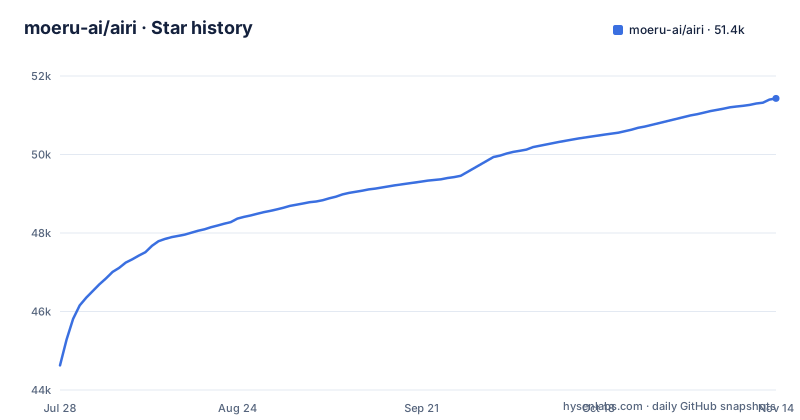
Star history
- moeru-ai/airi51,400 ★ · +6,773
| Repository | 2026-07-28 | 2026-11-13 |
|---|---|---|
| moeru-ai/airi | 44.6k | 51.4k |
6,773 Stars in the last 108 days, measured from the daily GitHub snapshot. Compare with other projects
Editorial analysis
What AIRI Actually Solves
AIRI targets a narrow but real problem: giving you a persistent, self-hosted AI character that can talk to you in realtime and interact with the world through games. The README is explicit about the inspiration, Neuro-sama, a popular AI streamer. The project aims to recreate that experience, not as a cloud service, but as something you own. The description calls it a "soul container" for virtual characters, which is a poetic way of saying the persona and its memory live on your hardware. For engineers, the value proposition is control: you decide where the model runs, what data is stored, and how the character behaves. It is not a chatbot that answers queries; it is a companion that can hold a voice conversation and, according to the README, play Minecraft and Factorio. That is a specific niche, and the project does not pretend to be a general-purpose assistant.
How It Works: Voice, Games, and a Persistent Persona
Realtime voice chat requires speech-to-text, an LLM for response generation, and text-to-speech. The README mentions a separate organization, proj-airi, for sub-projects including RAG, a memory system and an embedded database. The repository has a web app and a desktop app (stage-web and stage-tamagotchi scripts in package.json), but how the voice and game features work internally is not described in the README.
Getting It Running: Commands and Platforms
Installation is straightforward for end users. Windows users can run `winget install MoeruAI.AIRI` or use Scoop with `scoop bucket add airi https://github.com/moeru-ai/airi` followed by `scoop install airi/airi`. macOS users get a Homebrew Cask: `brew install --cask airi`. There are also direct download links for a Windows setup executable and a macOS DMG, plus a Linux download button, though the README does not specify the Linux package format. The web version is available at https://airi.moeru.ai, which suggests you can try it without installing. For developers, the repository is on GitHub with a docs site at https://airi.moeru.ai/docs/. The download links point to v0.14.1, which is also the latest release tag.
The Beta Caveat: Versioning and Stability
The project is clearly in active development, but the release cadence tells a cautionary tale. The latest releases are v0.14.1 (2026-10-30), v0.14.0 (2026-10-29) and v0.13.1 (2026-10-28), three versions in three days. The download buttons point to v0.14.1, the newest release. With version numbers below 1.0 and a pace like that, you should expect changes between versions. For an engineer evaluating this for a hobby project, that is acceptable. For anything mission-critical, it is a red flag. The project also has a Discord server and a Telegram channel, which suggests community support is the primary mechanism for troubleshooting.
Licensing and Ownership: MIT with a Warning
AIRI is licensed under MIT, which is permissive: you can use, modify, and distribute it, even commercially, as long as you include the original copyright notice. That is a strong point for adoption. The README also contains a warning that there is no officially minted cryptocurrency or token associated with the project. That is a useful caution because AI companion projects sometimes attract scam tokens. For engineers, MIT means you can fork the project, embed it in your own software, or build a product around it without paying licensing fees. The main constraint is that the project itself may depend on third-party models or services, such as ChatGPT or Claude, which have their own terms. The README mentions these models as the power behind the companion, so you need to check whether your usage complies with those providers' policies. The project does not appear to bundle models; it likely connects to external APIs, which means operational costs and data privacy depend on the provider you choose.
Where AIRI Falls Short: Documentation and Verification
The biggest limitation is that the opening of the README is mostly download buttons, install commands and community links, with little on configuring the model provider or the voice pipeline. There is a docs site at https://airi.moeru.ai/docs/, which is the first place to look for setup details. The project also assumes you have access to powerful LLMs, which may require API keys and incur costs. The description names Minecraft and Factorio playing, but the opening of the README does not state version compatibility. If you are not interested in the anime waifu aesthetic or the Neuro-sama style, the project may feel gimmicky. It is a niche tool, not a general-purpose automation platform.
Alternatives: What Else Offers This Mix
The closest alternative in spirit is SillyTavern, an open-source frontend for roleplaying with LLMs. SillyTavern focuses on text-based roleplay and character cards, with a large community and extensive documentation. It does not natively do realtime voice chat or game playing, but you can pair it with external tools like Text-to-Speech extensions. The difference is that SillyTavern is a chat interface, while AIRI aims to be a full companion with voice and game interaction. Another alternative is a custom bot built with a framework like Discord.py or a game-specific bot for Minecraft, but that requires significant development effort. If you want a ready-to-run Neuro-sama clone, AIRI is the closest fit among the options here. If you want a more documented and community-supported roleplay tool, SillyTavern is a safer bet. The choice depends on whether you value the integrated voice and game features over the stability of a mature project.
Maintenance and Upgrade Path
The project is actively maintained, with three releases in three days (v0.13.1, v0.14.0, v0.14.1), which indicates a fast iteration cycle. That is good for feature development but bad for stability. Upgrading between these fast-moving versions may require migrating configuration or data, and the opening of the README does not document a migration path. The separate organization for sub-projects suggests that the core is modular, which could ease upgrades, but it also means more moving parts. The MIT license means you can fork and maintain your own version if the project stalls, but you would need to keep up with upstream changes. The community is active on Discord and Telegram, so you can ask for help,. For a hobbyist, the maintenance cost is manageable. For a business, the fast release pace and the lack of a documented upgrade process in the README is a serious concern. You should plan to pin a specific version and test thoroughly before updating.
Editorial conclusion
Adopt AIRI if you want a self-hosted, MIT-licensed AI companion that you can shape and control, and if you are comfortable with a project that is still pre-1.0 (latest release v0.14.1) and releases quickly. Do not adopt it if you need a production-grade virtual assistant with clear SLAs or if you expect a turnkey setup without reading source code. Before deploying, verify the exact model provider setup, the audio pipeline dependencies, and whether the game integration works with your specific game versions; the opening of the README does not cover them.
Frequently asked questions
What is Project Airi?
A self-hosted virtual character project that re-creates Neuro-sama, a soul container of AI waifu and virtual characters. The project description says it does realtime voice chat and can play Minecraft and Factorio, on web, macOS and Windows.
How do I install Project Airi?
On Windows, winget install MoeruAI.AIRI, or add the Scoop bucket and install airi/airi. On macOS, brew install --cask airi works without adding a custom tap. Release binaries are also attached to the GitHub releases.
Is there an official Project Airi token or cryptocurrency?
No. The README carries a warning stating that there is no officially minted cryptocurrency or token associated with the project, and asks readers to check the information and proceed with caution.
Official sources
Add this badge to your README
If you maintain this project, the badge below links readers to this analysis and shows its maintenance status from the daily GitHub snapshot. Paste the markdown into your README; add ?metric=license or ?metric=stars to the image URL for a different field.

[](https://hysenlabs.com/projects/moeru-ai-airi)Star history chart for your README
[](https://hysenlabs.com/projects/moeru-ai-airi)Was this useful?