Dark-Web: A Curated Index of Tor Investigation Tools, Not a Tool Itself
tools for exploring darkweb
At a glance
- What is it?
- This repository is a hand-curated list of open source projects and services for searching, scanning, and crawling Tor hidden services. It offers no code, no installer, and no original tooling, so its value depends entirely on the quality and freshness of its links.
- Who is it for?
- Adopt Dark-Web if you are a security researcher, threat intelligence analyst, or hobbyist looking for a single bookmark list of Tor-related tools and services. Do not adopt it if you need an actual tool, because the repository contains no executable code or installation instructions.
- Can I use it commercially?
- Not without permission. GitHub finds no licence file in the repository, and without a licence all rights are reserved by default: you may read the code but not reuse it. Check the README, or ask the authors, before using it.
- Is it still maintained?
- Yes. The repository received new commits within the last day.
- What is it written in?
- GitHub does not report a main language for this repository.
Answers come from the project's GitHub data, last synced on October 22, 2026, and from our analysis. They are not legal advice.
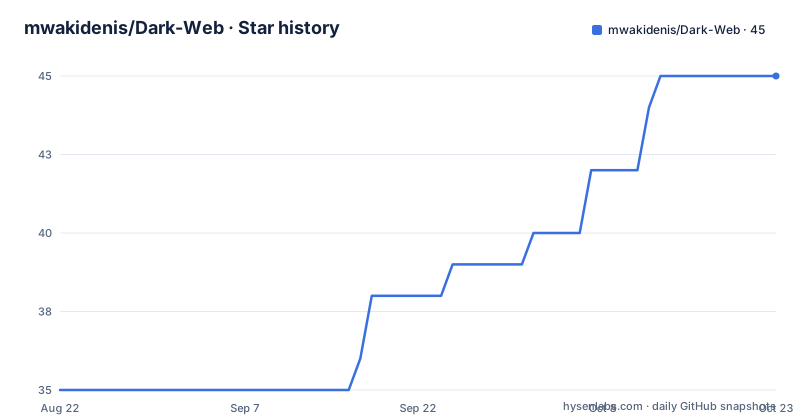
Star history
- mwakidenis/Dark-Web45 ★ · +10
| Repository | 2026-08-22 | 2026-10-22 |
|---|---|---|
| mwakidenis/Dark-Web | 35 | 45 |
10 Stars in the last 61 days, measured from the daily GitHub snapshot. Compare with other projects
Editorial analysis
What This Repository Actually Is
The Dark-Web repository is a plain README file that categorizes external resources for exploring Tor's hidden services. It lists tools under four headings: search engines, onion link directories, scanners, and crawlers. There is no source code, no configuration file, and no license file in the material provided. The primary language is unknown, and the last push date is not available. In short, this is a link aggregator, not a software project. If you clone it, you get a single markdown document. That is the whole deliverable.
Who Benefits from a Link List
The target audience is someone who needs a starting point for dark web research without spending hours hunting for tools. A law enforcement analyst, a threat intelligence researcher, or a curious developer might find value in having search engines like Ahmia and OnionSearch listed next to crawlers like TorBot and Prying Deep. The categorization helps a newcomer understand the landscape: search first, then scan, then crawl. But the list is static. It does not tell you which tools are actively maintained, which are abandoned, or which have known issues. That gap matters because the dark web tooling ecosystem changes quickly.
The Mechanism: How the List Is Organized
The README groups tools by function. The search engine section includes Katana, OnionSearch, Darkdump, Ahmia, Darkus, and Onion Search Engine. The onion link section lists Tor66, TorNode, and Darkweblink, with both clearnet and .onion URLs. The scanning section covers Onionscan, Onioff, and docker-onion-nmap. The crawling section lists TorBot, TorCrawl, VigilantOnion, OnionIngestor, Darc, Midnight Sea, and Prying Deep. Finally, a miscellaneous section includes DeepDarkCTI. Each entry is a hyperlink to an external GitHub repository or a website. There is no description of what each tool does, no installation command, and no usage example. The structure is the only mechanism: it saves you the time of searching for these names yourself.
How to Get It Running: There Is Nothing to Run
Because the repository contains no code, there is no installation procedure. The README does not provide any commands like git clone, pip install, or docker run. To use the list, you simply open the README on GitHub and click the links. For example, the Ahmia entry points to ahmia.fi and its source repository at github.com/ahmia/ahmia-site. The OnionSearch entry points to github.com/megadose/OnionSearch, which is a separate project you would need to install on your own. The Dark-Web repository itself offers no way to automate the process of fetching these tools. If you want a script to install all listed tools, you will have to write it yourself, using the URLs as a starting point.
Limitations and Failure Modes
The most obvious limitation is the lack of maintenance metadata. The material shows no last push date, no releases, and no license. That means you cannot tell if the list is current. A .onion link like Tor66's fresh list may be dead tomorrow, and the README will not reflect that. Another failure mode is that the list mixes active projects with possibly abandoned ones. For instance, OnionScan (github.com/s-rah/onionscan) has been largely unmaintained for years, but the README lists it without any warning. A newcomer might spend time trying to install a tool that no longer works with current Tor versions. The repository also includes commercial or semi-commercial services like IACA Dark Web Investigation Support, which may have different terms of use than open source tools. Without annotations, the reader cannot distinguish a one-off script from a robust platform.
A Real Alternative: Ahmia's Source Code
If you want an actual tool instead of a list, the Ahmia search engine is a concrete alternative. The README links to its source repository at github.com/ahmia/ahmia-site. Ahmia is a real web application that indexes .onion services and provides a search interface. Its approach is fundamentally different: instead of pointing you to other tools, it is a working search engine you can deploy or contribute to. You can run it, modify it, and integrate it into your own research pipeline. The trade-off is that Ahmia requires a server, a database, and ongoing maintenance to keep its index fresh. Dark-Web, by contrast, costs nothing to maintain beyond updating links. But that is also its weakness: a list cannot search, scan, or crawl for you.
Maintenance and License Implications
The material provides no license for the Dark-Web repository. That is a problem for reuse. Without a license, the default copyright rules apply, meaning you cannot legally redistribute the README or incorporate it into your own documentation without permission. The linked tools themselves have their own licenses, which vary. For example, TorBot and Prying Deep are open source, but you must check each repository for its specific license terms. The maintenance cost of Dark-Web is low but real: someone must periodically verify that each link still resolves and that the listed tools are still relevant. The repository shows no evidence of such maintenance, so you should assume the list may be stale.
Editorial conclusion
Adopt Dark-Web if you are a security researcher, threat intelligence analyst, or hobbyist looking for a single bookmark list of Tor-related tools and services. Do not adopt it if you need an actual tool, because the repository contains no executable code or installation instructions. Before relying on any listed link, verify that the upstream project is still maintained and that the .onion addresses are reachable, since the README provides no update date and the repository shows no recent releases. If you want a maintained, self-contained alternative, consider the Ahmia search engine source code, which is an actual application you can run, rather than a link list.
Frequently asked questions
Is the dark web illegal?
The repository takes no position on legality and offers no legal guidance. What it contains is a list of twenty-one publicly linked tools grouped into search engines, onion link directories, scanners and crawlers. Accessing a network is a separate question from what is on it, and nothing on the page addresses either.
how to install dark web
There is nothing to install from this page. It contains no installation instructions, no commands and no configuration, only links to other projects and services. Most entries are repositories you would clone, one is a single Python script file, and one is a container image.
how to use dark web search
The search section of the list names seven entries, including one that publishes both a running site and its source repository. At least three of the seven are given only as hidden service addresses with no normal web equivalent, and the page documents no query syntax, filters or result formats for any of them.
how to use dark web safely
The repository says nothing about safety, operational security, or legal boundaries, and it does not describe what any tool finds or does. It is a bare index with no commentary on any entry, so it is not a source for guidance on the subject. Take advice on that from your own organisation or a qualified professional rather than from a link list.
Official sources
Add this badge to your README
If you maintain this project, the badge below links readers to this analysis and shows its maintenance status from the daily GitHub snapshot. Paste the markdown into your README; add ?metric=license or ?metric=stars to the image URL for a different field.

[](https://hysenlabs.com/projects/mwakidenis-dark-web)Star history chart for your README
[](https://hysenlabs.com/projects/mwakidenis-dark-web)