nextstrain/ncov: SARS-CoV-2 Genomics Workflow and Data Setup
Nextstrain build for SARS-CoV-2
At a glance
- What is it?
- nextstrain/ncov is a Python-based Nextstrain workflow for analyzing SARS-CoV-2 genomes and publishing public evolutionary builds. It is most relevant to teams that can obtain prepared GISAID sequence and metadata data, since `data/metadata.tsv` is no longer stored in the repository.
- Who is it for?
- Researchers and institutions already working with GISAID and Nextstrain can adopt this repository as the reference workflow behind the public SARS-CoV-2 builds, subject to reviewing its current change log. It is a poor fit for users who need repository-contained sample metadata, a turnkey public-data download, or a standalone sequence-alignment program.
- Can I use it commercially?
- Yes. MIT is a permissive licence: you can use, modify and sell software built on it, as long as you keep its copyright and licence notices.
- Is it still maintained?
- Yes. The repository last received commits 12 days ago.
- What is it written in?
- Mainly Python, according to GitHub's language statistics.
Answers come from the project's GitHub data, last synced on November 7, 2026, and from our analysis. They are not legal advice.
Star history
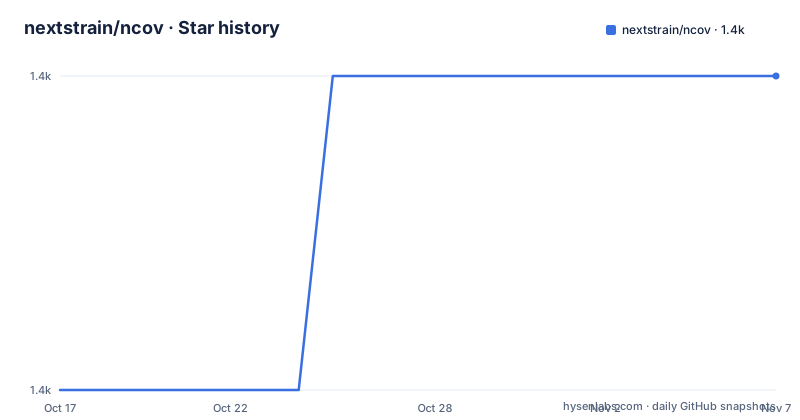
- nextstrain/ncov1,364 ★ · +1
| Repository | 2026-10-17 | 2026-11-07 |
|---|---|---|
| nextstrain/ncov | 1.4k | 1.4k |
1 Stars in the last 21 days, measured from the daily GitHub snapshot. Compare with other projects
Editorial analysis
What nextstrain/ncov analyzes
nextstrain/ncov addresses the need to examine how SARS-CoV-2 genomes evolve and spread across a collection of samples. Its intended users are bioinformatics teams, evolutionary epidemiologists, and researchers who already work with viral sequence data and Nextstrain workflows. The repository supports the publicly available builds linked from `nextstrain.org/ncov`, so it is infrastructure for a specific research problem rather than a general-purpose command-line utility.
The required observations are genome sequences together with associated metadata. The README states that hCoV-19 and SARS-CoV-2 genomes were shared through GISAID, and that the analysis uses the resulting sequence and metadata collection. This distinction matters. The project is not a sequence database and does not package all of its current input data. The repository no longer contains `data/metadata.tsv`, while prepared metadata and FASTA files are available through GISAID.
The project also treats genome interpretation and quality control as part of its scope. Its FAQ directs users who cannot find submitted sequences to `docs/data_faq.md`. It also points to `clades.nextstrain.org`, which can flag sequences that are likely to be excluded by the pipeline. Researchers submitting sequences should understand that submission to GISAID does not by itself guarantee visible inclusion in a Nextstrain build.
Phylogeny, rooting, and temporal assumptions
The bioinformatics notes identify Wuhan-Hu-1/2019, linked in the README as `MN908947`, as the reference for site numbering and genome structure. The phylogeny is rooted using early Wuhan samples. These choices connect the repository's reporting conventions to a defined reference and rooting context, which matters when comparing results or interpreting mutations against other analyses.
Temporal interpretation depends on a stated nucleotide substitution rate of `8 × 10^-4 subs per site per year`. That is a modeling assumption documented by the project, not a performance characteristic. Users changing their data period, sampling design, or analysis configuration should review whether it remains appropriate for their work.
The README also records that SNPs at the first and last few bases of the alignment in early nCoV samples were masked as likely sequencing artifacts. This is a concrete data-handling decision with direct consequences for downstream sequence interpretation. Site numbering, masked terminal positions, rooting, and temporal assumptions all affect reproducibility, so copying only the output files without retaining the documented analytical context would be misleading.
The repository layout points to a `Snakefile`, `workflow/`, `scripts/`, `defaults/`, `data/`, and `narratives/`. Based on those entries, the project separates workflow orchestration, processing code, configuration defaults, data handling, and narrative material. The README does not enumerate every stage or intermediate file, so the linked workflow documentation is necessary for a complete architectural trace.
Obtaining input for a first nextstrain/ncov analysis
There is no installation command in the README. The project directs users to its workflow documentation for tutorials and reference material, and to the data preparation guide for obtaining the required GISAID inputs. This omission is important for a first use. The repository is a workflow, not a packaged application with a documented one-command installer in the README.
A first practical step is to follow the linked data preparation guide and obtain the continually updated, pre-formatted metadata and FASTA files through GISAID. The README does not document credentials, download commands, environment variables, ports, or service configuration, so none can be supplied accurately here. A researcher should not substitute an unrelated public sequence collection and assume that it matches the public Nextstrain build inputs.
After obtaining the data, the workflow documentation is the documented route for installing and running the project. Before starting, check the current change log because the README specifically points readers there for backwards-incompatible workflow changes. Once a build completes, the relevant result should be evaluated against the project's public SARS-CoV-2 builds rather than judged solely by whether a process exits.
A useful first quality-control step is checking sequences against the concerns covered in `docs/data_faq.md`. The README also identifies `clades.nextstrain.org` as a place for basic quality control. Flagged sequences will likely be excluded by the pipeline, according to the README.
GISAID access as nextstrain/ncov's main boundary
The clearest limitation is the separation between workflow code and current input data. `data/metadata.tsv` is no longer included, and obtaining prepared metadata and FASTA files requires the GISAID route described by the README. This makes nextstrain/ncov unsuitable for a user who expects to clone the repository and immediately reproduce a current build from bundled inputs.
The project also is not a general replacement for an alignment or phylogenetics package. Its documentation is tied to SARS-CoV-2, the Wuhan-Hu-1/2019 reference convention, early Wuhan rooting, and a specific temporal assumption. An engineer working on another pathogen, a nonviral dataset, or an alternative reference and rooting policy would need to modify both the data assumptions and the surrounding workflow rather than treating the repository as a generic tool.
A second limitation is interpretive. The pipeline can exclude sequences, and the README does not promise that every submitted GISAID record appears in Nextstrain. Users who need complete inclusion should consult `docs/data_faq.md` before treating absence from a build as a submission failure. Likewise, clade assignment is documented separately in `docs/naming_clades.md`, while `clades.nextstrain.org` provides the referenced assignment tool. Naming and analytical interpretation therefore depend on documentation beyond the repository overview.
Alternatives to the full nextstrain/ncov workflow
One alternative is a separately configured workflow with a locally prepared SARS-CoV-2 dataset rather than this exact repository. The nextstrain/ncov repository carries conventions, defaults, scripts, narratives, and documentation associated with the public SARS-CoV-2 builds. A separate Nextstrain project could be preferable when another team's reference, sampling design, masking policy, or temporal assumptions must take precedence.
A different alternative is to use a lower-level sequence alignment and phylogenetic analysis tool while keeping GISAID as the data source. That approach separates raw computational processing from the Nextstrain build and reporting layer. It may fit a team that needs direct control over alignment, tree inference, rooting, or metadata filtering, although the README does not identify a specific lower-level package or claim that it can reproduce these public builds.
The choice is therefore not simply Nextstrain versus conventional bioinformatics software. It is whether the goal is to reproduce and extend this project's documented SARS-CoV-2 workflow or to construct a different analysis with other assumptions. For the former, the public builds, current documentation, and change log are key. For the latter, borrowing only the repository's scripts would discard the context that makes their behavior meaningful.
Releases, MIT licensing, and change management
The repository is not archived, and its last push was on 2026-10-09. Recent releases include v18 on 2026-07-07, v17 on 2025-07-17, and v16 on 2025-01-29. These dates show recent repository activity, but they do not mean every workflow change is backward compatible. The README instead directs users to the Nextstrain change log for details about breaking changes.
The declared license is MIT. That identifies the repository's stated licensing model, but it does not grant access to GISAID data and does not resolve every question involving sequence submissions, databases, or derived datasets. Users must review the terms associated with each external data source separately. The README's acknowledgement of the originating and submitting laboratories also makes data provenance part of responsible use.
Upgrade work should account for workflow compatibility and current data expectations, not just Python dependencies, which the README does not specify here. In particular, a new checkout may have a newer workflow while a user's input follows an older release. The documented change log is the first project-specific checkpoint before copying configuration, resuming an interrupted run, or comparing outputs from different releases.
Editorial conclusion
Researchers and institutions already working with GISAID and Nextstrain can adopt this repository as the reference workflow behind the public SARS-CoV-2 builds, subject to reviewing its current change log. It is a poor fit for users who need repository-contained sample metadata, a turnkey public-data download, or a standalone sequence-alignment program. Before adoption, verify access to the required GISAID data, the current workflow documentation, and any backwards-incompatible changes since the installed release.
Frequently asked questions
Does nextstrain/ncov include the current SARS-CoV-2 metadata in its Git repository?
No. The README states that `data/metadata.tsv` is no longer included and directs users to obtain continually updated, pre-formatted metadata and FASTA files through GISAID.
Where can I find installation and workflow instructions for nextstrain/ncov?
The README links to the project workflow documentation for tutorials and reference material. It does not provide an installation command.
Why might a SARS-CoV-2 sequence be missing from a nextstrain/ncov build?
The README points users to `docs/data_faq.md` for common causes. It also says that sequences flagged by `clades.nextstrain.org` are likely to be excluded by the pipeline.
Official sources
Add this badge to your README
If you maintain this project, the badge below links readers to this analysis and shows its maintenance status from the daily GitHub snapshot. Paste the markdown into your README; add ?metric=license or ?metric=stars to the image URL for a different field.

[](https://hysenlabs.com/projects/nextstrain-ncov)Star history chart for your README
[](https://hysenlabs.com/projects/nextstrain-ncov)Was this useful?