Velune: a third-party YouTube Music client with a real audio engine
A premium ad-free YouTube Music client for Android. Built with Kotlin & Jetpack Compose.
At a glance
- What is it?
- Velune is an Android app written in Kotlin and Jetpack Compose that plays YouTube Music without ads and without a subscription, and it is far more than a wrapper: gapless playback, crossfade, EBU R128 loudness normalisation, tempo and pitch control, encrypted offline caching and word-by-word synced lyrics with translation. It is GPL-3.0 and entirely community maintained.
- Who is it for?
- Adopt Velune if you want an ad-free, offline-capable YouTube Music experience on Android and you are comfortable with a community project that talks to YouTube's own endpoints. Do not adopt it as a general purpose music player, since it is bound to one service, and note the repository's own warning that a third party site using the Velune name is not operated by the maintainer.
- Can I use it commercially?
- Yes, with conditions. GPL-3.0 is a copyleft licence: if you distribute software that includes it, you must release that software's source code under the same licence. Running it internally without distributing it does not trigger that obligation.
- Is it still maintained?
- Yes. The repository last received commits 56 days ago.
- What is it written in?
- Mainly Kotlin, according to GitHub's language statistics.
Answers come from the project's GitHub data, last synced on November 7, 2026, and from our analysis. They are not legal advice.
Star history
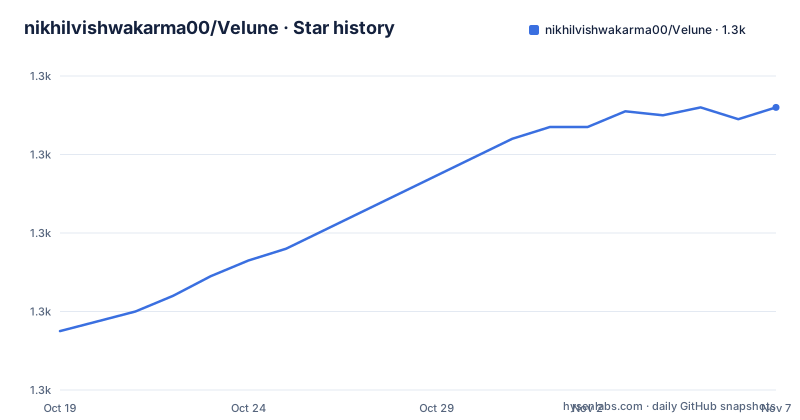
- nikhilvishwakarma00/Velune1,332 ★ · +57
| Repository | 2026-10-19 | 2026-11-07 |
|---|---|---|
| nikhilvishwakarma00/Velune | 1.3k | 1.3k |
57 Stars in the last 19 days, measured from the daily GitHub snapshot. Compare with other projects
Editorial analysis
An independent client, and the project says so plainly
Velune is described as a premium ad-free YouTube Music client for Android, built with Kotlin and Jetpack Compose, and the README states the legal position without hedging. Velune is an independent client and is not affiliated with YouTube or Google, and it asks people to please support artists through official platforms. That sentence is the honest summary of what this project is. It is a client for a service you can already use, built by someone who wanted that service without the advertising and without the subscription, and it inherits the ethical question that comes with any client of this kind, which the project acknowledges rather than pretends away. The positioning in the README is a complete reimagining of YouTube Music, with no ads, no subscription and full control. The audience is people who listen to music through that service and want gapless playback, loudness normalisation, pitch control and offline caching,.
The impersonation warning is the first thing in the README
Before anything else there is an official notice, and it is worth taking seriously. The README states that this is the official Velune repository, maintained by Nikhil Vishwakarma, that the official source code and releases are on GitHub, and that readers should be cautious of third-party websites or downloads using the Velune name that are not linked from that repository. It names one site in particular, velune.cc, and says explicitly that it is not operated or maintained by the author and that the author is not affiliated with it. For your safety, download Velune only from the official GitHub releases. That is a specific and unusual warning to find in a README, and it is the sort of thing that normally appears after a real incident of someone else shipping builds under the name. The safe habit follows from it: take the APK from the GitHub releases, or from the two named distribution channels the project points at, Obtainium and IzzyOnDroid, and not from a website you found through a search result.
The audio engine is the part that makes it a music player
The feature list is grouped, and the group worth reading closely is the audio engine, because it is where a third-party client can genuinely be better than the first-party one. There is gapless playback, a crossfade engine, silence skipping, loudness normalisation to EBU R128, tempo and pitch control, and system EQ integration. Each of those addresses a real irritation with a streaming client that plays compressed audio through a phone speaker: the gap between tracks, the sudden jump in level between a quiet acoustic and a loud mastered track, and the absence of pitch control for a DJ set. The rest of the core experience list is ad-free playback, full library sync, offline caching with encryption, and background playback. The encryption of the cached data is the detail that matters for an offline feature, because a YouTube Music cache on a shared or a backed-up device is exactly the kind of thing you would not want in the clear. The UI group adds Material You dynamic colours, Discord Rich Presence, a personalised home feed, year in review statistics and a custom animated loader, and the highlight feature is real-time synced lyrics with word-by-word sync, smooth animations and translation support, which is a hard thing to do and the one most likely to be the reason someone installs the app.
Eight Gradle modules for one app
The project structure in the README is a list of Gradle modules, and it explains the shape of the codebase better than a paragraph could:
velune/
├── app/
├── innertube/
├── lrclib/
├── kizzy/
├── canvas/
├── lastfm/
├── kugou/
The app module is the application itself, innertube is the module that talks to YouTube's own API surface, lrclib and kizzy are the lyrics side, canvas is the composable UI library, lastfm is the scrobbling integration, and kugou is a Chinese music service integration. The tree at the repository root confirms the same split, adding betterlyrics/ and simpmusic/ as further upstream-derived pieces, and it carries a crowdin.yml, so the interface is translated through Crowdin, plus renovate.json for dependency updates, fastlane/ for release metadata, lint.xml, a ScanAccessibility.kts script and the usual Gradle files. The architecture section describes the approach as MVVM plus Clean Architecture with Unidirectional Data Flow and a modular, scalable codebase, and the stack table names Kotlin for the language, Jetpack Compose with Material 3 for the UI, Media3 with ExoPlayer for audio, Hilt for injection, Room with encryption for the database, Ktor with Retrofit for networking, coroutines and Flow for async work, and Gradle KTS for the build.
Building it locally, and the credits that explain the design
The getting started section lists the requirements as Android Studio Ladybug or newer, JDK 17 and Android SDK 34 or above, and the clone is two commands:
git clone https://github.com/nikhilvishwakarma00/Velune.git
cd Velune
After that you open the project in Android Studio, let it sync and run it. The credits section is the other informative part of the README, because it names the projects the design comes from: Archivetune as the base framework, Metrolist, InnerTune, Kizzy, SimpMusic and BetterLyrics. A project that lists its ancestors this precisely is a fork-and-refine rather than a from-scratch build, and that tells you both where to look for behaviour you like and where to look when something breaks. It also explains the module names, since innertube, kizzy and lrclib correspond to entries in that list. The community links are a Discord server and GitHub Discussions, and the repository carries a CODE_OF_CONDUCT.md and a CONTRIBUTING.md.
Where Velune is the wrong tool
Four limits are visible. The first is the service dependency. This is a client for YouTube Music, so it is only as good as that service, and it is not a general music player for your local files or for another streaming service, whatever the kugou module suggests about its breadth. The second is the account and terms question. The project states that it is not affiliated with YouTube or Google and asks you to support artists through official platforms, and a user deciding whether to install it should take that framing seriously, because the client talks to YouTube's own endpoints and the arrangement depends on an unofficial relationship that YouTube can change. The third is the maintenance reality of a one-person project. The last push was on 2026-09-13, but the newest tagged release is v1.1.2 from 2026-05-24, after v1.1.1 in May and v1.10 in April, so there is a gap between the source and the shipped build, and a breaking change to the inner API surface would arrive as a broken app rather than as a changelog entry. The fourth is the offline promise. Caching works and it is encrypted, but a cached library is still a copy of streamed content under someone else's licence, and it is worth knowing that the durability of that feature depends on the upstream service continuing to serve the same endpoints.
Editorial conclusion
Adopt Velune if you want an ad-free, offline-capable YouTube Music experience on Android and you are comfortable with a community project that talks to YouTube's own endpoints. Do not adopt it as a general purpose music player, since it is bound to one service, and note the repository's own warning that a third party site using the Velune name is not operated by the maintainer. Before you install, take the build from the official GitHub releases rather than a mirror, read the legal note, and check the current release, because the newest tagged build is v1.1.2 from 2026-05-24 while the last push was on 2026-09-13.
Frequently asked questions
What is Velune?
It is a premium ad-free YouTube Music client for Android, written in Kotlin with Jetpack Compose and released under the GPL-3.0 licence. The project states that it is an independent client and is not affiliated with YouTube or Google.
Where should I download Velune from?
From the official GitHub releases. The README warns that third-party websites and downloads using the Velune name may not be official, and it states specifically that velune.cc is not operated by the maintainer. Obtainium and IzzyOnDroid are also linked as distribution channels.
What audio features does Velune add over a stock music app?
Gapless playback, a crossfade engine, silence skipping, loudness normalisation to EBU R128, tempo and pitch control, and system EQ integration, alongside encrypted offline caching, background playback and full library sync.
What are the main modules in the Velune project?
The README lists app, innertube, lrclib, kizzy, canvas, lastfm and kugou, and the repository root adds betterlyrics and simpmusic. The architecture is described as MVVM plus Clean Architecture with Unidirectional Data Flow.
How do I build Velune locally?
Clone the repository with `git clone https://github.com/nikhilvishwakarma00/Velune.git`, change into the Velune directory, and open it in Android Studio, sync and run. The requirements are Android Studio Ladybug or newer, JDK 17 and Android SDK 34 or above.
Official sources
Add this badge to your README
If you maintain this project, the badge below links readers to this analysis and shows its maintenance status from the daily GitHub snapshot. Paste the markdown into your README; add ?metric=license or ?metric=stars to the image URL for a different field.

[](https://hysenlabs.com/projects/nikhilvishwakarma00-velune)Star history chart for your README
[](https://hysenlabs.com/projects/nikhilvishwakarma00-velune)Was this useful?