seekdb's benchmark lives in another repository, and its hybrid search example orders by distance approximately
The AI-Native Search Database. Best for agent storage, it unifies vector, text, structured, and semi-structured data into a single engine. This all-in-one database makes agents smarter, easier to run, and more stable.
At a glance
- What is it?
- A search database built on the OceanBase engine that unifies vector, full-text and scalar filtering in one SQL statement, with copy-on-write database forks for agent experimentation. The headline throughput figures are the vendor's own and the harness that produces them is a separate repository.
- Who is it for?
- seekdb fits an agent workload that writes continuously and reads back milliseconds later, and that needs transactional guarantees and a familiar SQL surface rather than a specialised vector store. Three things to check before you plan around it.
- Can I use it commercially?
- Yes. Apache-2.0 is a permissive licence: you can use, modify and sell software built on it, as long as you keep its copyright and licence notices.
- Is it still maintained?
- Yes. The repository received new commits within the last day.
- What is it written in?
- Mainly C++, according to GitHub's language statistics.
Answers come from the project's GitHub data, last synced on November 15, 2026, and from our analysis. They are not legal advice.
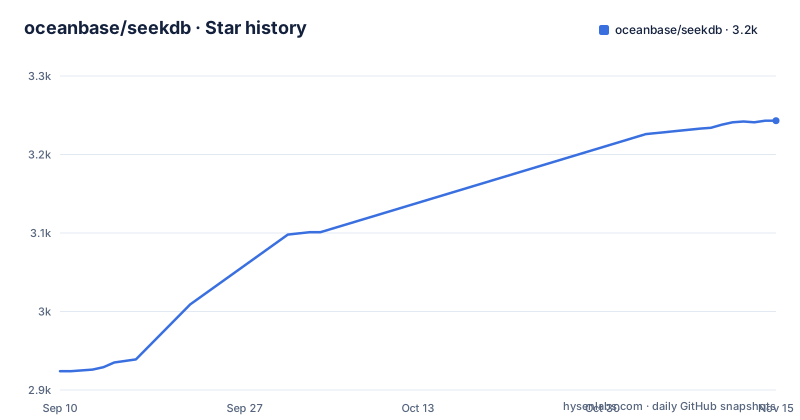
Star history
- oceanbase/seekdb3,243 ★ · +319
| Repository | 2026-09-10 | 2026-11-15 |
|---|---|---|
| oceanbase/seekdb | 2.9k | 3.2k |
319 Stars in the last 66 days, measured from the daily GitHub snapshot. Compare with other projects
Editorial analysis
The headline numbers are the vendor's own, and the harness is in another repository
The README leads with a throughput figure and a latency figure: 1,523 queries per second on a streaming write plus search workload, with a 21.7 millisecond P99 under concurrency. The section that supports it explains the mechanism, and then a second block gives the comparison.
The mechanism is an asynchronous index pipeline. The write path commits and returns without waiting on index construction. A change stream consumes the redo log asynchronously and updates a delta HNSW index, and queries hit both that delta index and a snapshot index with fine-grained read locks. The project attributes low-latency visibility to its incremental and snapshot index design; measure write-to-search visibility for the selected version and workload.
The comparison figures are where the two halves of the README disagree. The summary line at the top of the file says ten times Milvus and three times Elasticsearch. The body says 10.7 times the QPS of Milvus, and then compares P99 jitter against both Elasticsearch and Milvus, claiming 1.1 times jitter against roughly ten times for the two alternatives on the same workload.
So the Elasticsearch multiplier appears only in the summary line, and the body gives a jitter comparison instead of a QPS one. Two source paths are cited for the mechanism, under the observer directory.
The reproduction route is a third repository: a link labelled as reproducing the benchmark points at a streaming vector database benchmark project under the same organisation, not at anything in this tree. A launch blog in the documentation directory carries the longer write-up.
FORK and MERGE are SQL, with three merge strategies and kernel-level copy-on-write
The sandbox feature is the one that speaks directly to agent work, and it is expressed as three statements rather than as an API.
`FORK DATABASE` snapshots an entire database in seconds, and the README is explicit that no data is copied. The agent then works on the fork: the example uses it, inserts a row into a memory table with a session identifier, an embedding and content, and writes freely. The stated permission is wide, described as writing, querying and even breaking tables.
Bringing the work back is a `MERGE TABLE` from the sandbox table into the main one, and the merge takes a strategy. Three are named: fail, theirs and ours. The example uses theirs, which means the sandbox's version wins on conflict. The alternative is discarding the fork with `DROP DATABASE`.
The implementation note is the important qualifier. It says this is kernel-level copy-on-write, and it contrasts that explicitly with application-layer save and restore. So the isolation is a property of the storage engine rather than something the application implements, and the failure mode of an agent that breaks tables is contained by the fork rather than by convention.
The test suite that covers this lives under a tools deploy path in the mysql test suite, in a directory named for the fork and table feature.
The hybrid search example ends with an APPROXIMATE order-by
The pitch for combined search is that vector, full-text and scalar filtering go into one execution plan, with no client-side merging of results and no glue code.
The example that demonstrates it mixes all three in one statement. It selects an identifier and a title and computes an L2 distance against an inline embedding literal, filters on a full-text match against a phrase, adds a scalar equality on an author identifier and a scalar range on a creation timestamp, orders by the computed distance and limits to ten rows.
Two details in that statement are worth reading rather than skimming.
The full-text clause uses MySQL's match-against syntax rather than a vector-index-specific operator, which follows from the engine being OceanBase and the compatibility claim being MySQL. A client can therefore mix a full-text predicate and a vector distance in the same where clause without either index knowing about the other.
And the ordering carries the keyword approximate. The nearest neighbours are not computed exactly; the ordering is approximate and the limit is applied to that approximation. That is the standard trade for a graph index, and it is written into the example rather than buried in a note, which is the right way to show it. What the README does not state anywhere is how the approximation affects recall, so a reader has the mechanism but not the error bound.
Four install routes, and they are not equivalent in what they pin
The installation section offers four routes. The displayed examples do not pin an exact version; select a specific package or image version where reproducibility matters.
The cloud route is a single HTTP call with no request body shown, against an instances endpoint, described as one curl and a running database with no signup and no credit card:
curl -X POST https://d0.seekdb.ai/api/v1/instancesThe free period is seven days. So the fastest route to a database is an unauthenticated request that produces something temporary.
The Python route is a single package install, and the package is a separate distribution from this repository, hosted in its own repository:
pip install -U pyseekdbThe 30-second section presents the same command as the fast path, adding that there are no servers, no schemas and no embedding setup, and that embedded mode runs in process with a switch to server or cluster mode on one line.
The Docker route runs a detached container publishing two ports and mounting a local directory. Two things stand out. The image tag is latest, so it floats. And the volume is mounted at a path under the OceanBase name rather than under this project's name, which follows from the engine underneath being OceanBase.
The binary route differs by platform again. On Linux it is a script fetched over a pipe into a shell, and the URL carries no version. On macOS it is a Homebrew formula, which requires tapping the project's own tap first:
brew tap oceanbase/seekdb
brew install seekdb
Offline DEB and RPM packages exist and are documented on the deployment page rather than in this file.
The data directory is named after OceanBase, and three build systems sit at the root
Two structural facts explain most of what this repository is.
The first is the engine. The README states that seekdb is built on the OceanBase SQL engine, and the container's volume path is an OceanBase data directory. The MySQL compatibility claim follows from that: the wire protocol is MySQL's, the full-text syntax in the hybrid example is MySQL's, and the deployment shape list includes running inside an OceanBase distributed cluster alongside embedded and single-node.
The second is that this is a very large build tree with more than one build system at the root. There is a Bazel setup, with a version file, a root module file with a lock file, a workspace directory and a helper script, plus a separate dependencies directory. There is a CMake setup with its own directory and a root CMake file. There are shell and PowerShell build scripts. And there is a Rust directory, whose purpose the README does not mention anywhere.
Alongside those are the things a database project accumulates rather than designs: a debug macro directory, a profiling directory, an unit test directory, a packaging directory and an RPM directory, an images directory, and the documentation directory that carries the launch blog.
The build scripts are one detail worth noting for anyone reproducing a build: the Linux install is fetched over a pipe into a shell with no version in the URL, so the script that runs is whatever the bucket currently serves.
Continuous integration is configured for two forges, and there are two suppression files
The root contains configuration for two hosting services rather than one: a GitHub directory and a single GitLab CI file.
Alongside them sit two files with the same stem and different suffixes, one for a generic case and one naming the open-source case. Given their names, these are suppression lists for a security scanner, maintained separately for internal builds and for what is published. That is a reasonable thing to do and an unusual one to see, because it means the published tree and the internal tree have different security-scanner behaviour.
Two more dot-directories relate to measurement rather than build. One is named for a performance test, and the other for a farm of them. So the repository does carry its own performance test infrastructure, which sits oddly beside the fact that the headline benchmark is reproduced from a different repository.
The rest of the metadata is conventional: a conduct code, a contributing guide, a notice file, and agent instructions in both a dot-directory and a file. There are three README files at the root, for English, Chinese and Japanese, and the top of the English one links the other two.
The README asks for a star, and two of the four install sections open by default
Two small structural choices in the README are worth naming, because they change what a reader sees.
The first is a request for a star, set in small type beneath the navigation: readers are asked to give the project a star if they find it useful, with the stated reason that it helps others discover the project. It is the only sentence in the file addressed to the reader rather than about the software.
The second is the layout of the installation section. The four platform options are collapsible blocks, and two of them are expanded by default while two are collapsed. The two open ones are the cloud route and the Python route; the Docker route and the binary route are closed. So the default reading of that section shows the two easiest paths and collapses the Docker and binary options, whose displayed examples also do not pin exact versions.
The same pattern appears earlier. The performance section is a heading with no figures under it, followed by links to the blog and the reproduction repository. The reader who wants the numbers has to follow a link, and the numbers themselves are further down under the agent-workload heading.
The rest of the document is consistent about what the project is: a state store for agents, where the headline capability is that a write becomes searchable without the write waiting for the index.
Editorial conclusion
seekdb fits an agent workload that writes continuously and reads back milliseconds later, and that needs transactional guarantees and a familiar SQL surface rather than a specialised vector store. Three things to check before you plan around it. The performance figures in the README are the project's own, and the harness that produces them lives in a different repository, so reproducing them means finding that repository first. The headline claims are stated two ways, with the summary line and the body text using different comparison figures. And the installation routes are not equivalent: the cloud instance is free for seven days, the container runs a floating latest tag with the data directory on an OceanBase path, and the Linux installer is a script fetched over a pipe with no version in it.
Frequently asked questions
What is seekdb?
A search database from OceanBase that unifies vector, text, structured and semi-structured data in a single engine, built on the OceanBase SQL engine with MySQL compatibility and full ACID. It runs as an embedded library, as a single-node server, or inside an OceanBase distributed cluster, and adds database-level forks for agent experimentation.
How do I install seekdb?
Four routes are documented: a cloud instance created by an HTTP POST and free for seven days, the Python SDK with `pip install -U pyseekdb`, a Docker container publishing two ports and mounting a data directory at an OceanBase path, and a binary install, which is a script piped into a shell on Linux and a Homebrew formula on macOS. The Python SDK and the container documentation live in separate repositories.
How does seekdb write and search without a tail latency spike?
The write path commits and returns without waiting on index construction. A change stream consumes the redo log asynchronously and updates a delta HNSW index, while queries read both the delta and a snapshot index with fine-grained read locks. The README's own figure for this is 1,523 queries per second at a 21.7 millisecond concurrent P99.
Is seekdb a replacement for Milvus or Elasticsearch?
The repository does not frame it as a substitution. It states throughput and latency figures comparing itself to both, and links a separate streaming vector database benchmark repository as the way to reproduce them, while positioning itself on MySQL compatibility, ACID transactions and single-query hybrid search.
Official sources
Add this badge to your README
If you maintain this project, the badge below links readers to this analysis and shows its maintenance status from the daily GitHub snapshot. Paste the markdown into your README; add ?metric=license or ?metric=stars to the image URL for a different field.

[](https://hysenlabs.com/projects/oceanbase-seekdb)Star history chart for your README
[](https://hysenlabs.com/projects/oceanbase-seekdb)Was this useful?