OLinuXino: An Open Hardware Single Board Computer Family
OLINUXINO is Open Source / Open Hardware, low cost from EUR 24 Linux Industrial grade Single Board Computer capable to operate -25+85C
At a glance
- What is it?
- OLinuXino is Olimex's family of single board computers, designed so the hardware and software designs are public and OSHW certified, with industrial grade temperature options, battery and UPS circuitry on some boards, and Olimage as the maintained Linux image. The repository holds the board designs, the mechanical files, the documentation and the software.
- Who is it for?
- OLinuXino fits a developer who needs a board they can modify, replicate or put into a product without a licensing fee, and who works in a temperature range or power condition that a general purpose board will not survive.
- Can I use it commercially?
- Not without permission. GitHub finds no licence file in the repository, and without a licence all rights are reserved by default: you may read the code but not reuse it. Check the README, or ask the authors, before using it.
- Is it still maintained?
- Yes. The repository last received commits 12 days ago.
- What is it written in?
- Mainly C, according to GitHub's language statistics.
Answers come from the project's GitHub data, last synced on November 7, 2026, and from our analysis. They are not legal advice.
Star history
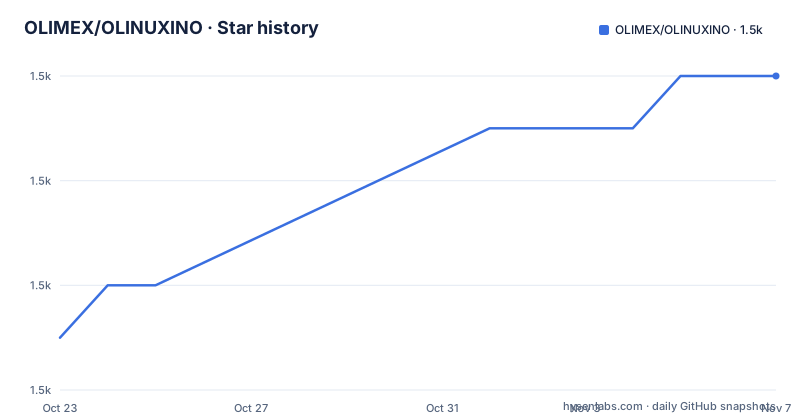
- OLIMEX/OLINUXINO1,506 ★ · +5
| Repository | 2026-10-23 | 2026-11-07 |
|---|---|---|
| OLIMEX/OLINUXINO | 1.5k | 1.5k |
5 Stars in the last 15 days, measured from the daily GitHub snapshot. Compare with other projects
Editorial analysis
A Family Where the Schematics Are Public
OLinuXino is a series of single board computers developed and produced by Olimex, and the name is pronounced Oh-LIH-nuh-zeeno.
The defining characteristic is stated in the introduction: they are completely open-source, meaning that the hardware and software designs are publicly available for anyone to review, modify and redistribute. The repository reflects that literally, with the top level divided into four directories:
BOXES/
DOCUMENTS/
HARDWARE/
SOFTWARE/
The hardware directory holds the designs, the boxes directory the mechanical files, the documents directory the documentation, and the software directory the firmware and software side. A board you can order is a board whose schematics and board files are in the tree, which is a different proposition from a board whose design files are available under an NDA or on request.
The family is compared in the README to the Raspberry Pi and BeagleBone, and the differences it lists are the ones that come from that openness plus the industrial positioning. The primary language recorded for the repository is C, which is what you would expect from a tree that carries firmware and board support code alongside the design files.
What the OSHW Certificate Actually Covers
The boards have received certifications from the Open Source Hardware Foundation, which the README says guarantees that the hardware and software designs meet certain criteria for openness and transparency.
That is a narrower and more concrete claim than the word open usually carries, and the repository gives it structure. The certificate is attached to specific product pages on the Olimex site, where each board family has its own open-source-hardware entry, and the boards are certified rather than the company.
Two consequences follow for someone evaluating the family. The first is that the openness is checkable, since a certificate against a specific board is a claim you can look up rather than a marketing sentence. The second is that the certification covers openness and transparency, and it is not a statement about quality, longevity or support, which are the questions the industrial section of the README answers instead.
The README is careful on that point as well. The permissive licensing of the hardware is listed as a separate advantage from the certification, and it is the licensing rather than the certificate that makes the boards usable in a commercial product without fees or royalties.
Olimage Is the Image to Use, and the Others Are Frozen
The operating system story is a story about which image is current, and the README is clear about it.
Olimex provides mainline images called Olimage, designed specifically for Arm based single board computers like the OLinuXino boards. Olimage is described as a lightweight and optimized operating system that takes full advantage of the OLinuXino's hardware components, including the processor, memory, storage and other peripherals like GPIOs and I2C buses, and it is regularly updated to ensure a stable and secure operating environment.
The second paragraph is the one to plan around. Armbian and sunxi images were provided in the past, and while they are no longer actively supported, they are still available for download. So there is an obvious trap here: the community images have stopped being maintained, and the maintained one is the vendor image.
For a deployment that matters, that ordering decides the choice. A board running a frozen image gets no kernel updates, no security fixes and no driver work for new peripherals, and the README is not offering otherwise.
The Olimage guide is a PDF in the documents directory of the repository, so the setup documentation is part of the same tree as the designs.
Industrial Grades, Temperature Ranges and Battery Circuitry
The ruggedness section is where the family separates from a general purpose hobby board, and it is worth reading carefully because the numbers are specific.
Some models are designed and manufactured to comply with industrial and commercial standards, which means they can operate continuously for extended periods within industrial grade temperature ranges of -40 to +85 degrees Celsius, or commercial grade ranges of 0 to 70 degrees. A board that is only tested from 0 to 70 is not the same product as one that is specified from -40 to +85, and for an enclosure in a factory or a vehicle that distinction is the whole decision.
Some boards are also designed specifically for industrial environments, making them more tolerant of high and low temperatures and able to withstand electrical noise, which is a different property from temperature tolerance and matters for control systems.
Then there is the power story. Some OLinuXino boards feature circuitry for out-of-the-box battery usage, including use as an Uninterruptible Power Supply. The described use case is remote locations or applications where a reliable power source is essential, and the difference from a board with a battery connector is that the board manages the transition, so the system survives a power interruption rather than stopping.
The processors are ARM parts from manufacturers such as Allwinner and Freescale, chosen for low power consumption, high processing power and compatibility with open source software, with processing power options from single-core to quad-core depending on the use case.
The Configuration Range, From A20 Servers to the STM32MP1
The family covers several distinct processor families, and the configuration list in the README shows the spread.
OSHW-Server is a series of low-power server kits built on the A20-OlinuXino-LIME2 board, designed as a cost-effective and energy-efficient solution for running server applications. The idea of a home server kit built from an open board is unusual, and it follows from the open hardware and reproducibility arguments: the design is public, so a second unit can be made from the files.
STMicro STMP1 is a series of boards featuring the STM32MP157 System on a Chip, which includes a dual-core Arm Cortex-A7 running up to 800 MHz together with a Cortex-M4 at 209 MHz, plus a dedicated 3D graphics processing unit. The mixed core arrangement is the interesting part, since the Cortex-M4 is a microcontroller core sitting next to the application processors, and that combination is what makes hardware assisted work in the Linux user space possible.
The Ralink RT5350F is another series, and the list continues beyond what the README excerpt shows.
The interfaces are the conventional set for this class of board, with HDMI, Ethernet, USB and Wi-Fi, plus RAM, storage, connectivity options and expansion slots, which the README describes as making the boards easy to integrate with other devices and systems.
Reproducibility Is the Feature Commercial Buyers Care About
The third of the standout features in the README is the one that rarely shows up in a comparison table and is arguably the most important for an organisation.
The OLinuXino family is designed with reproducibility in mind. The hardware designs are thoughtfully executed, making it easy for users to replicate and manufacture their own boards. The stated use is developers who need to scale up production or customise their boards for specific applications.
Compare that with the alternative. If you buy a hundred boards from a hobby vendor and the vendor stops selling them, you have a hundred boards and no way to make more. If the design is public and the licensing is permissive, the second hundred is a manufacturing problem rather than a sourcing problem, and the difference compounds: the design can be modified for a specific need and then produced.
That is the argument for the permissive licensing in one sentence. The hardware can be used without any restrictions, so you can design, modify and distribute your own products without any licensing fees or royalties, and there are no restrictions on accessing the hardware designs or code.
The pairing of the two features is what makes the family distinctive. Openness without reproducibility is just documentation, and reproducibility without permissive licensing is a trap, since you still cannot sell what you make.
Editorial conclusion
OLinuXino fits a developer who needs a board they can modify, replicate or put into a product without a licensing fee, and who works in a temperature range or power condition that a general purpose board will not survive. It is a poor fit if you want the software ecosystem of a Raspberry Pi and nothing else, since the images are Olimex's own and the older community ones are no longer actively supported, and a poor fit if you need a current board revision from a vendor with a long support commitment. Before ordering, check which image is maintained for your specific board, because the Armbian and sunxi images are still downloadable but are no longer actively supported, and confirm the temperature grade of the configuration you are buying. The repository publishes no GitHub releases, the licence is not stated in the metadata, and the last push was on 2026-05-18.
Frequently asked questions
What is OLinuXino?
It is a series of single board computers developed and produced by Olimex, known for robustness and versatility, and completely open-source in the sense that the hardware and software designs are publicly available for anyone to review, modify and redistribute. The boards have received certification from the Open Source Hardware Foundation.
Which operating system image should I use?
Olimage, the mainline images Olimex provides for Arm based single board computers like these boards. It is regularly updated for stability and security. Armbian and sunxi images were provided in the past and are still available for download, but they are no longer actively supported.
What temperature ranges can the boards handle?
Some models are built to industrial and commercial standards and can operate continuously within industrial grade ranges of -40 to +85 degrees Celsius or commercial grade ranges of 0 to 70, and some boards are designed for industrial environments with higher tolerance of electrical noise.
Can the boards be used in a commercial product?
Yes. The README states that the permissive licensing of the hardware makes it ideal for commercial use, with no restrictions, so you can design, modify and distribute products without licensing fees or royalties, and that the designs are reproducible enough to manufacture your own boards.
Which processors do the OLinuXino boards use?
ARM processors from manufacturers such as Allwinner and Freescale, chosen for low power consumption, high processing power and compatibility with open source software, with processing power options from single-core to quad-core. Configurations include the A20-OlinuXino-LIME2 used in the OSHW-Server kits, the STM32MP157 in the STMicro STMP1 series with a dual-core Cortex-A7, a Cortex-M4 and a 3D GPU, and the Ralink RT5350F series.
Official sources
Add this badge to your README
If you maintain this project, the badge below links readers to this analysis and shows its maintenance status from the daily GitHub snapshot. Paste the markdown into your README; add ?metric=license or ?metric=stars to the image URL for a different field.

[](https://hysenlabs.com/projects/olimex-olinuxino)Star history chart for your README
[](https://hysenlabs.com/projects/olimex-olinuxino)Was this useful?