Open Mercato: a Next.js and PostgreSQL CRM/ERP framework that ships agent rules alongside its business modules
The AI-Engineering Foundation Framework for CRM/ERP and commerce: open-source TypeScript, with multi-tenancy, RBAC, events and domain modules already decided as conventions and specs, so Cursor, Claude Code and Codex build features instead of re-deciding architecture. Start with 80% done.
At a glance
- What is it?
- open-mercato/open-mercato is an MIT-licensed TypeScript monorepo of ready business modules for CRM, ERP and commerce, built so that Claude Code, Codex and Cursor are told where code belongs. It is pre-1.0, and most people are meant to scaffold an app from it instead of cloning it.
- Who is it for?
- Open Mercato fits a team that wants a working CRM/ERP back office to start from and already uses AI coding agents, and accepts a pre-1.0 framework with Docker, Node 24 and about 8 GB of free RAM as the entry price. It does not fit someone who wants a finished product, a production hosting service or a fully MIT stack, since enterprise modules are licensed separately and the cloud workspace is a beta trial.
- Can I use it commercially?
- Yes. MIT is a permissive licence: you can use, modify and sell software built on it, as long as you keep its copyright and licence notices.
- Is it still maintained?
- Yes. The repository received new commits within the last day.
- What is it written in?
- Mainly TypeScript, according to GitHub's language statistics.
Answers come from the project's GitHub data, last synced on November 22, 2026, and from our analysis. They are not legal advice.
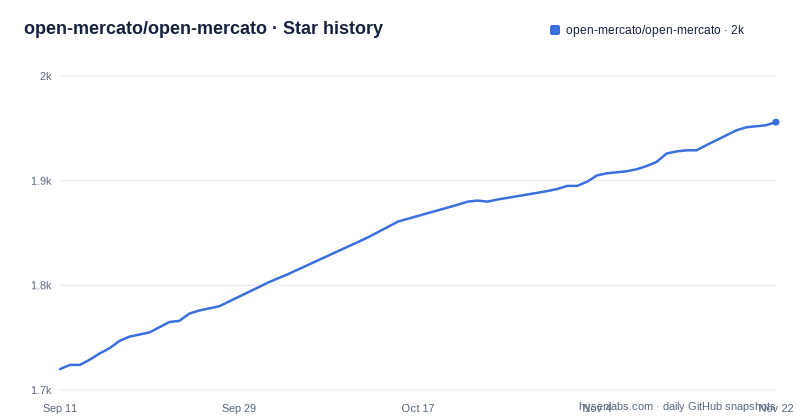
Star history
- open-mercato/open-mercato1,956 ★ · +236
| Repository | 2026-09-11 | 2026-11-22 |
|---|---|---|
| open-mercato/open-mercato | 1.7k | 2k |
236 Stars in the last 72 days, measured from the daily GitHub snapshot. Compare with other projects
Editorial analysis
You are meant to scaffold an app, not clone this repository
The README is blunt about the entry point. To build an app you run a scaffolding command, shown here:
npx create-mercato-app my-appThe note addressed to AI coding agents adds options: a --preset of classic, empty, crm or wms, an --agents choice that can be all or a list of claude-code, codex, cursor and github-copilot, and --init-git. It also says never to clone this repository unless the human wants to change Open Mercato Core, and to ask a single clarifying question if a request such as install this repo is ambiguous.
The consequence is that the repository you are looking at is the framework core, a monorepo with apps and packages workspaces, not the application you ship. Cloning it is the right move for contributors and module authors only. A developer who clones it to start a project is working on the framework itself.
Every generated app carries AGENTS.md, skills and specs that tell the agent where code goes
The central idea is an architecture-aware harness. Every app ships an AGENTS.md and a set of skills that say where code, modules, data models and UI belong, and how to troubleshoot and upgrade. Specs live next to the code in .ai/specs/ and drive the work in a plan, approve, implement order. After scaffolding, the app's own AGENTS.md takes over and every task starts with om-help.
The project's argument is that AI assistants generate code but do not decide where it goes or keep it consistent across a large team. That makes the rules the product as much as the modules. If you do not use an AI agent, you still get business modules, but a large part of the design is aimed at someone who does. The extra skills collection at open-mercato/skills adds code review, ticketing and debugging.
GitHub Copilot gets instructions only, so the hook-based workflow stops there
Choosing which agents to wire up is a decision in the first stage. The README describes all as Claude Code, Codex, Cursor and GitHub Copilot, and specifies that Copilot gets instructions only, with no hooks.
If your team standardises on Copilot, you receive the written guidance but not the hook behaviour that the other agents can use. That does not make the framework unusable with Copilot, but it means the experience described in the README is written for the other three. Decide this before you scaffold. The repository root also contains CLAUDE.md and AGENTS.md of its own for people working on core.
The first run asks for Docker and about 8 GB of free RAM
The Minute 10 stage tells you that you need Docker running, with Docker Desktop, OrbStack or Colima named as choices, and about 8 GB of free RAM. The root package.json requires Node 24.x and pins Yarn 4.17.1. The same file defines scripts such as dev, dev:classic, dev:greenfield and dev:ephemeral for the core repository.
The README says the full four-stage run, from npx to a working module with a business rule and a cafe login, took one agent evening: about 2 hours 10 minutes of wall time, with the first install and the module build as the long parts. That figure is from the authors' own demo run with a fictional coffee roaster, Kaldi and Co., so treat it as a rough reference. A machine that is short on memory or cannot run containers will struggle at the first step.
The cloud workspace is a beta trial with a waitlist, not production hosting
For people without a terminal, Open Mercato Cloud is a hosted trial workspace marked Beta. It needs an account. Inside are the crm, classic and empty templates, demo users, a View as role switcher, a live preview, VS Code in the browser, a web terminal, Claude Code, Codex, PostgreSQL and Redis. There is no Docker inside, and the README says it is not production hosting.
If sign-up says Email registration is currently closed, you are on the waitlist. To keep your work you run gh auth login in the web terminal and use Create repository and Create PR, or Export sandbox, which produces a tar with your workspace and a database dump. The non-developer video course built on the sandbox is available in Polish only. Plan to move your work out before relying on it for anything real.
The core is MIT, but enterprise modules are licensed separately
The README says Open Mercato Core is MIT licensed, with no per-seat licence, and that you own the code. In the same list it says enterprise modules are licensed separately. The repository includes official-modules.json, and module authors can list their own work through the Open Mercato Modules submission page after building with create-mercato-module.
The practical step is to check each module you plan to use before you design around it, because MIT for the core does not extend to everything that the project describes as a module. The core is meant to start a business app at about 80 percent done, in the project's words, and those modules are what supply that figure. Verify the license of the specific ones you rely on.
Cezar runs tasks in separate git worktrees and never merges on its own
Cezar is described as the agentic development IDE. It runs each task in its own git worktree and streams it live, runs the same skills in parallel, on a schedule or on GitHub events, and never merges on its own. In the cloud workspace it is preinstalled as the AI Coding Agent tab, also marked Beta.
The never-merge rule is the safety property to note: unattended runs produce branches you review, not changes on main. That also means you remain the bottleneck for review, so running many tasks in parallel only helps if you can read their output. For the development stack, the compose file brings up an OpenCode container with defaults of OM_AI_PROVIDER openai and OM_AI_MODEL gpt-5-mini, and legacy OPENCODE variables are still forwarded as a fallback.
The version is 0.x and the next release is already numbered 0.10.0
The recent releases are v0.9.0 on 2026-10-09, v0.8.0 on 2026-09-18 and v0.7.0 on 2026-08-26. The package.json in the repository already reads 0.10.0, and the last push was on 2026-11-02. A project in the 0.x range ships a new minor version about every three weeks here.
The repository carries BACKWARD_COMPATIBILITY.md, UPGRADE_NOTES.md and CHANGELOG.md, which is where to look before updating an app. Because your app is generated from this core, an upgrade means reading those notes and checking your own modules against the new minor. Pin the version you start with and read the upgrade notes at every step.
Editorial conclusion
Open Mercato fits a team that wants a working CRM/ERP back office to start from and already uses AI coding agents, and accepts a pre-1.0 framework with Docker, Node 24 and about 8 GB of free RAM as the entry price. It does not fit someone who wants a finished product, a production hosting service or a fully MIT stack, since enterprise modules are licensed separately and the cloud workspace is a beta trial. Before committing, scaffold the classic starter, read UPGRADE_NOTES.md and confirm which modules you need are under the core license.
Frequently asked questions
What is Open Mercato?
Open Mercato is an open-source TypeScript framework on Next.js and PostgreSQL that ships ready business modules for CRM, ERP and commerce. It also ships rules and skills for Claude Code, Codex and Cursor.
How do I start a project with Open Mercato?
Run npx create-mercato-app my-app. You need Docker running and about 8 GB of free RAM. The README says not to clone the repository unless you want to change Open Mercato Core.
Is Open Mercato free to use commercially?
The core is MIT licensed with no per-seat licence. The README also says enterprise modules are licensed separately, so check the license of each module you use.
Official sources
Add this badge to your README
If you maintain this project, the badge below links readers to this analysis and shows its maintenance status from the daily GitHub snapshot. Paste the markdown into your README; add ?metric=license or ?metric=stars to the image URL for a different field.

[](https://hysenlabs.com/projects/open-mercato-open-mercato)Star history chart for your README
[](https://hysenlabs.com/projects/open-mercato-open-mercato)Was this useful?