Ask-Anything: a hub repository whose newest model lives somewhere else
[CVPR2024 Highlight][VideoChatGPT] ChatGPT with video understanding! And many more supported LMs such as miniGPT4, StableLM, and MOSS.
At a glance
- What is it?
- The Ask-Anything repository is a VideoChat family archive: an end-to-end video chat model, a ChatGPT-backed variant, StableLM, MOSS and MiniGPT-4 variants, plus VideoChat2 with its benchmark and two million instruction examples. Its changelog is the interesting part, because the two most recent entries announce models hosted in other repositories, and one of them discloses that thirty repeated benchmark questions were replaced.
- Who is it for?
- Ask-Anything is worth reading as a map of one lab's video-understanding line, because the entries are dated and specific enough to show which idea produced which result, and because the honest notes are in the same list as the claims. Three things to take from it.
- Can I use it commercially?
- Yes. MIT is a permissive licence: you can use, modify and sell software built on it, as long as you keep its copyright and licence notices.
- Is it still maintained?
- Yes. The repository last received commits 129 days ago.
- What is it written in?
- Mainly Python, according to GitHub's language statistics.
Answers come from the project's GitHub data, last synced on November 19, 2026, and from our analysis. They are not legal advice.
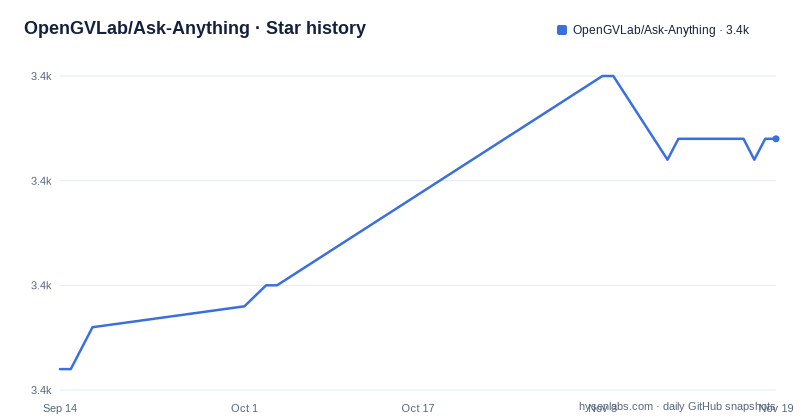
Star history
- OpenGVLab/Ask-Anything3,362 ★ · +11
| Repository | 2026-09-14 | 2026-11-19 |
|---|---|---|
| OpenGVLab/Ask-Anything | 3.4k | 3.4k |
11 Stars in the last 66 days, measured from the daily GitHub snapshot. Compare with other projects
Editorial analysis
The newest model announced here is released from a different organisation's repository
The update list is the substance of this repository, and its most recent entry is dated 17 July 2026. That is also the date the default branch was last pushed, which suggests the entry and the commit are the same event.
What the entry announces is VideoChat3, described as a fully open, efficient 4B video multimodal model for general, long-form and streaming video understanding, with weights, code, training recipes and complete datasets. The link goes to a repository under a different organisation entirely, and the claimed improvement is stated as 18 of 19 offline metrics and 10 of 11 streaming metrics over a named 4B baseline.
The entry before it tells the same story at a smaller scale. In January 2025 the project released videochat-flash and videochat-tpo, and both links point to separate OpenGVLab repositories rather than to directories in this tree. The flash model is credited with new records on multiple video benchmarks for short and long video, and the second uses classical vision task annotations such as tracking to tune a model with direct preference optimisation, adding tracking and segmentation capabilities.
So the most useful thing this repository does now is point at the current work rather than contain it.
The tree lists directories that the getting started section does not link to
There are ten top-level directories, and the navigation does not line up with them.
The getting started section offers five build paths, each linking to a running-usage anchor: an end-to-end one, and four that route through a video_chat_text directory, namely the ChatGPT, StableLM, MOSS and MiniGPT-4 variants. The directory listing, however, shows both video_chat_text/ and separate top-level directories named video_chat_with_ChatGPT, video_chat_with_MOSS and video_miniGPT4, alongside video_chat/ and video_chat2/.
Two of those names therefore exist at the top level while the getting started links point inside another directory of a similar name. Whether those are duplicates left from the April 2023 releases, or the same code reached by a different path, is not something the file resolves. Anyone starting from the repository rather than from the readme should confirm which path is current before following an anchor.
The rest of the top level is small and predictable: an example directory, a license file, both an English and a Chinese readme, and a gitignore. There are no tests, no continuous integration configuration and no packaging files at the root, which is consistent with a repository of research code and model directories rather than an installable package.
Two architectures for the same idea: explicit and implicit
The earliest code release, dated 19 April 2023, shipped two chat variants and the distinction between them is the most reusable idea in the repository.
The ChatGPT variant is described as explicit communication with ChatGPT, with the note that it is sensitive with time. The MiniGPT-4 variant is described as implicit communication through Vicuna, noted as not sensitive with time, and positioned as a simple extension of MiniGPT-4 that will be improved in the future.
That single difference decides whether your setup keeps working. An explicit path depends on an external service remaining available and behaving as expected, so it inherits someone else's model and someone else's outage schedule. An implicit path keeps the language model local behind Vicuna, so nothing external is in the loop, at the cost of being tied to the weights you chose at the time.
The technical report for the same release presents the idea in the same two shapes, describing two versions of VideoChat built via text and via embed. Later in the year a long-video branch added langchain and whisper into VideoChat to get past the one-minute limit, which is a third variant built by composing rather than by swapping the backend.
Thirty repeated benchmark questions were replaced, and the entry says by how much
The 13 June 2024 entry is the most useful one in the file for anyone about to quote a number from it. It bundles a bug fix with the release of testing scripts, and inside it sits a warning that some repeated questions in MVBench, about thirty of them, were replaced, with the stated effect that this may only affect the results by 0.5 per cent.
That is a benchmark integrity note rather than a code note. MVBench is the benchmark this project released alongside VideoChat2 and it was accepted at CVPR2024, so a change to its question set is a change to the yardstick rather than to the runner. The file states the size of the effect and says the scripts are available so the result can be checked.
The same entry points at scripts for two external benchmarks, EgoSchema and Video-MME, and names the notebooks to read, demo_mistral.ipynb and demo_mistral_hd.ipynb under the video_chat2 demo directory. Publishing the test scripts alongside a change to the benchmark is the behaviour you would want from any project whose numbers end up in a comparison table.
VideoChat2 arrived with a benchmark, two million instruction examples and a vllm branch
The 29 November 2023 entry is the release that gave the repository its current shape. VideoChat2 is described as a baseline built on UMT and Vicuna-v0, with two million diverse instruction examples released for tuning, and MVBench released as a benchmark for video understanding. The earlier end-to-end VideoChat is the instruction tuning work, also supporting images, with a report describing the text and embed versions.
Acceptance and then recognition followed in order: MVBench was accepted by CVPR2024 in February 2024, and selected as a poster highlight in April.
The model variants after that are worth reading as a progression rather than a list. A phi3 variant arrived first as the fast one. A mistral variant followed with six benchmark scores attached, on MVBench, NExT-QA, STAR, TVQA, EgoSchema-full and IntentQA. A high-definition variant, fine-tuned on high-resolution data for detailed captioning, claimed 54.8 per cent on Video-MME as the best score among 7B models. And a branch using vllm was released in June 2024 purely to speed up inference of the same model.
So the same weights were re-released four times for different reasons: speed, accuracy, captioning detail, and serving throughput.
A commented-out block holds the instruction data note, and a line promises an update
Some of the file is invisible when it renders. Near the top there is an HTML comment announcing that the video_chat directory is being updated by instruction tuning for video and image chatting, pointing at the instruction data released in a separate InternVideo repository, and stating that the old version of video_chat moved to the video_chat_with_ChatGPT directory.
That comment carries the only statement in the file about where the old code went, and it is the kind of note that gets deleted when it stops being true. A second commented-out block near the bottom held an example video link.
Below those, a single line says the team is also working on an updated version and to stay tuned, which after a run of dated entries through 2026 reads less like news and more like a placeholder that was never replaced.
The Chinese readme is a separate file at the top level, and the badges at the head of the English one point to an openxlab application entry, a Discord server, two arXiv papers, a social account, and two Hugging Face spaces, one for an 8-bit VideoChat model and one for an 8B InternVideo2 chat model.
Two example videos and five separate run instructions
The example directory holds two video files, one of a baseball swing and one of yoga, and they are the only binary assets in the repository. Everything else is text and model code.
Running anything means picking one of the five paths in the getting started section and following its own instructions, because the readme does not contain a single command of its own. There is no install step at the root, no requirements file and no script: the five paths each link to a running-usage section inside its own directory, and the environments they need are described there instead of here.
That structure is the honest shape of this kind of archive. Model code needs specific checkpoints, specific framework versions and often a specific serving stack, and a single combined setup would misrepresent that. The cost is that a reader has to pick a variant before they can start, and the variant list in the tree does not match the variant list in the navigation.
The hosted side is separate from all of it. The homepage is the video chat demo, and the model badges point at hosted spaces, so you can try an end-to-end chat without installing anything from this tree at all.
Editorial conclusion
Ask-Anything is worth reading as a map of one lab's video-understanding line, because the entries are dated and specific enough to show which idea produced which result, and because the honest notes are in the same list as the claims. Three things to take from it. The work has moved: the newest model announced here is released from a different organisation's repository, and two more from January 2025 came out as their own repositories, so this tree is an archive rather than a single product. The benchmark numbers come with caveats stated in the file itself, including thirty replaced questions in one evaluation, so read those lines before quoting a score. And the two architectures named explicit and implicit matter if you plan to build on it, since one depends on an external service being available and the other does not.
Frequently asked questions
What is inside the OpenGVLab Ask-Anything repository?
A family of video chat projects: an end-to-end VideoChat, a ChatGPT-backed variant, StableLM, MOSS and MiniGPT-4 variants, and VideoChat2 with its MVBench benchmark and two million instruction examples. Each has a directory at the top level.
What does the Ask-Anything changelog say about changed benchmark questions?
In the 13 June 2024 entry it states that some repeated questions in MVBench, about thirty of them, were replaced, and that this may only affect the results by 0.5 per cent.
Where is VideoChat3 released from?
From a separate repository under a different organisation, announced in the 17 July 2026 entry of the Ask-Anything update list, which is also the date the default branch was last pushed.
What is the difference between the explicit and implicit chat variants in Ask-Anything?
The ChatGPT variant communicates explicitly with ChatGPT and is described as sensitive with time, while the MiniGPT-4 variant communicates implicitly through Vicuna and is described as not sensitive with time.
Does Ask-Anything include install instructions of its own?
No. The readme offers five build paths, each linking to a running-usage section inside its own directory. There is no install step, requirements file or script at the repository root.
Official sources
Add this badge to your README
If you maintain this project, the badge below links readers to this analysis and shows its maintenance status from the daily GitHub snapshot. Paste the markdown into your README; add ?metric=license or ?metric=stars to the image URL for a different field.

[](https://hysenlabs.com/projects/opengvlab-ask-anything)Star history chart for your README
[](https://hysenlabs.com/projects/opengvlab-ask-anything)Was this useful?