ord: public domain, no warranty, and a signer that does not do sat control
👁🗨 Rare and exotic sats
At a glance
- What is it?
- ord is the index, block explorer and command line wallet for Bitcoin ordinals, released into the public domain under CC0 and described by its own README as experimental software with no warranty. What it documents in unusual detail is how it can hurt you: Bitcoin Core performs no sat control, a wallet command silently loads a wallet, and the donation address is a two-of-four multisig.
- Who is it for?
- ord fits someone deliberately experimenting with ordinals on a segregated wallet who is comfortable reading a security document before pointing a service at the internet. Three things to take seriously.
- Can I use it commercially?
- Yes. CC0-1.0 is a permissive licence: you can use, modify and sell software built on it, as long as you keep its copyright and licence notices.
- Is it still maintained?
- Yes. The repository last received commits 20 days ago.
- What is it written in?
- Mainly Rust, according to GitHub's language statistics.
Answers come from the project's GitHub data, last synced on November 22, 2026, and from our analysis. They are not legal advice.
Star history
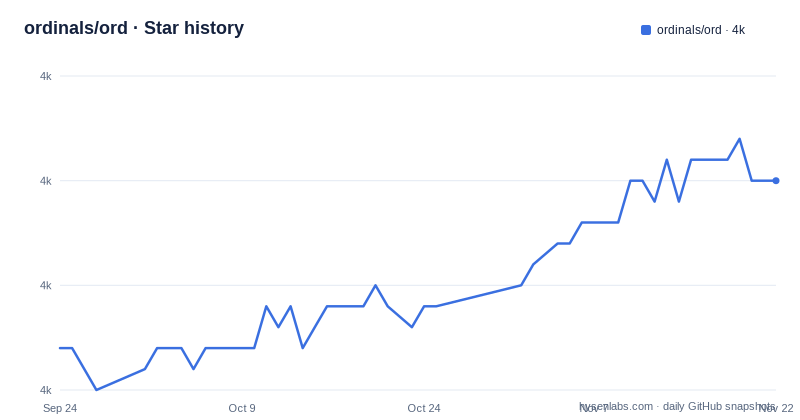
- ordinals/ord3,975 ★ · +8
| Repository | 2026-09-24 | 2026-11-22 |
|---|---|---|
| ordinals/ord | 4k | 4k |
8 Stars in the last 59 days, measured from the daily GitHub snapshot. Compare with other projects
Editorial analysis
Public domain dedication paired with a no-warranty statement
The licensing choice is unusual for a Rust program. The repository is dedicated to the public domain under CC0, which is a waiver rather than a licence with conditions, and the README pairs it with a sentence that has been read as hedging: the software is experimental and comes with no warranty, with a pointer to the licence file for details. Read together, the effect is that a user gets no licence obligations and no recourse. That is a deliberate choice for an experimental tool rather than an oversight, and it is why the README spends more space on what can go wrong than on what the thing does. The GitHub description is three words about rare satoshis and a pair of emoji, the crate description is a symbol followed by wallet and block explorer, and the project's stated purpose is collecting and trading satoshis as curios, which is the numismatic framing rather than a financial one.
Bitcoin Core does not do sat control, and that is the wallet risk
The wallet section is the most useful part of the README and it is entirely about danger. ord relies on Bitcoin Core for private key management and transaction signing, which has three consequences the project states plainly. First, and this is the one to internalise: Bitcoin Core is not aware of inscriptions and does not perform sat control, so using `bitcoin-cli` commands or making RPC calls against an ord wallet may lead to loss of inscriptions. In other words the signer does not enforce the thing that makes an ordinal an ordinal, and a routine Core operation can move a sat out from under it. Second, `ord wallet` commands automatically load the wallet named by the `--name` option, which defaults to ord, so a command you run can leave that wallet loaded for whatever runs next. Third, and consequently, ord should not be used with wallets holding a material amount of funds, and ordinal and cardinal wallets should be kept segregated.
A two-of-four multisig holds the donation address
The project is community funded and says so, naming the current lead maintainer and stating that their work on ord is entirely funded by donations. The address given for them is a Bitcoin address with a link to a block explorer, and it is a two-of-four multisig whose keys are held by four named individuals, each linkable to their own account. That threshold matters more than it first appears: any two of the four can move the funds, so no single person can spend the project's money alone, and no single person can block spending either. The stated use of the funds is maintenance and development of ord plus the hosting costs for the project's own website. Publishing the keyholders in the README is the sort of thing that is common in this part of the ecosystem and rare elsewhere, and it is the clearest governance statement in the file.
The server hosts untrusted HTML and the mitigations are example files
A separate security section warns that the server component hosts untrusted HTML and JavaScript, which creates potential vulnerabilities including cross-site scripting and spoofing attacks, and that you are solely responsible for understanding and mitigating them, with a pointer to a security document in the docs tree. What makes that warning concrete is the examples directory, which is not a set of samples but a set of attack payloads. There is a page that demonstrates an alert, and three that demonstrate the mitigations by name: one showing that external resources are blocked, one showing that navigation to external pages is blocked, and one showing that top navigation is blocked. There is also a video file. So the hardening the security note asks you to understand is exercised by named examples in the repository, which is a better form of documentation than a paragraph, and it also tells you the explorer is the part of the tool you should not expose without reading it first.
CI runs the ignored tests as well as the suite
The contributing guide is unusually concrete about how to verify a change. It puts emphasis on testing across three categories: unit tests, which usually sit at the bottom of a file in a mod block called tests, integration tests, which execute a subcommand of the binary and live in a tests directory, and fuzzing, whose structure is in a fuzz directory and which they say they do not do a lot of. The recommended runner is just, and one recipe runs the whole thing:
cargo fmt -- --check
cargo test --all
cargo test --all -- --ignored
So there are two full passes, and the second one runs the tests marked ignored, which is a deliberate choice rather than a leftover: anything parked as ignored still gets exercised in CI. Four more recipes are offered for formatting, fuzzing, documentation and a watch mode scoped to the library tests. One operational note is easy to miss: if tests fail or appear to hang, raise the limit on open files with `ulimit -n 1024` first, which points at filesystem-heavy tests rather than at a deadlock.
A mocked bitcoind exists because the tests have to run fast
The testing approach is explained rather than asserted. The project says it follows test-driven development and uses tests as a way to get visibility into the code, and that for that to work the tests have to run fast, so that the loop between changing something, running the test and seeing the result stays short. That constraint has a concrete consequence in the repository: a mocked Bitcoin Core instance was written, and it lives in its own crate under the crates directory. For a tool whose real dependency is a full node with a transaction index, a mock is the only way to get the feedback loop they describe, and building one is a larger investment than it looks. The mocked instance is what lets the integration tests execute a subcommand of the binary against a deterministic chain state instead of against a synced node.
The BIP is a MediaWiki page and the manifest disables test autodiscovery
Two structural details explain a lot. The technical description of how ordinal numbers are assigned and transferred is not a proposal document in this repository but a page on a MediaWiki instance, and the file backing it, a MediaWiki export, is committed at the root. So the specification the implementation follows is versioned here in a wiki format, which means the tool and the rule travel together in one repository but in a format most tooling will not parse. The second detail is in the package manifest, which sets `autotests` and `autobins` to false. Those two settings tell Cargo not to discover test and binary targets by convention, so every one of them has to be declared explicitly in the manifest. It is a deliberate structure for a workspace with its own binary layout, and the cost is that a new integration test file will not be picked up until someone adds the declaration.
Editorial conclusion
ord fits someone deliberately experimenting with ordinals on a segregated wallet who is comfortable reading a security document before pointing a service at the internet. Three things to take seriously. Keep ordinal and cardinal wallets apart, because the signer does not enforce sat control and an ordinary bitcoin-cli command against an ord wallet can lose inscriptions, which is a failure mode with no error message. Treat the explorer as untrusted content, since it renders other people's HTML and JavaScript and the mitigations live in a page you are expected to read. And read the licensing pair honestly: CC0 means no obligations and no warranty, which is fine for software you run on your own machine and worth thinking about twice before you build a product on. The one-of-a-kind governance detail worth remembering is that the donation multisig is two of four, so no single maintainer controls the money.
Frequently asked questions
What does the ord wallet do with Bitcoin Core?
ord relies on Bitcoin Core for private key management and transaction signing, which has three stated implications. Bitcoin Core is not aware of inscriptions and does not perform sat control, so bitcoin-cli commands or RPC calls against an ord wallet may lead to loss of inscriptions. ord wallet commands automatically load the wallet named by the --name option, which defaults to ord. And ord should not be used with wallets holding a material amount of funds, so ordinal and cardinal wallets should be kept segregated.
What does ord require before it can build its index?
A synced bitcoind node run with -txindex, which ord talks to over RPC. If bitcoind is running locally as the same user with no extra configuration, ord finds it by reading the .cookie file from its datadir and connecting on the default RPC port. If it is not on mainnet, not run by the same user, or using a non-default datadir or port, extra flags are needed.
How do I install ord?
With a curl pipeline that fetches an install script from the project site and runs it, after which `ord --version` should work. Pre-built binaries are also on the releases page, there is a Homebrew formula, and a Debian package can be produced with cargo-deb. Building from source needs libssl-dev on Linux and rustc 1.79.0 or later, with the binary landing at ./target/release/ord.
How do I run ord's tests?
Through the just task runner, with `just ci` corresponding to a formatting check, the full test suite, and then the same suite again with the ignored tests included. Other recipes cover formatting, fuzzing, documentation and a watch mode. If tests appear to hang, raise the open file limit with ulimit -n 1024 before running them.
Is it safe to run the ord server on a network?
The project's own warning is that the ord server explorer hosts untrusted HTML and JavaScript, creating potential cross-site scripting and spoofing attacks, and that you are solely responsible for understanding and mitigating them. Its documentation has a security page, and the examples directory carries test pages demonstrating that external resources are blocked, that navigation to external pages is blocked and that top navigation is blocked.
Official sources
Add this badge to your README
If you maintain this project, the badge below links readers to this analysis and shows its maintenance status from the daily GitHub snapshot. Paste the markdown into your README; add ?metric=license or ?metric=stars to the image URL for a different field.

[](https://hysenlabs.com/projects/ordinals-ord)Star history chart for your README
[](https://hysenlabs.com/projects/ordinals-ord)Was this useful?