Gridfinity Extended turns Gridfinity bins into parametric OpenSCAD scripts
Gridfinity Extended OpenSCAD Model
At a glance
- What is it?
- gridfinity_extended_openscad is a set of OpenSCAD scripts that reproduce Zack Freedman's Gridfinity bins and add customization, extension patterns and further parts. It expects the OpenSCAD Developer Version, and it ships JSON sidecar files that carry the customiser parameters.
- Who is it for?
- Gridfinity Extended suits anyone printing Gridfinity-compatible storage who wants parameterised bins rather than fixed STL files, and the customiser workflow plus the JSON sidecars make variants easy to keep. It does not suit you if you want a one-click download from a repository with versioned releases, because the repository has no GitHub releases and the online customiser is hosted on MakerWorld instead.
- Can I use it commercially?
- Yes, with conditions. GPL-3.0 is a copyleft licence: if you distribute software that includes it, you must release that software's source code under the same licence. Running it internally without distributing it does not trigger that obligation.
- Is it still maintained?
- Yes. The repository last received commits 44 days ago.
- What is it written in?
- Mainly OpenSCAD, according to GitHub's language statistics.
Answers come from the project's GitHub data, last synced on November 6, 2026, and from our analysis. They are not legal advice.
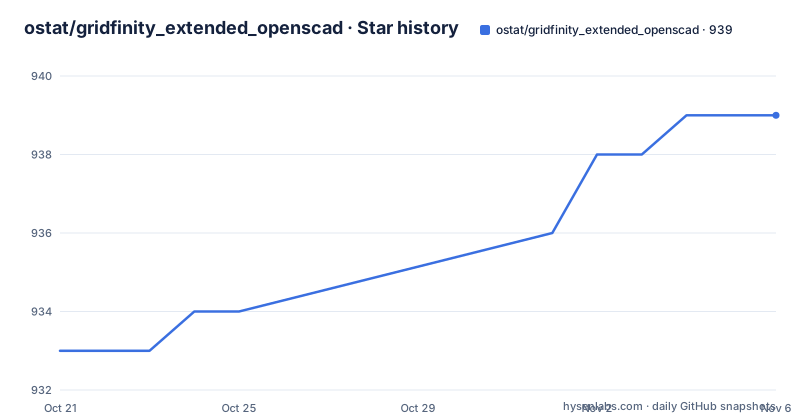
Star history
- ostat/gridfinity_extended_openscad939 ★ · +6
| Repository | 2026-10-21 | 2026-11-06 |
|---|---|---|
| ostat/gridfinity_extended_openscad | 933 | 939 |
6 Stars in the last 16 days, measured from the daily GitHub snapshot. Compare with other projects
Editorial analysis
A Gridfinity recreation with extra features and extension patterns
gridfinity_extended_openscad is a set of OpenSCAD scripts for generating Gridfinity related 3D models, hosted at gridfinity-extended.ostat.com/ and documented at docs.ostat.com/docs/openscad/gridfinity-extended.
The project describes itself as a recreation of Zack Freedman's Gridfinity system in OpenSCAD, designed to reproduce the original Gridfinity bins accurately while adding extra features and customization options. The credited base work is by Zack Freedman of voidstarlab and by vector76's gridfinity_openscad repository, and the README says this project is based on that work.
That lineage is the alternative worth comparing against, and the difference is stated plainly in the README's feature list. The base project is the reference implementation of the bin system. Gridfinity Extended keeps that accuracy and then adds extension patterns for further personalization and modularity, plus customization options on the base model.
The audience is makers with a 3D printer who already work with Gridfinity, plus anyone who wants to generate a bin sized to their own items rather than picking one from a catalogue.
The Developer Version is a hard requirement, not a suggestion
The README is unusually clear about this. The project relies on features available in the OpenSCAD Developer Version, and it tells you to make sure you download it from the OpenSCAD Developer Version page rather than the stable release.
That single requirement shapes the whole setup, because the Developer Version is a snapshot build. The scripts use features that the current stable release does not provide, so installing the stable OpenSCAD and expecting the models to work is the most likely way to lose an evening.
The README describes two ways to use the project. The first is the official online customiser hosted on MakerWorld, at a specific model page with a profile id. The scripts uploaded there are described as fully featured and supported, and the author states that they are kept updated with the latest version from GitHub.
The second is running the scripts locally, which the README says is the recommended way: the scripts run faster and you can save your configuration, but it requires downloading and installing OpenSCAD locally. The trade-off is real. The online customiser gives you a working instance with no install, at the cost of running in someone else's browser and not owning your saved configuration.
Clone the repository, then set the manifold backend and textmetrics
The local setup is three steps, and two of them are configuration steps inside OpenSCAD that people routinely miss.
First, clone or download the repository.
git clone https://github.com/ostat/gridfinity_extended_openscad.gitThe README also notes that you can download the ZIP file from the repository page and extract it instead.
Second, and this is the part that changes your render times, open the OpenSCAD application and go to Menu > Edit > Preferences. In the Advanced tab, select the manifold backend, which the README says makes OpenSCAD faster. Then go to the Features tab and check textmetrics, which enables the text related features for the base text.
Those two settings are not cosmetic. The backend choice affects how long a render takes, and the textmetrics flag gates the text on the base model, so a missing flag means the labels are simply absent from the output rather than an error message.
Third, you are ready to open a script.
Parameters live in the Customizer, and JSON sidecars carry them
Once OpenSCAD is configured, the editing loop runs through the Customizer window, which you open with View > Customizer if it is not already visible. You open the SCAD library file you want to modify, for example gridfinity_baseplate.scad, then adjust parameters in that panel and the model updates in real time.
The README gives three example parameters: Width with an example value of 2, described as the number of modules wide, Depth with an example value of 1, described as the number of modules deep, and Magnets set to Enabled, described as including magnet holes. Width and Depth being expressed in modules is the key idea, since it is what makes a generated bin drop into an existing Gridfinity layout.
Rendering has two speeds. F5 gives a quick preview and F6 gives a full render, which is the one you use before sending to a slicer.
The repository layout also explains how the parameters travel. Each major script has a matching JSON file next to it, such as gridfinity_baseplate.json, gridfinity_basic_cup.json, gridfinity_drawers.json, gridfinity_item_holder.json and gridfinity_marble.json. Those are the customiser parameter definitions, and they are what the online customiser and saved configurations rely on. There is also a canonicalize.py script at the root, which suggests the JSON files are machine-maintained rather than hand-edited, and a combined/ directory that appears to hold the merged output.
Cups, baseplates, drawers, trays and a chess set in one library
The Scripts Overview in the README is the catalogue, and it is longer than a typical add-on library.
gridfinity_basic_cup.scad creates the basic Gridfinity Cup with customizable dimensions, magnet slots and divider options, and the README calls it the foundation for most Gridfinity bins. gridfinity_baseplate.scad generates customizable baseplates with magnet placement, weighted bases and various styles. gridfinity_drawers.scad adds modular drawers with options for drawer sizes, handles and dividers. gridfinity_lid.scad produces lids with sliding, hinged and magnet-secured variants, and gridfinity_sliding_lid.scad is a specialised version with locking mechanisms.
Then there are the parts for specific things: gridfinity_item_holder.scad has built-in dimensions for common memory cards, cartridges, batteries and tools, gridfinity_socket_holder.scad has predefined dimensions for common socket sizes, gridfinity_tray.scad is a catch-all tray for small items, gridfinity_silverware.scad organises cutlery, and gridfinity_chess.scad generates a Gridfinity-compatible chess set.
There are also files with no entry in the README's overview, such as gridfinity_glue_stick.scad, gridfinity_sieve.scad, gridfinity_vertical_divider.scad, gridfinity_bin_removable_walls.scad and a legacy gridfinity_silverware_legacy.scad. The top level also holds modules/, scripts/, demos/, Renders/ and Images/ folders, with the Images folder holding the demo gifs the README embeds.
A baseplate variant cut for the FLsun Q5 build volume
One script in the repository exists for a single reason, and it is a useful signal about how this project is used.
gridfinity_baseplate_flsun_q5.scad is described as a specialised version of the baseplate script tailored for the FLsun Q5 3D printer, and it ensures compatibility with that printer's build dimensions and features.
Printer-specific variants like this exist because a generic baseplate sized for a large printer wastes filament and time on a smaller machine, and sometimes does not fit the printable area at all. Encoding the printer in the script is a pragmatic answer to that, and it tells you the maintainers expect real print queues rather than occasional one-off prints.
The alternative approach, worth naming, is to keep one generic baseplate and set the build volume in your slicer. The trade-off is real but small either way, since the generic script is still in the library and the variant is an addition rather than a replacement. If your printer is not an FLsun Q5, you will use gridfinity_baseplate.scad and slice the output with whatever limits your machine has.
No releases, a GPL-3.0 licence and a fork-and-pull-request flow
The repository has no GitHub releases, which is unusual for a project that people download and use as a versioned reference. There is a single release entry dated 2020-07-12 in the metadata for the repository name, and nothing since.
What substitutes for releases is the git history itself and the online customiser, which the README says is kept updated with the latest version from GitHub. The repository is not archived and the last push was on 2026-09-25, so the code is being worked on, but there is no tagged version to pin your models to.
The licence field on the repository says GPL-3.0. That matters for the OpenSCAD files specifically, since a published STL derived from these scripts is a derivative work of them, and redistribution of that STL carries the licence obligation with it. The repository also credits the original Gridfinity work by Zack Freedman and vector76's gridfinity_openscad, and the two projects have separate licences, so a derived model inherits obligations from more than one source.
The contribution flow is conventional: fork the repository, make improvements, and submit a pull request to the main repository for review. Issues are handled through the repository's issue tracker. There is no contributor agreement mentioned and no separate maintainer governance document in the top level listing.
Editorial conclusion
Gridfinity Extended suits anyone printing Gridfinity-compatible storage who wants parameterised bins rather than fixed STL files, and the customiser workflow plus the JSON sidecars make variants easy to keep. It does not suit you if you want a one-click download from a repository with versioned releases, because the repository has no GitHub releases and the online customiser is hosted on MakerWorld instead. Before you clone it, install the OpenSCAD Developer Version and switch the backend to manifold and enable textmetrics, because the base model text will not render without that feature flag.
Frequently asked questions
Which version of OpenSCAD does gridfinity_extended_openscad need?
The README states the project relies on features available in the OpenSCAD Developer Version and tells you to download it from the OpenSCAD Developer Version snapshots page. The stable release is not sufficient for these scripts.
How do I enable text on the Gridfinity Extended base model?
In OpenSCAD go to Menu > Edit > Preferences, go to the Advanced tab and select the manifold backend, then in the Features tab check textmetrics, which the README says enables the text related features for the base text.
Can I use Gridfinity Extended without installing OpenSCAD?
Yes. The README points to an official online customiser on MakerWorld at the model page for Gridfinity Extended, which is described as fully featured and kept updated with the latest version from GitHub. Running locally is recommended because it is faster and lets you save your configuration.
Official sources
Add this badge to your README
If you maintain this project, the badge below links readers to this analysis and shows its maintenance status from the daily GitHub snapshot. Paste the markdown into your README; add ?metric=license or ?metric=stars to the image URL for a different field.

[](https://hysenlabs.com/projects/ostat-gridfinity-extended-openscad)Star history chart for your README
[](https://hysenlabs.com/projects/ostat-gridfinity-extended-openscad)Was this useful?