peladonerd: the file index behind a Spanish-language DevOps YouTube channel, organized by video number
Repo con los archivos que uso para mi videos en youtube
At a glance
- What is it?
- Pelado-Nerdworks/peladonerd stores the files shown in a Spanish-language YouTube channel about Docker, Kubernetes and Raspberry Pi. It is an index of video companions, not a tool, and its owner promises nothing about upkeep.
- Who is it for?
- Use peladonerd as a companion while watching the matching video in Spanish, and as a map of topics from Docker basics to GatewayAPI. Do not treat it as a maintained reference, since the owner says he promises nothing, no license is declared and some chapters have no files.
- Can I use it commercially?
- Not without permission. GitHub finds no licence file in the repository, and without a licence all rights are reserved by default: you may read the code but not reuse it. Check the README, or ask the authors, before using it.
- Is it still maintained?
- Yes. The repository last received commits 3 days ago.
- What is it written in?
- Mainly JavaScript, according to GitHub's language statistics.
Answers come from the project's GitHub data, last synced on November 7, 2026, and from our analysis. They are not legal advice.
Star history
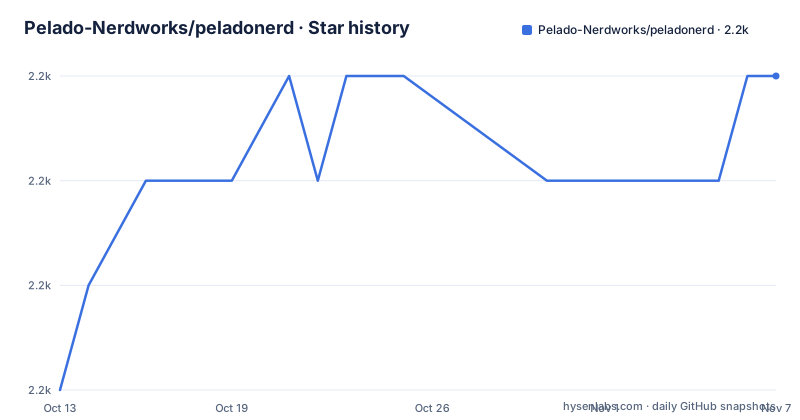
- Pelado-Nerdworks/peladonerd2,247 ★ · +3
| Repository | 2026-10-13 | 2026-11-07 |
|---|---|---|
| Pelado-Nerdworks/peladonerd | 2.2k | 2.2k |
3 Stars in the last 25 days, measured from the daily GitHub snapshot. Compare with other projects
Editorial analysis
The repo is a table of contents where each row pairs a folder with a video
Pelado Nerd is a YouTube channel, and this repository holds the code used in its videos. The README is in Spanish and consists mostly of one long numbered list. Each entry gives a chapter title, a relative folder such as ./docker/4 or ./kubernetes/20, and a youtu.be link to the video it belongs to.
There is nothing to install and no build step. No package manifest appears among the top-level entries, which are .github, assets, docker, kubernetes, openclaw, raspi, slack, streaming, terraform, v2m and varios, plus README.md and .gitignore. The language label says JavaScript, but that label tells you little, since the content is configuration and notes meant to be read next to a video.
The author asks for contributions in one sentence: fork the repo and send a pull request. Nothing else is said about review or testing.
Docker chapters one to three have no folder at all
The README states the rule outright: if a chapter title has no link, no file needed to be posted. The Docker section shows it. Introducción a Docker, Imágenes and Volúmenes y puertos link only to their videos, while chapter 4 onward point into the repository: Docker-compose in ./docker/4, Networking in ./docker/5, Multi Stage Builds in ./docker/6.
The list runs to thirteen Docker entries. Chapter 7, CI/CD, sends you to a separate repository, peladonerd/hola-docker, and later ones cover Swarm, Multi-Arch Builds, Docker Registry and Buildkit. Entry 12 is a Curso Docker Completo 2021 and entry 13 is called Docker Deskop - Alternativas, spelled that way in the list.
The consequence for a reader: a missing link is deliberate, not broken, but nothing in the repository distinguishes a chapter with no files from one whose files were never uploaded.
Raspberry chapters borrow from a second repository, and one link is reused
Seven Raspberry entries cover installing Docker on a Raspberry Pi with Samba file sharing, downloading torrents automatically, Plex on Docker, remote access with NO-IP.com, Flexget, kiosk mode and Nginx with SSL. Most point to ./raspi/N folders. Two do not.
Plex sobre Docker en Raspbery links to github.com/pablokbs/plex-rpi, and Flexget links to that same address. A reader looking for Flexget files is sent to the Plex repository. If you follow the Flexget link, look inside plex-rpi for any Flexget configuration, because the list gives no separate Flexget folder.
The first Raspberry entry also bundles two topics, Docker and Samba, in one folder, ./raspi/1, so a search inside the repo for either word has to look in the same place.
Forty-three Kubernetes chapters, with number 33 missing and two topics split into parts
Kubernetes is the largest section. It starts with creating a cluster on Digital Ocean in ./kubernetes/1, then moves through Services and Load Balancers, Deployments, Requests and limits, HPA, probes, Prometheus, Ingress, Daemonsets, Logstash and Volumes in two parts.
Later entries reach into the ecosystem: Kustomize, kubeadm, Rancher, Jobs and Cronjobs, Thanos, ArgoCD, Pod Priorities, Pod Disruption Budgets, k0s, istio, LimitRange, Helm 2, external-dns, MetalLB, crossplane, fluent-bit, cluster-autoscaler, wasm, apisix, keda and GatewayAPI as entry 44.
The numbering has gaps and repeats. Entry 33 does not exist, so the list jumps from LimitRange at 32 to Helm 2 at 34, and no Helm entry precedes it. Prometheus appears at 7 and again as Prometheus 2: Grafana at 17, and HPA returns at 25 as HPA 2: Custom metrics. Entry 35 is a Curso Kubernetes Completo 2021, and chapter 14 links its CircleCI files to a separate flisol2019 repository.
The Varios section links to folders that do not match their label
Varios collects what fits nowhere else: a free SSL site with Docker and Let's Encrypt, Traefik, OpenVPN, Podman, a Transmission bot for Telegram, CoreDNS, WireGuard with PiHole, VIM and Mastodon. The README text available here is cut off in the middle of the Mastodon entry, so later items are not visible.
Two entries point outside the varios directory. Poste links to ./terraform/3, and Gitlab CI/CD links to ./streaming/2. GitHub Actions goes to a different repository, pablokbs/prueba-gha. The directory names terraform and streaming exist at the top level, yet the README shows no list of their own, so any content there is reachable only through these links.
Top-level folders openclaw, slack, v2m and assets have no explanation in the README text available. Their purpose cannot be told from names alone, so check each folder before assuming what it holds.
No license, no releases, and a maintenance promise that promises nothing
The owner writes that he will try to keep the repository updated and as documented as he can, but promises nothing. That sentence is the whole maintenance policy. The repository is not archived, and the last push was 2026-10-18, so the owner has pushed recently. The GitHub release list is empty, so there are no versions to pin.
License information is unknown in the repository metadata, and no LICENSE file appears among the top-level entries. Without a stated license, the terms for copying configuration into your own project are unspecified. Small snippets for personal learning are the realistic use. For company infrastructure, ask the author.
There is also nothing that tells you which Kubernetes or Docker version a given folder targets. The 2021 course entries hint at when some material was recorded, and newer topics like GatewayAPI sit at the end of the list. Check any manifest against current API versions before applying it to a real cluster.
Feeding it back: fork, pull request, and a community Slack
At the top of the README are a Ko-fi support badge and a link to a Slack workspace at slack.peladonerd.com. A slack folder also sits in the repository. The README documents no issue process, so those two links are the only stated places to ask questions or support the author.
The contribution flow is the shortest one possible: fork, change, open a pull request. There is no CONTRIBUTING file in the top-level listing and no style guide, so a fix to a wrong link, such as the Flexget one, is the kind of change a pull request can plausibly cover.
The README is written in informal Spanish, with forms like forkeá and haceme. Readers without Spanish can still open the files in each folder, but the surrounding text and the videos are in Spanish.
Editorial conclusion
Use peladonerd as a companion while watching the matching video in Spanish, and as a map of topics from Docker basics to GatewayAPI. Do not treat it as a maintained reference, since the owner says he promises nothing, no license is declared and some chapters have no files. Before copying anything, open the numbered folder for your topic and check what is actually inside, because the index links to other repositories for several chapters.
Frequently asked questions
What is the peladonerd repository?
It holds the code and configuration files used in the videos of the Pelado Nerd YouTube channel. The README lists the videos by topic and links each to a numbered folder.
Does peladonerd have a license?
The repository metadata lists the license as unknown, and no LICENSE file is among the top-level entries. The repository also has no GitHub releases.
Which topics does peladonerd cover?
The README sections are Docker, Raspberry, Kubernetes and Varios. Varios includes Traefik, OpenVPN, Podman, WireGuard with PiHole and Mastodon.
Official sources
Add this badge to your README
If you maintain this project, the badge below links readers to this analysis and shows its maintenance status from the daily GitHub snapshot. Paste the markdown into your README; add ?metric=license or ?metric=stars to the image URL for a different field.

[](https://hysenlabs.com/projects/pelado-nerdworks-peladonerd)Star history chart for your README
[](https://hysenlabs.com/projects/pelado-nerdworks-peladonerd)Was this useful?