diff-svc: alpha tags from 2022, a status note declaring the project finished, and a requirements line with no version
Singing Voice Conversion via diffusion model
At a glance
- What is it?
- A singing voice conversion project built on DiffSinger that shares a name with a paper it says it has nothing to do with. Its two release tags are alphas from November 2022, its checkpoints are distributed through a chat channel rather than a release, and its update log is the best documentation in the repository because it records the bugs that changed how people had to run it.
- Who is it for?
- diff-svc is worth reading as a documented piece of research and a reference for how a DiffSinger based conversion pipeline was put together in 2022. It is not a base to build a service on, and the repository itself says as much.
- Can I use it commercially?
- Yes, with strict conditions. AGPL-3.0 is a network copyleft licence: if people use a modified version over a network, for example as a hosted service, you must offer them its source code under the same licence.
- Is it still maintained?
- Yes. The repository last received commits 162 days ago.
- What is it written in?
- Mainly Jupyter Notebook, according to GitHub's language statistics.
Answers come from the project's GitHub data, last synced on November 15, 2026, and from our analysis. They are not legal advice.
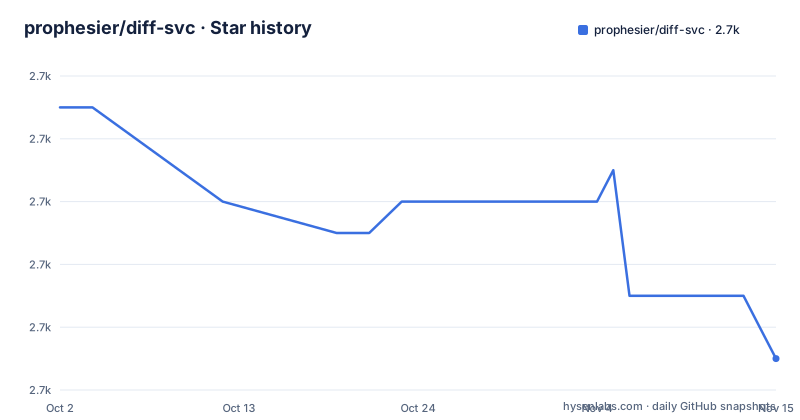
Star history
- prophesier/diff-svc2,713 ★ · -8
| Repository | 2026-10-02 | 2026-11-15 |
|---|---|---|
| prophesier/diff-svc | 2.7k | 2.7k |
-8 Stars in the last 44 days, measured from the daily GitHub snapshot. Compare with other projects
Editorial analysis
The status note calls the project finished, and the branch has commits from June 2026
The project status section states that the project is no longer actively maintained, that it served as an early exploration of applying diffusion models to singing voice conversion, and that it has since been succeeded by community driven projects, naming so-vits-svc and ddps-svc among them. The repository metadata tells a different recent story: it is not archived and the last push on the default branch main is dated 2026-06-06, four months ago. Both facts can be true at once, since a note written in 2022 does not update itself, but a reader has to decide which signal to trust. The release history offers no help, since both tags are alphas from November 2022 and nothing has been published since. Treat the status note as the project's statement of intent and the commit date as evidence that someone is still touching the tree, and decide for yourself which of the two describes the code you want.
Two alpha tags, and the trained models are shared through a chat channel
The release list holds v0.1.0-alpha dated 2022-11-21 and v0.1.1-alpha dated 2022-11-22, two tags a day apart and then nothing for the three and a half years that followed. So there is no release artifact to download and no version history beyond those two points. The trained models are handled differently: the README says checkpoints, demo audio and the other files needed for inference and training can be obtained in a QQ channel identified by number, with a QR code image for joining and a note that anyone who cannot get in should try a different network environment. A Discord link is offered for English support. The model files are the actual product of a project like this, and they are distributed through chat channels rather than through version control or a package index, which means a pin to v0.1.1-alpha does not pin the weights you actually run.
The repository shares a name with a paper it says it is unrelated to
The acknowledgements section carries a warning in both languages: this project has no connection with the paper of the same name, DiffSVC, and readers should not confuse the two, with a link to the arXiv entry. That warning matters more than it first appears, because the repository name and the paper name are the same string and the search terms around this project are full of the paper. What the repository is actually built on is named in the same section: diffsinger, the diffsinger maintained by the openvpi group, and soft-vc, with thanks to openvpi members for help during development and training. The description calls it singing voice conversion via a diffusion model, and the README adds that it converts input singing voices into a target timbre and supports basic pitch correction. Anyone arriving from the paper will have the wrong mental model of what is in the tree.
Every dependency is pinned, and one line carries no version at all
The requirements file pins every entry with an equals sign, down to the CUDA build: torch, torchaudio and torchvision are all fixed at the 1.12 era with a cu113 suffix, pytorch-lightning is at 1.3.3, numpy at 1.23.4, librosa at 0.9.1 and praat-parselmouth at 0.4.1. A fixed CUDA build is a deliberate choice, since a general torch pin would resolve to whatever wheel the platform serves. Two entries deserve more attention. pywin32 is pinned in the shared file, which is a Windows only package in a list everyone installs, matching the presence of a Windows batch file for preprocessing at the repository root. And one visible line reads Werkzeug= with nothing after the equals sign, which is not a valid requirement. A second, lighter file sits beside it, requirements_short.txt, and a PNG of the requirements list is committed to the tree as well.
The update log is where the real documentation lives
The dated entries at the top of the README read as a changelog and happen to be the most useful part of it, because four of them describe failures that changed how people had to run the project. On 2022.11.23 a bug was fixed that could resample the original ground truth audio used for inference to 22.05kHz, and readers were asked to check their own test audio against it. On 2022.10.28 the hubert stage moved from ONNX inference to torch inference, and anyone who had already downloaded the ONNX model was told to fetch the pt version and replace it, with no configuration change needed, which then made direct GPU inference and preprocessing possible on a 6GB card. On 2022.10.27 a fix stopped hubert from falling back to CPU on GPU servers, which had slowed preprocessing and inference by three to five times without affecting training. And on 2022.10.26 a fix made data preprocessed on Windows usable on Linux.
A Flask service, a batch script, and a Windows batch file named in Chinese
The top level listing describes a research prototype with several ways in. inference.ipynb is the documented inference path, which is also why the repository's primary language is recorded as Jupyter Notebook and why ipython, ipykernel and jupyter_client appear as pinned dependencies. The two commands the README actually prints are these, preprocessing first:
export PYTHONPATH=.
CUDA_VISIBLE_DEVICES=0 python preprocessing/binarize.py --config training/config.yaml
and then training:
CUDA_VISIBLE_DEVICES=0 python run.py --config training/config.yaml --exp_name [your project name] --resetAlongside them sit run.py for training, infer.py, batch.py, onnx_export.py, simplify.py and trans_key.py, plus package directories named modules, network, infer_tools, preprocessing, training, utils, raw and results. Two entries stand out for what they imply about how this was used. flask_api.py is a web service entry point, so the inference pipeline was reachable over HTTP at some point. And the file named 预处理.bat is a Windows batch script for preprocessing, which fits both the Windows specific dependency and the entry about Windows preprocessed data failing on Linux. A test_output.wav and two PNGs are committed at the root as well.
AGPL-3.0 with an added request to be contacted before reuse
The license is AGPL-3.0, and on top of that the notes section, written in Chinese and English, adds three conditions of the author's own. The project is established for academic exchange and is not intended for production environments. Nobody is responsible for copyright issues arising from sounds the model produces, which is the standard disclaimer for a voice conversion tool and also the sharpest edge in it. Anyone redistributing the code or publishing results, including submissions to video sites, is asked to indicate the original author and the source repository. And anyone using the project for any other plan is asked to contact the author in advance. A license file and the notes sit side by side, so what you are agreeing to is the AGPL plus a request that has no mechanism attached to it and no stated consequence if it is ignored.
Editorial conclusion
diff-svc is worth reading as a documented piece of research and a reference for how a DiffSinger based conversion pipeline was put together in 2022. It is not a base to build a service on, and the repository itself says as much. Four things to check before you invest anything. The status note states the project is no longer actively maintained and points at community successors, even though the branch has commits dated 2026-06-06, so establish which code you are actually running. The trained checkpoints are not published as releases; they are shared through a chat channel with a scan code, which is a poor basis for reproducibility. The environment is pinned hard, including Windows only packages, with one malformed requirement line. And the terms are AGPL-3.0 with an added request to be credited and contacted in advance, which is a condition you need to accept explicitly rather than infer.
Frequently asked questions
Is prophesier/diff-svc related to the DiffSVC paper?
No. The README states in both languages that the project has no connection with the paper of the same name and asks readers not to confuse them. What it is based on is diffsinger, the diffsinger maintained by openvpi, and soft-vc.
Where do I download trained checkpoints for diff-svc?
The release page only carries v0.1.0-alpha and v0.1.1-alpha from November 2022. The README says checkpoint files, demo audio and other files needed for inference and training are available in a QQ channel given by number, joined by scanning a QR code, with a Discord offered for English support.
What are the documented preprocessing and training commands for diff-svc?
Preprocessing sets the module path with export PYTHONPATH=. and then runs CUDA_VISIBLE_DEVICES=0 python preprocessing/binarize.py --config training/config.yaml. Training runs CUDA_VISIBLE_DEVICES=0 python run.py --config training/config.yaml --exp_name [your project name] --reset, with details in the training and inference document.
Which audio sample rates does diff-svc handle?
Support for 44.1kHz was provided formally on 2022.12.4, after an earlier entry added adaptation for it on 2022.11.11. A fix on 2022.11.23 addressed a bug that could resample the original ground truth audio used for inference to 22.05kHz, and readers were asked to check their own test audio.
What does diff-svc require in its Python environment?
Every entry in requirements.txt is pinned with an equals sign, including torch, torchaudio and torchvision at cu113 builds, pytorch-lightning at 1.3.3, numpy at 1.23.4 and pywin32, which is Windows only. One visible line reads Werkzeug= with no version after the equals sign, and a shorter requirements_short.txt sits beside it.
Is diff-svc still being worked on?
The project status note in the README states that the project is no longer actively maintained and names community driven projects that succeeded it, such as so-vits-svc and ddps-svc. The repository is not archived and its last push on main is dated 2026-06-06.
Official sources
Add this badge to your README
If you maintain this project, the badge below links readers to this analysis and shows its maintenance status from the daily GitHub snapshot. Paste the markdown into your README; add ?metric=license or ?metric=stars to the image URL for a different field.

[](https://hysenlabs.com/projects/prophesier-diff-svc)Star history chart for your README
[](https://hysenlabs.com/projects/prophesier-diff-svc)Was this useful?