RoboGuice retired in 2016 and struck through its own README
GitHub describes it as Google Guice on Android, version 3.0 [RETIRED]. The repository metadata lists Java as its primary language. The metadata lists the NOASSERTION license. This article stays within the project description and details documented in the GitHub repository README.
At a glance
- What is it?
- roboguice/roboguice wrapped Google Guice for Android and was for nearly five years the most used dependency injection framework there, until August 2016 when its author stopped supporting it. The repository was never archived, so it still opens with a retirement notice, a marketing section with every sentence struck through, and a table of apps from 2012.
- Who is it for?
- RoboGuice is worth reading as a case study in how an Android dependency injection library was positioned and why it was dropped, and worth copying from if you are maintaining an application that still uses it. It is not worth adopting for anything new, since the support statement is unambiguous and the last push was 2017-01-19.
- Can I use it commercially?
- Check first. The repository uses a licence we do not classify automatically, so read its LICENSE file before any commercial use.
- Is it still maintained?
- Probably not. The repository last received commits 118 months ago, on January 19, 2017.
- What is it written in?
- Mainly Java, according to GitHub's language statistics.
Answers come from the project's GitHub data, last synced on October 22, 2026, and from our analysis. They are not legal advice.
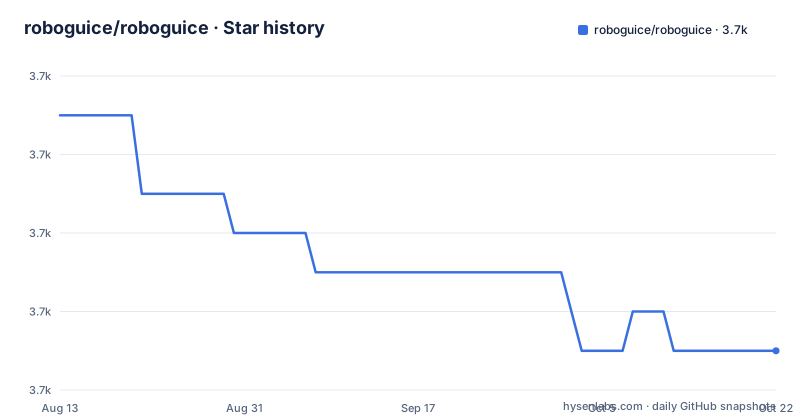
Star history
- roboguice/roboguice3,717 ★ · -6
| Repository | 2026-08-13 | 2026-10-22 |
|---|---|---|
| roboguice/roboguice | 3.7k | 3.7k |
-6 Stars in the last 70 days, measured from the daily GitHub snapshot. Compare with other projects
Editorial analysis
The retirement notice is the first thing in the file
Nothing about this README reads like documentation for an active library. The opening note is italicised and says that as of August 2016 RoboGuice is no longer supported. It adds the history in one sentence: for nearly five years it was the number one dependency injection framework on Android because of its ease of use, but other responsibilities kept the author from giving it the attention it needed, and over time it stopped keeping up with what the community wanted. The advice is to migrate to one of the other dependency injection frameworks for Android, and a second line thanks people for their years of support. The repository itself is not marked archived, so GitHub will not warn you, and the last push to the default branch master is dated 2017-01-19, roughly five months after the announcement.
Every marketing sentence is struck through, including the title
The visual treatment is the second signal. The heading that used to introduce the library is struck through, and so is the body of the pitch beneath it, line after line: the claims about smoothing out the wrinkles in Android development, about taking the guesswork out of development, about slimming down application code, and about there being no magic because everything is configured explicitly or can be overridden. The Get Started link to the wiki is struck through too, and so is the Related projects heading and its single entry. The two badges at the top, one for a continuous integration service and one for Maven Central, are the only things left unstruck, along with the app table further down. So the file reads as a tombstone: the text is preserved for history, and the formatting tells you not to read it as current.
The pitch was Guice with the platform's small annoyances removed
What the struck-through text describes is still a useful summary of the library's scope. It leverages the Google Guice library, described as production ready, to bring dependency injection to Android in a form light enough for a mobile application. The specific annoyances it claimed to remove were concrete: forgetting to null check the extras returned by getIntent(), and having to cast the result of findViewById() to a TextView. The injectable objects it named were views, resources, system services or any other object, so the Android framework types were first class in the injection graph rather than looked up by hand. The claim about less code was framed as fewer places for bugs and code that reads as application logic instead of platform mechanics. None of that is measured in the file; it is the vocabulary of a 2012 era Android pitch.
HOWTO-SUBTREES.TXT describes a multi-repository build
The tree is the clearest sign of how large this was. The top level holds roboguice, guice, roboblender, astroboy, additional-tests and maven_repo_3rd_party as separate directories, alongside a root pom.xml. That last file, plus a text file named HOWTO-SUBTREES.TXT, points to a layout built from git subtrees rather than from a single flat module: pieces of the library and of its dependencies are vendored into their own directories. Quality tooling is configured through three XML files, roboguice_checks.xml, roboguice_checks_suppressions.xml and test_suppressions.xml, which is the pattern for keeping static analysis findings and suppressions in version control. Continuous integration is declared in a .travis.yml, an older service that no longer appears in the project. There is no Gradle file at the root, which is itself evidence of the era.
Getting your app listed meant editing the README by hand
A long table of applications occupies the lower half of the file, and a comment above it explains the mechanism rather than describing an app store badge. To be listed, you download your app icon from Google Play, add it to the assets directory, modify README.md and submit a pull request with your changes. That process is what produced entries such as Agit, Android Shuffle, Bartab, Bento, CallerID, Cars.com, CardStar, ChessMates, Crossfit Travel, Crunchyroll, Digg, GeoBeagle, Getaways by Groupon, Groupon, Gymglish, LinkedIn Pulse, Moola, MOTOACTV, MyEpisodes Manager, Nike+, OpenTable, TripIt!, Skype, Starbucks, SwiftKey, TaskBomb and Wifi Syncr. Several of those links point at the retired market.android.com host, so the table is a record of what the library was used for rather than a set of working references.
The related project was RoboBlender and its Proguard plugin
The single related project listed, also struck through, is the RoboBlender Proguard Gradle Plugin, credited with generating appropriate Proguard rules for a roboblender configuration. That tells you what RoboBlender was for: shrinking a released Android application, which needs rules that survive code shrinking, and the plugin existed because those rules were not something an application author should write by hand. The roboblender directory at the root is where that code lived, and the astroboy directory sits beside it as another sub-project of the same family. Nothing in the file gives a version, a download coordinate or a support statement for either project, so a reader who lands on this repository looking for the Proguard plugin finds only a dead link in a struck-through line.
The licence is undeclared and the changelog is the only history
Two inconsistencies are worth knowing before you copy anything from here. A LICENSE file exists at the root, but the repository metadata reports no licence, reported as NOASSERTION rather than an SPDX identifier, so automated licence detection will not tell you what terms apply. And there are no GitHub releases, which means there is no tag to depend on and no release note to read; the version history lives in a CHANGELOG.md at the root instead. The project description still reads Google Guice on Android, version 3.0 with the word RETIRED appended in brackets, which is the clearest single field in the repository. Taken together, the version signals say the same thing as the notice: the code is what version 3.0 was, and it stopped moving in 2017.
Editorial conclusion
RoboGuice is worth reading as a case study in how an Android dependency injection library was positioned and why it was dropped, and worth copying from if you are maintaining an application that still uses it. It is not worth adopting for anything new, since the support statement is unambiguous and the last push was 2017-01-19. If you inherit an application that depends on it, read the changelog, check which Android SDK level that code predates, and plan a migration to another Android dependency injection framework rather than a version bump.
Frequently asked questions
Is RoboGuice still supported?
No. The README states that as of August 2016 RoboGuice is no longer supported, that other responsibilities kept the author from giving it the attention it needed, and that it has not kept up with what the community wants. It advises migrating to another dependency injection framework for Android.
What did RoboGuice do that plain Guice did not?
It brought Google Guice to Android in a form light enough for a mobile application and handled platform specific types such as views, resources and system services through injection. The struck-through pitch also claimed it removed the need to null check extras from getIntent() and to cast the result of findViewById().
What is the last version of RoboGuice and when did the repository stop changing?
The project description reads Google Guice on Android, version 3.0 with RETIRED appended, and the repository has no GitHub releases. The last push to the default branch master is dated 2017-01-19, and the only version history is a CHANGELOG.md at the root.
How is the RoboGuice repository laid out?
It is a subtree based multi project build: roboguice, guice, roboblender, astroboy, additional-tests and maven_repo_3rd_party directories beside a root pom.xml, with HOWTO-SUBTREES.TXT explaining the arrangement, three analysis and suppression XML files, and a .travis.yml for continuous integration.
Official sources
Add this badge to your README
If you maintain this project, the badge below links readers to this analysis and shows its maintenance status from the daily GitHub snapshot. Paste the markdown into your README; add ?metric=license or ?metric=stars to the image URL for a different field.

[](https://hysenlabs.com/projects/roboguice-roboguice)Star history chart for your README
[](https://hysenlabs.com/projects/roboguice-roboguice)