Quant Guild Library: Jupyter Lessons for Quantitative Finance
A library of Jupyter notebooks and corresponding YouTube lectures by Roman Paolucci
At a glance
- What is it?
- Quant Guild Library pairs quantitative finance Jupyter notebooks with Roman Paolucci's lecture videos. It is an educational repository rather than an installable Python package, with material spanning options, portfolio construction, stochastic processes, backtesting, market data, and algorithmic trading.
- Who is it for?
- Quant Guild Library suits learners who want worked quantitative finance ideas with a corresponding lecture, but it is not suitable as a production trading library or as evidence that its examples are ready for live deployment. Before adoption, inspect the target notebook for dependency versions, data assumptions, brokerage requirements, and licensing terms, since the repository does not document installation, runtime compatibility, or a license.
- Can I use it commercially?
- Not without permission. GitHub finds no licence file in the repository, and without a licence all rights are reserved by default: you may read the code but not reuse it. Check the README, or ask the authors, before using it.
- Is it still maintained?
- Yes. The repository last received commits 93 days ago.
- What is it written in?
- Mainly Jupyter Notebook, according to GitHub's language statistics.
Answers come from the project's GitHub data, last synced on November 7, 2026, and from our analysis. They are not legal advice.
Star history
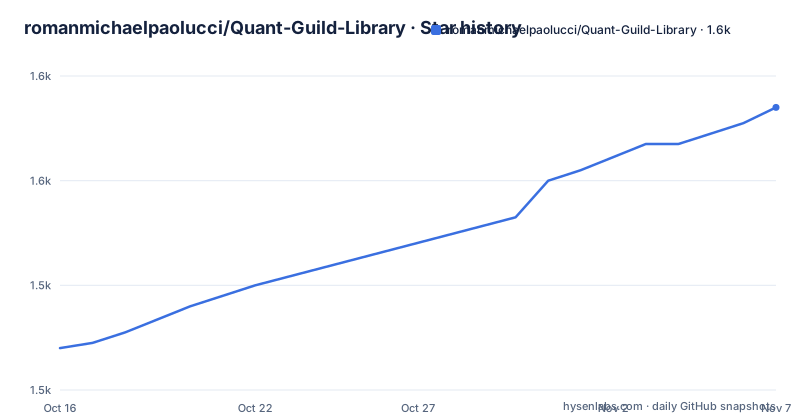
- romanmichaelpaolucci/Quant-Guild-Library1,574 ★ · +46
| Repository | 2026-10-16 | 2026-11-07 |
|---|---|---|
| romanmichaelpaolucci/Quant-Guild-Library | 1.5k | 1.6k |
46 Stars in the last 22 days, measured from the daily GitHub snapshot. Compare with other projects
Editorial analysis
What Quant Guild Library Contains
Quant Guild Library addresses a specific gap between mathematical explanations and executable examples in quantitative finance. The repository is aimed at people who want to study topics such as stochastic calculus, options pricing, portfolio construction, trading strategy evaluation, market-data access, volatility, and finance-related AI. Its format is notebook plus lecture: each folder is described as containing a Jupyter Notebook and a corresponding video lecture by Roman Paolucci.
This is not a conventional Python library with an importable public API. There is no documented package interface in the README, and the top-level layout consists of `.vscode/`, `2025 Video Lectures/`, `2026 Video Lectures/`, and `README.md`. That distinction matters when evaluating adoption. A team looking for functions to add to an application will not find that contract described here. A learner looking for readable examples tied to an explanation is the closer fit.
The lecture index also reveals the intended learning path is broad rather than tied to one production stack. Listed subjects include the Black-Scholes equation, implied volatility, variance swaps, Kalman filters, Hawkes processes, volatility surfaces, mean-variance optimization, Black-Litterman, Sharpe ratios, CAGR, tail risk, Interactive Brokers integration, and several kinds of backtesting pitfalls. Some topics are conceptual, while others use Python or mention a brokerage. The README does not claim that every notebook has the same dependency set or execution path.
Notebook And Video Repository Structure
Based on the repository layout, the primary data flow is editorial rather than programmatic. The README serves as the catalog, organizing numbered lecture links under year-based directories. Each folder then pairs executable educational content with the linked lecture. This structure makes it possible to navigate from a topic on the README to a notebook, then use the video as the explanation for assumptions, derivation steps, or interpretation.
The range of examples shows two related forms of quantitative work. Some subjects are model oriented. The index includes Brownian motion, Poisson processes, Hawkes processes, Volterra process discretization, survival modeling for tail risk, Black-Scholes pricing, and risk-neutral option valuation. Other subjects concern portfolio and strategy decisions, including alpha and beta, capital management, Sharpe ratios, volatility drag, backtesting errors, mean reversion with Kalman filters, and portfolio optimization.
There is also an applied trading layer. The README names lessons on obtaining historical market data through Interactive Brokers and Python, building an AI stock trading bot, creating an options trading system, and working with volatility surfaces through Interactive Brokers. Those titles do not prove that the notebooks contain complete, brokerage-ready systems. The repository description does not document credentials handling, order safeguards, data validation, execution controls, or deployment architecture. The lecture index should therefore be read as a topic map, not an assurance of production readiness.
Getting Started Without A Documented Install Path
The README does not provide installation commands, a Python version, a dependency file, or a Jupyter setup procedure. It also does not identify an installation command for a package named `Quant-Guild-Library`. The repository itself is the stated place to obtain the notebooks and lectures, so a first-time user should locate the relevant notebook in either `2025 Video Lectures/` or `2026 Video Lectures/`.
There is no reproducible launch command in the README that can be reproduced without inventing details. The short first use is therefore documentation-oriented: choose one numbered topic, open the corresponding notebook, inspect its imports and data requirements, and compare it with the linked lecture. For a beginner, lecture 100, "Black-Litterman vs. Mean-Variance Portfolio Optimization in Python," exposes the distinction between topics explicitly. For a more foundational option-pricing study, lecture 139 covers deriving the Black-Scholes equation.
The README also says each folder contains both forms of content. A user should not assume that every notebook can be executed unchanged on the first attempt. Market-data examples may depend on external services or brokerage access, while mathematical examples may still require common numerical libraries. Because no dependency manifest is described, the first verification point is the notebook's own import and configuration cells.
Why The Paired Lecture Format Matters
The strongest feature of this repository is the explicit relationship between code and explanation. Quantitative finance code often depends on modeling assumptions that are not visible in a function call. Stochastic processes involve state definitions and discretization choices. Option valuation depends on pricing assumptions and volatility treatment. Backtests depend on how data availability, transaction costs, and strategy behavior are represented. A matching lecture can provide context that a standalone notebook may leave implicit.
The index also offers a way to select topics by career stage. Lectures 130, 133, and 137 are explicitly labeled as projects for beginner, intermediate, and advanced learners. That makes the repository easier to use as a study sequence than as a complete software product. The progression is visible in the catalog, although the README does not define prerequisites or a formal curriculum.
The format also separates attention between derivation and application. "How to Derive the Black-Scholes Equation" is different from "How to Trade Options with the Black-Scholes Model," just as "Portfolio Alpha & Beta" differs from "How a Quant Engineers a Portfolio." A learner can choose whether the immediate goal is understanding the mathematics, calculating a metric, examining a portfolio process, or connecting a model to Interactive Brokers. The catalog supports those choices, but it does not state how closely every notebook follows the corresponding video or whether exercises and solutions are included.
Limits Of A Broad Quant Education Repository
The broad catalog is also a limitation. A repository spanning stochastic processes, options, optimization, machine learning, backtesting, and brokerage integration can offer breadth, but the README gives no shared architecture, dependency baseline, testing policy, or compatibility matrix. That makes it difficult to treat all notebooks as one reproducible software environment. A notebook on a mathematical derivation may require only numerical tools, while an Interactive Brokers example can involve account configuration, market data, and external service behavior.
The project is also the wrong tool for someone seeking a maintained quantitative framework with stable APIs, versioned releases, and documented interfaces. There are no GitHub releases, no package version in the README, and no stated support policy. The title of a lecture should not be read as a guarantee that its example covers production concerns such as latency, outages, partial fills, position limits, or model monitoring.
Backtesting material illustrates another boundary. The catalog includes "3 Backtesting Pitfalls That Ruin Your Trading Strategy," which indicates awareness of evaluation problems, but the README does not claim that the repository provides a general backtesting engine. The same applies to AI trading lessons. A notebook may teach how to build an example bot without offering a safe or validated path to live capital. Users who need deployable trading software should expect to supply their own data, infrastructure, execution controls, and review.
Maintenance, License, And Upgrade Boundaries
The repository is not archived, and its last push was on 2026-08-06. That date indicates a recent repository change within the information available, but it does not establish a release cadence or a commitment to ongoing notebook maintenance. There are no GitHub releases, so there is no documented semantic version or release-based upgrade path for consumers.
The license is unknown. The repository metadata provided does not identify a license, and the README excerpt does not state one. That leaves an adoption question unresolved: users cannot infer from this documentation whether they may modify, redistribute, incorporate, or commercially use the notebooks and associated material. This is a licensing boundary, not a legal conclusion.
The upgrade cost is likely to depend on the example rather than on a shared package upgrade. Numerical library changes, Python runtime changes, Jupyter changes, or external market-data and brokerage interfaces can make an old notebook require edits. The README does not define supported versions or migration steps. Anyone planning to reuse code should inspect the notebook imports, credentials assumptions, data files, and external service calls before treating it as maintained source.
Editorial conclusion
Quant Guild Library suits learners who want worked quantitative finance ideas with a corresponding lecture, but it is not suitable as a production trading library or as evidence that its examples are ready for live deployment. Before adoption, inspect the target notebook for dependency versions, data assumptions, brokerage requirements, and licensing terms, since the repository does not document installation, runtime compatibility, or a license.
Frequently asked questions
What is the Quant Guild Library?
It is a collection of Jupyter notebooks and corresponding YouTube lecture videos about quantitative finance. The topics include stochastic calculus, options pricing, portfolio management, trading strategies, and AI in finance.
Does the Quant Guild Library have installation instructions?
The README does not document an installation command, Python version, or dependency setup. Users are directed to the repository's notebooks and lecture folders, including `2025 Video Lectures/` and `2026 Video Lectures/`.
Is Quant Guild Library a Python package for production trading?
The repository is presented as a library of Jupyter notebooks and lecture videos, not as an installable Python package with a documented public API. Some listed lessons use Python and Interactive Brokers, but the README does not describe production deployment safeguards.
Official sources
Add this badge to your README
If you maintain this project, the badge below links readers to this analysis and shows its maintenance status from the daily GitHub snapshot. Paste the markdown into your README; add ?metric=license or ?metric=stars to the image URL for a different field.

[](https://hysenlabs.com/projects/romanmichaelpaolucci-quant-guild-library)Star history chart for your README
[](https://hysenlabs.com/projects/romanmichaelpaolucci-quant-guild-library)Was this useful?