Spacewave, a workspace that runs in the tab and replaces ten dependencies with forks
self-host directly in the web browser, no servers required. local-first
At a glance
- What is it?
- Spacewave 0.57.22 puts the app in the browser, syncs peer to peer, and lets you swap Redis for IndexedDB. Here is what the component layout does, and what the build pins.
- Who is it for?
- Spacewave suits someone who wants an encrypted shared workspace that keeps working when the network does not, and who is willing to run a Go toolchain to build it. The storage abstraction is the part with real value: the same app code runs against Redis, BadgerDB, S3, or IndexedDB.
- Can I use it commercially?
- Yes. Apache-2.0 is a permissive licence: you can use, modify and sell software built on it, as long as you keep its copyright and licence notices.
- Is it still maintained?
- Yes. The repository received new commits within the last day.
- What is it written in?
- Mainly Go, according to GitHub's language statistics.
Answers come from the project's GitHub data, last synced on November 14, 2026, and from our analysis. They are not legal advice.
Star history
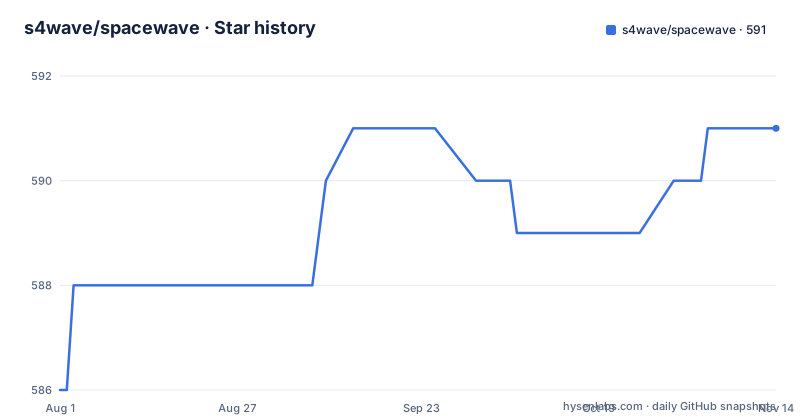
- s4wave/spacewave591 ★ · +5
| Repository | 2026-08-01 | 2026-11-14 |
|---|---|---|
| s4wave/spacewave | 586 | 591 |
5 Stars in the last 105 days, measured from the daily GitHub snapshot. Compare with other projects
Editorial analysis
The whole app runs in the tab, and there is no server to install
The pitch is that there is nothing to deploy. Open it in a browser and you get a private, encrypted workspace running on your own machine, with no account, no setup, and no server to run, and it syncs peer to peer between your devices and works offline. From source that is two install steps:
bun install
uv sync --frozen --all-groups
Two package managers, because the repository is a polyglot monorepo: Bun for the TypeScript and React side, uv for the Python resource package. Three ways then start it. The desktop build runs as native processes:
bun run start:desktopThe two web builds are the interesting pair, because they differ in how Go reaches the browser, and that is covered next.
`start:web` and `start:web:wasm` are two different Go compilers
The same application, two toolchains:
bun run start:webruns the web app with GoScript browser Go plugins, and:
bun run start:web:wasmruns it with standard Go compiled to WebAssembly. GoScript is the project's own component for compiling Go to TypeScript modules that stay readable, so a Go package becomes a TypeScript module rather than an opaque WebAssembly blob, and the intent is to share algorithms, data structures, and runtime code without writing a second implementation. It also powers Bldr's Go compiler mode for Spacewave's own web plugins. Choosing between the two is a choice about whether you want inspectable TypeScript output or the standard compiler and its ecosystem. The desktop path is the third option and the only one where Go runs as a native process rather than inside a worker, which is what the architecture section says happens: app logic runs in WebWorkers and SharedWorkers in the browser and as native processes on the desktop, which is the mechanism that brings the Go ecosystem into the browser at all.
Hydra swaps Redis, BadgerDB, S3, and IndexedDB without touching your code
The storage claim is stated as one sentence and it is the strongest thing in the architecture section: an app can allocate a SQL database and store it in Redis, BadgerDB, or IndexedDB without changing a single line of code when switching backends. That is Hydra, the component described as storing data anywhere with peer-to-peer sync. It covers several data structures rather than one, including SQL, key-value, and a graph database, and its backends include BadgerDB, Redis, and S3 on a server and IndexedDB in the browser. The reason the project exists at all is stated in the same breath: traditional web apps put data on servers, the frontend only displays a response, and server-side rendering has increased that dependence. The comparison offered is a video game rendered entirely server-side.
Bifrost picks the transport, and the plugin list includes terminal access
Networking is a separate component, Bifrost, described as network over any transport: cross-platform peer-to-peer communication, encrypted transport protocols with stream multiplexing, and WebRTC plus WebSocket in the browser. At the product level that surfaces as connecting over WebRTC, WebSocket, LAN, or relay, whichever your devices can reach. The plugin ecosystem is where the scope gets broader than a document editor, covering files, databases, notes, and document collaboration, chat and messaging, and terminal access with remote control of your devices, plus SkiffOS for building and managing Linux devices. Encryption is stated as applying to storage, sync, and collaboration, and the paid tier, at eight dollars a month for 100 GB, adds managed cloud storage and relay while the app is described as working without it. The two remaining components are worth naming because they show the scope is not limited to documents. Forge is continuous integration and automation: a distributed job scheduler, pipeline automation, and workflow orchestration. Auth holds password and PEM-based authentication primitives with shared building blocks for provider and session flows, and Identity holds identity records and domain-backed configuration for account and provider workflows.
Ten upstream dependencies resolve to Aperture Robotics forks
The module file is where an evaluator should start, because it changes what you are actually running. `go.mod` declares Go 1.27.0 and then replaces ten upstream projects with versions from an organisational fork: Cloudflare's circl, BadgerDB v4, ristretto v2, go-mysql-server, jsonpath, vitess, go-git v6, Pion's ice and webrtc v4, and logrus. Every replacement is a pseudo-version rather than a tag, and several carry comments naming the branch. So the build is not tracking released BadgerDB or released Pion; it is tracking a fork at a particular commit, several of them on a moving branch. That can be a deliberate response to upstream churn, and it is also the thing to check first when a dependency behaves differently than its documentation says.
Protobuf with six generator manifests, and one script to regenerate
Message encoding is Protobuf, and the tree shows how much machinery that costs here: six separate generator manifest files at the top level, one for the main target and one each for a C++ web plugin, a Python resource, a Python session journey, a Python web plugin, and a Rust web plugin. Changing any `.proto` file means regenerating, and there is one command for it. The Python side carries the cost more visibly. `pyproject.toml` sets mypy to strict, then exempts eighteen generated `*_pb2` modules from a single error code, because the generated stubs annotate map fields as a bare Mapping. Type stub packages are pinned exactly rather than by range, which tells you the generated surface moves fast enough that a range would break type checking on an unrelated day.
Python is pinned to the 3.11 line and starpc to a commit SHA
The resource package, named `spacewave-resource`, requires Python 3.11 and nothing else, written as a range that excludes 3.12. Its single dependency, starpc, is not a version at all but a git URL pinned to a specific commit, and the development group pins the same repository again with a subdirectory fragment for the Python plugin. A comment explains where the formatter comes from: the StarPC generator supplies Ruff for formatting and linting, which is why no Ruff entry appears in the dependency list. The packaging configuration collects six separate package roots under one find rule, each with its own `py.typed` marker, so the type information ships rather than being inferred. If you are on 3.12 or 3.13, this is the constraint that stops you before anything else does.
Three releases in one day, and the JavaScript package is still 0.0.0-dev
The version numbers tell two different stories. The Go releases are v0.57.20, v0.57.21, and v0.57.22, all published on 2026-10-02, which is a patch-number scheme that lets you ship several times a day. The `package.json` says version 0.0.0-dev and is marked private, because the JavaScript side is a monorepo package rather than the released artefact, and the version that matters comes from the Go tags. The branch was last pushed on 2026-10-01 and the default branch is master. The licence is Apache-2.0, and the documentation is split across several files rather than the README alone: a product document, a design document, a changelog with an unusual extension, an agents file, and a Starlark build file alongside the Go sources.
Editorial conclusion
Spacewave suits someone who wants an encrypted shared workspace that keeps working when the network does not, and who is willing to run a Go toolchain to build it. The storage abstraction is the part with real value: the same app code runs against Redis, BadgerDB, S3, or IndexedDB. It is a poor fit if you want an unmodified upstream dependency tree, because ten modules resolve to organizational forks rather than released versions, or if you need Python outside the 3.11 line that the resource package pins. Before you build, read the replace block in go.mod and the branch tags, since both tell you what happens when an upstream project moves.
Frequently asked questions
Do I need to run a server to use Spacewave?
No. It runs in your browser as a private, encrypted workspace on your own machine, with no account, no setup, and no server to run, and it syncs peer to peer between your devices and keeps working offline. A paid account adds managed cloud storage and relay at eight dollars a month for 100 GB, but the app is described as working without one.
How does Spacewave handle storage backends?
Through Hydra, an abstraction over several data structures including SQL, key-value, and graph, with pluggable backends such as BadgerDB, Redis, S3, and IndexedDB in the browser. The stated claim is that an app can allocate a SQL database and store it in any of them without changing a line of code when switching.
What is the difference between start:web and start:web:wasm?
The web app with GoScript browser Go plugins versus the web app with standard Go compiled to WebAssembly. GoScript compiles Go module packages into readable TypeScript modules so the logic can be shared without a second implementation, while the WebAssembly route uses the standard toolchain.
Why does Spacewave's go.mod replace so many dependencies?
Ten upstream projects are replaced with versions from an organisational fork, including BadgerDB v4, ristretto, vitess, go-git v6, Pion's ice and webrtc, circl, and logrus. Each is a pseudo-version off a fork rather than an upstream tag, and some name a branch, so the build tracks fork commits rather than released versions.
What Python version does Spacewave require?
The spacewave-resource package requires Python 3.11 and excludes 3.12. Its one dependency, starpc, is a git URL pinned to a commit rather than a released version, and the development group adds mypy, a Python plugin from the same repository, and a pinned protobuf stub package.
Official sources
Add this badge to your README
If you maintain this project, the badge below links readers to this analysis and shows its maintenance status from the daily GitHub snapshot. Paste the markdown into your README; add ?metric=license or ?metric=stars to the image URL for a different field.

[](https://hysenlabs.com/projects/s4wave-spacewave)Star history chart for your README
[](https://hysenlabs.com/projects/s4wave-spacewave)Was this useful?