speedyapply/2027-SWE-College-Jobs: four daily job tables with hourly pay, and the filtering they leave to you
2027 SWE internship & new graduate job list updated daily
At a glance
- What is it?
- SpeedyApply's 2027 repository is a set of Markdown tables of software engineering internships and new graduate roles, split by US versus international and by FAANG+, Quant and Other. It is fast to scan for pay and posting age, but eligibility, multi-city locations and whether a role is still open are left for the reader to check.
- Who is it for?
- Use speedyapply/2027-SWE-College-Jobs if you are a college student hunting 2027 software internships or new grad roles and want one place that shows company, location, hourly pay and posting age side by side. Do not treat it as an eligibility filter or an application tracker: PhD, co-op and graduation-year restricted roles share the same tables, and an Age value does not tell you the role is still open.
- Can I use it commercially?
- Not without permission. GitHub finds no licence file in the repository, and without a licence all rights are reserved by default: you may read the code but not reuse it. Check the README, or ask the authors, before using it.
- Is it still maintained?
- Yes. The repository received new commits within the last day.
- What is it written in?
- GitHub does not report a main language for this repository.
Answers come from the project's GitHub data, last synced on November 14, 2026, and from our analysis. They are not legal advice.
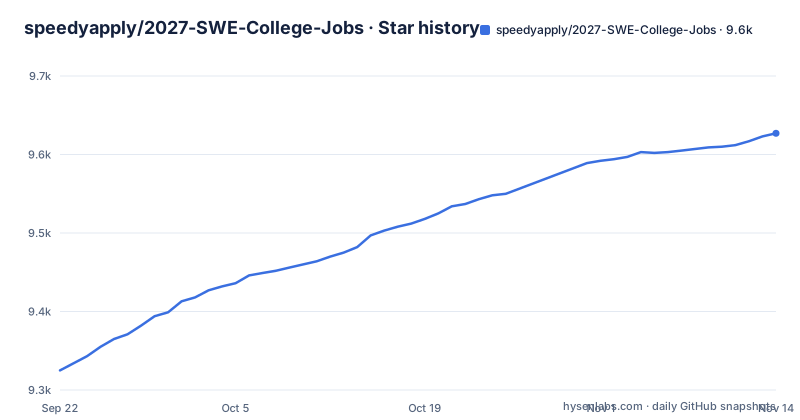
Star history
- speedyapply/2027-SWE-College-Jobs9,627 ★ · +302
| Repository | 2026-09-22 | 2026-11-14 |
|---|---|---|
| speedyapply/2027-SWE-College-Jobs | 9.3k | 9.6k |
302 Stars in the last 53 days, measured from the daily GitHub snapshot. Compare with other projects
Editorial analysis
Four Markdown files split by country and seniority
The repository has no code to install. It is five top-level entries: a .github/ directory and four Markdown files that each hold one slice of the job market. README.md is the USA internship list itself, so the landing page of the repository is already a job table. NEW_GRAD_USA.md holds US new graduate roles, INTERN_INTL.md holds international internships, and NEW_GRAD_INTL.md holds international new graduate roles.
At the time of the latest update the header counts were 1008 US internships, 1083 US new grad positions, 731 international internships and 1118 international new grad positions. Those counts sit in the README header next to each link, so you can see the size of each list before opening it. The split matters in practice: a student who only needs US internships never has to leave the README, while anyone searching abroad or for a full-time start has to switch files, and there is no single combined table that covers all four at once.
FAANG+, Quant and Other buckets inside every file
Each of the four files is divided again into three anchored sections: FAANG+, Quant and Other. The README header links straight to them, for example NEW_GRAD_USA.md#faang or INTERN_INTL.md#quant, so you can jump to a bucket without scrolling past a thousand rows. The US internship table also has a bottom anchor reached through an End of List link at the top.
The FAANG+ bucket is wider than the acronym suggests. The visible US internship rows include Microsoft, NVIDIA, Meta and Amazon, but also Rivian, Twitch, Salesforce, Figma, DoorDash, Lyft and Pinterest. The FAANG+ table is wrapped in an HTML comment marker, TABLE_FAANG_START, which separates the table block from the hand written header text above it. The consequence for readers is that the bucket name is a label chosen by the maintainers, not a fixed definition. If you want only a specific set of companies, you still have to scan the Company column yourself or use your browser's find function.
Six columns, and the salary column is an hourly rate
Every row uses the same six columns: Company, Position, Location, Salary, Posting and Age. Company links to the employer's own site, Posting links to the application page on whatever system that employer uses, such as Workday, Greenhouse, Ashby or a company careers portal.
For internships the Salary column is an hourly figure. Visible examples include $52/hr for Microsoft's Security and Identity internship in Redmond, $62/hr for NVIDIA's AI Systems Software Engineering Intern in Austin, $50/hr for a Meta PhD research internship, $53/hr for Amazon's Software Development Engineer Intern roles, $61/hr for Twitch in San Francisco and $60/hr for Figma's PhD graphics internship. That makes the table directly useful for anyone searching for 2027 SWE internship pay, because the number is next to the job instead of behind a click. It also means comparisons across rows assume the hourly rate is what you care about; housing, relocation and the length of the internship are not columns, so two $52/hr offers can still differ a lot once you read the posting.
Location strings hide extra cities behind +1 and +2
The Location column shows one city and a counter when a role is open in several places. Rivian's Software Engineering Intern rows read Palo Alto, CA +1, and the Embedded Platforms role reads Palo Alto, CA +2. Salesforce's Security/Government internship reads California, USA +2. Figma, DoorDash and others use the same +1 pattern.
The table does not expand those counters, so you cannot tell from the row which other cities are included. If you are constrained to one metro area, a row that starts with a city you cannot move to may still contain one you can, and a row that starts with your city may be primarily staffed somewhere else. Remote status also lives in this column as text rather than a separate flag: Pinterest's Software Engineer Intern 2027 row reads Remote - San Francisco, CA. Searching the page for the word Remote is the closest thing to a remote filter, and it only works where the employer's location string includes that word.
The 120-day window and what the Age column cannot tell you
SpeedyApply states that the positions are updated daily and that jobs posted within the last 120 days are prioritized. The Age column shows how long ago each role was posted; the visible US internship rows run from 1d for a Microsoft listing to 27d for Amazon Robotics, Amazon Leo and Lyft roles. The repository's last push was on 2026-11-01, which fits the daily update claim.
Age is a posting date, not an availability signal. A 27 day old row and a 1 day old row look identical apart from that number, and nothing in the table marks a role as closed, paused or rolling. The 120 day figure is described as a priority, not a hard cutoff, so older rows may still appear. For applicants the practical rule is to sort your effort by Age, apply to the youngest rows first, and open the Posting link before spending time on a tailored application, because the employer's page is the only place that confirms the role is still accepting candidates.
PhD, co-op and graduation year roles share the same table
The repository is titled as SWE internships and new grad positions, but the Position column carries far more variety than that. Visible rows include Meta's Research Intern - Embedded AI on Wearables - PhD, Figma's PhD Intern - Software Engineer - Graphics, Lyft's PhD Machine Learning Software Engineer Intern, an Amazon Robotics Embedded Firmware Co-op for Spring 2027, and two Twitch internships restricted by graduation year: one for Grad Year Spring 2028 and one for Grad Year Winter 2027.
There is no column for degree level, graduation window or season, so those constraints are only visible if you read the full title. An undergraduate scanning by company and pay will hit PhD only roles, and a student graduating in 2027 can apply to a Twitch row meant for the 2028 cohort without noticing. Seasons are also mixed: most titles say Summer 2027, while the Amazon co-op says Spring 2027. Read each Position string to the end before treating a row as a match.
No license, no releases, and companion links you should check first
GitHub reports no license and no releases for the repository, and no primary language, because it contains Markdown rather than code. There is nothing to version or install; the current state of the main branch is the list. The lack of a license means reusing the tables in your own site or tool is not covered by any stated terms, so scrape or republish only after asking the maintainers.
The README header points to three other SpeedyApply properties: the speedyapply.com site, a Discord server at discord.gg/gaJnCmTHuN (also the repository homepage via speedyapply.com/discord), and a SpeedyApply listing on the Chrome Web Store. The header links to the extension without explaining in that section what it does or what permissions it needs, so read the store listing before installing a browser extension that will sit on job application pages. For AI and machine learning roles, SpeedyApply maintains a separate repository, speedyapply/2027-AI-College-Jobs, which the README links as the place to look instead of this one.
Editorial conclusion
Use speedyapply/2027-SWE-College-Jobs if you are a college student hunting 2027 software internships or new grad roles and want one place that shows company, location, hourly pay and posting age side by side. Do not treat it as an eligibility filter or an application tracker: PhD, co-op and graduation-year restricted roles share the same tables, and an Age value does not tell you the role is still open. Before applying, open the posting link, confirm the degree and graduation window, and expand any location marked +1 or +2.
Frequently asked questions
What internships are available in 2027 on speedyapply/2027-SWE-College-Jobs?
The repository listed 1008 US software engineering internships and 731 international internships at its latest update, split into FAANG+, Quant and Other. Visible US rows include NVIDIA, Microsoft, Meta, Amazon, Rivian, Twitch, Salesforce, Figma, DoorDash, Lyft and Pinterest.
Are SWE jobs coming back, judging by the speedyapply 2027 list?
The speedyapply 2027 list does not track trends over time, but at its latest update it counted 1008 US internships, 1083 US new grad roles, 731 international internships and 1118 international new grad roles posted mostly within the last 120 days.
Which engineer makes $500,000 a year, according to 2027-SWE-College-Jobs?
2027-SWE-College-Jobs does not list annual compensation at that level. Its internship rows show hourly pay, with visible rates between $50/hr and $62/hr, the top being NVIDIA's Summer 2027 internships.
What careers will be in demand in 2027, based on the 2027-SWE-College-Jobs postings?
2027-SWE-College-Jobs makes no forecast. Its current internship titles cover AI systems, compilers, security and identity, embedded firmware, vehicle controls, graphics and machine learning roles.
Official sources
Add this badge to your README
If you maintain this project, the badge below links readers to this analysis and shows its maintenance status from the daily GitHub snapshot. Paste the markdown into your README; add ?metric=license or ?metric=stars to the image URL for a different field.

[](https://hysenlabs.com/projects/speedyapply-2027-swe-college-jobs)Star history chart for your README
[](https://hysenlabs.com/projects/speedyapply-2027-swe-college-jobs)Was this useful?