VectorChord: five Postgres majors, a 0.0.0 manifest, and an image from another org
Scalable, fast, and disk-friendly vector search in Postgres, the successor of pgvecto.rs.
At a glance
- What is it?
- VectorChord is a Postgres vector search extension built on pgrx and pgvector, with RaBitQ compression and two index implementations. Reading its manifest and Makefile rather than its feature list shows five PostgreSQL version features with no default, a memory path tuned only for two architectures on Linux and macOS, a manifest version of 0.0.0, and a Docker image published under a different organisation than the repository.
- Who is it for?
- VectorChord fits a Postgres shop that already stores vectors as pgvector columns and wants the storage and index build costs to fall without a data migration, because the extension is explicitly built on pgvector's types and syntax and the quick start ends at a four line table plus one index.
- Can I use it commercially?
- Check first. The repository uses a licence we do not classify automatically, so read its LICENSE file before any commercial use.
- Is it still maintained?
- Yes. The repository last received commits 112 days ago.
- What is it written in?
- Mainly Rust, according to GitHub's language statistics.
Answers come from the project's GitHub data, last synced on November 25, 2026, and from our analysis. They are not legal advice.
Star history
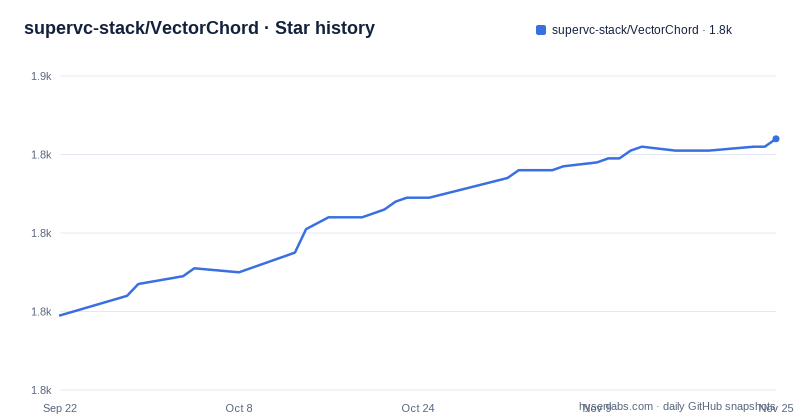
- supervc-stack/VectorChord1,844 ★ · +45
| Repository | 2026-09-22 | 2026-11-25 |
|---|---|---|
| supervc-stack/VectorChord | 1.8k | 1.8k |
45 Stars in the last 64 days, measured from the daily GitHub snapshot. Compare with other projects
Editorial analysis
The repository moved and the image namespace did not
The quick start is the first thing a new user copies, and it points at a registry namespace that does not match the repository it lives in:
docker run \
  --name vectorchord-demo \
  -e POSTGRES_PASSWORD=mysecretpassword \
  -p 5432:5432 \
  -d ghcr.io/tensorchord/vchord-postgres:pg18-v1.1.1
The image is under tensorchord, and the note underneath introduces a second family, `tensorchord/vchord-suite:pg17-latest`, described as including all official TensorChord extensions: VectorChord, VectorChord-bm25 and pg_tokenizer.rs, with the advice to pick a tag compatible with your extension version from a support matrix kept in a separate images repository. Meanwhile the source tree, the crate names and the repository itself sit elsewhere. That is not a broken instruction, since published images outlive organisation moves, but it does mean a reader cannot infer who builds the binaries from the repository they just cloned.
Two image families, one pinned tag and one floating latest
The base example pins a specific release, `pg18-v1.1.1`, which matches the newest release tag in the project. The all-in-one example does the opposite: `pg17-latest` floats, and it is on a different PostgreSQL major. So the two documented paths are not equivalent, and a reader who assumes they are will silently move from Postgres 18 to 17 and from a fixed extension version to whatever the tag currently resolves to. The note does say to choose a tag compatible with your extension version and points at a support matrix hosted in the images repository, which means the compatibility table itself lives outside both this repository and its documentation site. The suite also drags in a second extension, VectorChord-bm25, and a third, pg_tokenizer.rs, neither of which appears anywhere else in the README.
Five PostgreSQL majors, and none of them is the default
The manifest is a pgrx extension with a feature per server major. There are five of them, pg14, pg15, pg16, pg17 and pg18, each enabling the matching feature on both pgrx and pgrx-catalog, and the default feature list contains exactly one entry, `simd/init`. That default selects a SIMD initialiser and no PostgreSQL version at all, so a plain build produces a library with no server binding until somebody passes a pgNN feature. pgrx itself is pinned to exactly 0.17.0 with default features switched off and only the cshim feature enabled, which means the extension compiles against one known binding layer rather than whatever the newest is. The cost of that arrangement is visible in the release process: five major versions have to be built and tested per release, and the quick start only demonstrates one of them.
Eleven workspace crates and two index implementations
The workspace is members `crates/*`, and eleven of them are path dependencies of the extension: always_equal, distance, feistel, index, index_accessor, k_means, rabitq, simd, vchordg, vchordrq and vector. The names give the algorithm away in part. The k_means crate is what the README credits for the indexing speed, hierarchical K-means. The rabitq crate is the quantization the README's storage claims rest on. Two index implementations exist, vchordrq and vchordg, and the documentation mirrors that split with separate pages for indexing and for the graph index. The quick start uses the first one, with `CREATE INDEX ON items USING vchordrq (embedding vector_l2_ops)`. Beside the crates the tree carries `sql/`, `src/`, `tests/`, a `build.rs`, and `vchord.control`, the control file a PostgreSQL extension needs to be loadable.
The memory path stops at two architectures on two systems
The one platform-conditional dependency is the allocator. mimalloc is declared under a target expression that requires an x86_64 or aarch64 architecture and a Linux or macOS system at the same time, with the `local_dynamic_tls` feature. So a build on Windows takes a different allocation path from the one the release artefacts are tuned for, and so does any other operating system or architecture pair. That matters for how the README's figures should be read: they are quoted for particular instance types on a particular cloud, with no per-platform table anywhere in the repository. The manifest also carries a pgrx embedding binary, `pgrx_embed_vchord`, built from `src/bin/pgrx_embed.rs`, which is how the extension is loaded into a server process for the pgrx build flow.
make install asks pg_config, and there is no make test
The native install path is three layers of indirection. The Makefile takes `PG_CONFIG ?= pg_config` and asks it for two directories, the package library directory and the shared directory, then copies the build output into both under a `DESTDIR` prefix. Building first goes through `cargo run -p xtask -- build`, and the clippy target goes through the same xtask package. So compiling requires a pgrx toolchain, installing requires pg_config on the path plus write access to the PostgreSQL server's own directories, usually as root or the postgres user, and uninstalling is a set of glob removals over `vchord.*` in the library directory and `vchord.*` and `vchord--*.sql` in the extension directory rather than anything the server tracks. The declared targets are all, build, clippy, install and uninstall. There is no test target, even though a `tests/` directory is in the tree.
The manifest says 0.0.0 and the last tag is seven months old
Versioning comes from the workspace, and the workspace default is a placeholder. The package inherits `version.workspace = true` and `edition.workspace = true`, the workspace sets `version = "0.0.0"` with `edition = "2024"`, and `publish = false` says the crate is never uploaded to a registry. Published versions therefore come from the release process, not from the manifest. The tag history is 1.0.0 in November 2025, 1.1.0 in February 2026 and 1.1.1 at the end of February 2026, while the last commit to main is 6 August 2026. That gap is the practical point: anything you build from main is untagged, its version is not derivable from the tree, and the README's own image example points at the February release rather than at the branch.
Every performance figure is a footnote to the project's own blog
The README is built out of numbers, and every one of them resolves to a link back to the vendor. The headline is 400,000 vectors for a dollar, six times Pinecone's optimised storage and twenty-six times pgvector or pgvecto.rs for the same price. The feature list adds 100 million 768 dimensional vectors on an i4i.xlarge at 247 dollars a month, a billion 96 dimensional vectors on an i7ie.6xlarge at 2246 dollars a month, a hundred million vectors indexed in twenty minutes, billion vector indexes built on machines with 128GB of memory, and less than one percent recall loss for the 8 bit type. Each of those is a footnote to a post on the project's own blog, and the one academic citation, the RaBitQ paper in Proceedings of the ACM on Management of Data, covers the quantization rather than these results. Nothing in the repository measures any of it, so the claims are documented as marketing with receipts rather than as benchmarks you can rerun.
A dependency licence policy sits next to NOASSERTION on the repository
The tree carries `deny.toml` and a `licenses/` directory, which are the inputs to a dependency licence and advisory policy, plus `taplo.toml` and `rustfmt.toml` for formatting and `META.json.in` for packaging metadata that has to be filled in per build. The repository's own licence metadata is reported as NOASSERTION while a LICENSE file sits at the root, so the two disagree and nothing in the repository says which text governs the code. That matters for anyone redistributing the extension inside a product, and it is a question to put to the project rather than to guess at. One smaller artefact is worth noting for anyone editing the page: the documentation index lists Quantization Types twice, at the third and the fifth position, with the rest of the entries covering indexing, multi-vector retrieval, the graph index, range queries, tuning, monitoring, fallback parameters, recall measurement, prewarm, prefilter, prefetch and reranking.
Editorial conclusion
VectorChord fits a Postgres shop that already stores vectors as pgvector columns and wants the storage and index build costs to fall without a data migration, because the extension is explicitly built on pgvector's types and syntax and the quick start ends at a four line table plus one index. It does not fit a team that needs a pinned, reproducible build from source without reading three layers of tooling, or that needs the numbers in the README to be independently checkable, because every performance figure is a footnote to the project's own blog. Before you adopt it, decide your PostgreSQL major and enable the matching feature, because the default feature list selects none; build through the image rather than `make install` unless you have the server's library and share directories writable; and check the version you are actually running, since the tree carries 0.0.0 and the newest tag predates the last commit by months.
Frequently asked questions
What is VectorChord?
VectorChord is a PostgreSQL extension for vector search that applies RaBitQ compression together with autonomous reranking, and it depends on pgvector, including the vector representation. The crate is named vchord, and the extension is created in a database with CREATE EXTENSION IF NOT EXISTS vchord CASCADE.
How do I run VectorChord for a first test?
The README recommends the Docker image: run ghcr.io/tensorchord/vchord-postgres:pg18-v1.1.1 with a POSTGRES_PASSWORD set and port 5432 published, then connect with psql -h localhost -p 5432 -U postgres, where the default username is postgres and the default password is the one you passed to the container.
Which index types does VectorChord provide?
The quick start creates one with CREATE INDEX ON items USING vchordrq (embedding vector_l2_ops), and the documentation carries separate pages for indexing and for the graph index. The workspace holds a vchordrq crate and a vchordg crate, and the search itself is an ordinary SELECT with an ORDER BY on a distance operator and a LIMIT.
Which PostgreSQL versions does VectorChord support?
The crate exposes features for pg14, pg15, pg16, pg17 and pg18, each enabling the matching feature on pgrx and pgrx-catalog, while the default feature list contains only simd/init, so no PostgreSQL version is selected by default. pgrx is pinned to exactly 0.17.0 with default features disabled and only cshim enabled.
How does VectorChord relate to pgvector?
The README says VectorChord depends on pgvector, including the vector representation, and that because you can use those types directly your application can be migrated without pain. The compatibility claim is written the same way in the feature list, which claims full compatibility with pgvector data types and syntax with defaults that need no parameter tuning, and it also names pgvecto.rs as the project it succeeds.
Official sources
Add this badge to your README
If you maintain this project, the badge below links readers to this analysis and shows its maintenance status from the daily GitHub snapshot. Paste the markdown into your README; add ?metric=license or ?metric=stars to the image URL for a different field.

[](https://hysenlabs.com/projects/supervc-stack-vectorchord)Star history chart for your README
[](https://hysenlabs.com/projects/supervc-stack-vectorchord)Was this useful?