swirl-search: the quick start signs you in as admin, and the shipped images are all tagged latest
AI Search & RAG Without Moving Your Data. Get instant answers from your company's knowledge across 100+ apps while keeping data secure. Deploy in minutes, not months.
At a glance
- What is it?
- An Apache 2.0 federated search and retrieval tool that queries your existing applications live instead of copying them into a vector store, with a graphical interface shared with the commercial edition. The community build is honestly scoped in the readme, including a ranking pipeline that is deliberately simpler than the one it sells. What deserves attention instead is the deployment: fixed default credentials, an unauthenticated cache on a published port, and three container images pinned to moving tags.
- Who is it for?
- SWIRL Community is worth evaluating if the appeal of live federated query genuinely beats copying your data into a store, because the permission model and the absence of a second copy to govern are real advantages and the readme does not oversell them. Two things to decide before you deploy it anywhere shared.
- Can I use it commercially?
- Yes. Apache-2.0 is a permissive licence: you can use, modify and sell software built on it, as long as you keep its copyright and licence notices.
- Is it still maintained?
- Yes. The repository received new commits within the last day.
- What is it written in?
- Mainly Python, according to GitHub's language statistics.
Answers come from the project's GitHub data, last synced on November 15, 2026, and from our analysis. They are not legal advice.
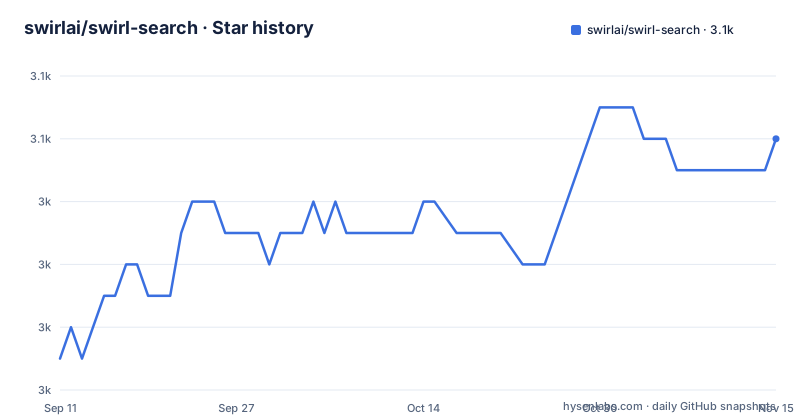
Star history
- swirlai/swirl-search3,050 ★ · +7
| Repository | 2026-09-11 | 2026-11-15 |
|---|---|---|
| swirlai/swirl-search | 3k | 3.1k |
7 Stars in the last 65 days, measured from the daily GitHub snapshot. Compare with other projects
Editorial analysis
This readme is explicitly a replacement for another repository's readme
The first two lines of the file are comments rather than prose, and they explain something about the repository before the documentation starts. The first says the file is a drop-in replacement for the readme of the same repository path, and the second says the image paths deliberately reference the other repository's documentation image assets so that they render unchanged. That is not a comment anyone writes for their own project. It means this repository's readme exists to stand in for a readme hosted elsewhere, probably because the canonical one lives somewhere this file cannot reach, and it means any judgement about how the project documents itself is really a judgement about two documents at once. Everything a reader is told about installation, credentials and editions is therefore documentation maintained for another home.
The documented first login is admin with the password password
The quick start is four commands and then a sentence. You download the compose file with a single fetch command, optionally export a callback port, a host name and your own model key, then bring the stack up with a pull followed by an up:
docker-compose pull && docker-compose upAfter that the file tells you to open a local path, log in with one literal username and one literal password, and run a search. Both credentials are printed in the documentation. The compose file publishes the service on a port mapped straight to the host with nothing restricting it, and it also publishes the cache service's port the same way, with no password configured for it in the file. So a reader who follows the instructions exactly has a search interface with published default credentials and an open cache on the same machine, which is fine on a laptop and not fine anywhere else.
The open edition's ranking is the simpler path, and the file admits it
The comparison table between the two editions is the most honest part of the readme, because it draws the line through search quality rather than around it. Both editions federate, both ship the same interface, both take your own model key. Relevancy ranking is where they diverge: the community build uses cosine vector similarity over a large language model plus a part-of-speech tagger, and the commercial edition runs a three-pass pipeline of keyword scoring, then embeddings with hybrid fusion, then a cross-encoder. Everything else in the table, canonical answers, pinned results, an agent-facing server, answer warnings, an analytics console and hosted support, is marked as not included. The readme then names the trigger explicitly: if you outgrow cosine ranking, that is the version to move to.
Generated answers arrive without a warning when they are wrong
Real-time retrieval with citations is in the community edition, using a key you supply, and that is the feature most people would come for. The warning that a generated answer may be hallucinated is not: the table marks it as not included, alongside canonical answers and pinned results. So the free build will synthesise an answer from live results and attach sources to it, and it will not tell you when that synthesis is unsupported by them. That combination is defensible as a paid-versus-free boundary and it is also the one that matters most for a tool whose entire argument is that answers carry sources you can click. Read the citations rather than trusting the summary.
The compose file rewrites its own configuration at every start
The container's start command is a single shell pipeline rather than an entrypoint script, and it does four things in order. It deletes a working directory, runs a setup step, then reads a demo configuration file, extracts a section of it with a JSON tool, and rewrites it with a series of substitutions: four placeholder values for the identity provider settings, plus a substitution that flips a single boolean from false to true. That last one is the interesting edit, because it is what turns on the Microsoft 365 sign-in path in a demo that ships with it off. The pipeline then starts a task worker and a scheduler together, and finally an application server. Three processes in one command, configuration mutated at boot, and the deletion on the first line is the mechanical reason the readme warns that container data does not survive a shutdown.
Every image in the stack is tagged latest
Three container images are involved and none of them is versioned. The compose file asks for the cache on its moving tag and for the application on its moving tag as well. The container definition then pulls the graphical interface out of a third image, also on a moving tag, copying a built asset directory and a configuration file from it. So the front end is not built from anything in this repository: it is a prebuilt bundle lifted from another project at whatever state that project's newest build happens to be. For a project whose selling point is that it runs where your data already lives, that is an unusual amount of trust placed in three external artifacts, and it means a deployment is not reproducible from this repository alone even though the code in it is. There is a fourth input as well: the container downloads a large language model and a set of language resources during the build, so even the build reaches out to two more networks before it can start.
Requirements are frozen exactly, with one exception and one shim
The dependency file is a full freeze rather than a list of ranges, which is the right call for a container build and a heavy one: several hundred packages at exact versions, including the web framework, the task queue, the channels layer, the object store client, the search client library and a multi-provider model gateway. Two entries are worth noting. One framework appears twice, once under a deprecated alias package at version zero point zero point one and once under its real name at a current version, so the alias is installed purely to pull in the real one. And one package, the identity provider library, is listed with no version at all, the single entry in a file where everything else is pinned. The build then downloads a large language model and a set of language resources at image build time.
The two-minute install is explicitly a throwaway
The readme leads with speed, and the quick start is honestly titled as taking about two minutes. Then a note under it says the container version does not retain data or configuration when it is shut down, and points to a separate guide for an installation that does. That single line reframes the whole section: the fast path is a demonstration, and the path that keeps your configuration is documented elsewhere. The stack does come with something to search out of the box, three public sources for academic papers, a biomedical literature database and a news aggregator, which is enough to see whether the ranking suits you before you connect anything of your own.
Editorial conclusion
SWIRL Community is worth evaluating if the appeal of live federated query genuinely beats copying your data into a store, because the permission model and the absence of a second copy to govern are real advantages and the readme does not oversell them. Two things to decide before you deploy it anywhere shared. The documented first-run credentials are printed in the readme and the compose file publishes a cache port with no authentication, so treat the two-minute path as a demo and put your own credentials and network policy in front of it. And read the edition comparison, because the answer quality you get is the part that differs: the open build ranks with cosine similarity and generates cited answers without a warning when they are wrong.
Frequently asked questions
What is SWIRL Community?
An Apache 2.0, self-hostable federated search and retrieval tool that queries your existing applications live, with the user's own permissions, instead of copying them into a vector database. The readme says there is no vector store, no extract-and-load pipeline, and no second copy to govern, and it ships a graphical interface that is the same one powering the commercial edition.
How does SWIRL Community rank results?
With cosine vector similarity using a large language model plus a part-of-speech tagger, alongside duplicate detection and result mixers. The three-pass reranker in the commercial edition goes further: keyword scoring, then embeddings with hybrid fusion, then a cross-encoder. The readme says to move up if you outgrow cosine ranking.
What does SWIRL Community leave out?
Canonical answers and pinned results, a first-class server for agents, a warning on generated answers that may be hallucinated, a business console with analytics and a semantic cache, and hosted options with managed connectors and support. Federated search, the interface, the connectors, and retrieval with your own key are all included.
How do I install SWIRL Community and log in?
Fetch the compose file with a curl command, optionally export a callback port, a host name and your own model key, then run docker-compose pull followed by docker-compose up. Open the local path the readme gives and sign in with the username admin and the password password, which are printed in the documentation itself.
Which connectors does SWIRL support?
The readme claims more than a hundred, but the authoritative current list is hosted on the vendor's website rather than kept in the repository. The connector objects themselves live in the swirl/connectors directory and the developer guide explains how to add one, and new connectors are requested by email.
What can SWIRL Community generate answers with?
Real-time retrieval with citations using a key you provide, with separate settings for the model that answers, the model that rewrites queries, and the model that handles the query itself. Results can be stored in SQLite or Postgres for later post-processing and analytics.
Official sources
Add this badge to your README
If you maintain this project, the badge below links readers to this analysis and shows its maintenance status from the daily GitHub snapshot. Paste the markdown into your README; add ?metric=license or ?metric=stars to the image URL for a different field.

[](https://hysenlabs.com/projects/swirlai-swirl-search)Star history chart for your README
[](https://hysenlabs.com/projects/swirlai-swirl-search)Was this useful?